



 Chat with AI
Exam 17: International Trade.

Exam 1: The Art and Science of Economic Analysis.203 Questions
Exam 2: Economic Tools and Economic Systems.209 Questions
Exam 3: Economic Decision Makers.225 Questions
Exam 4: Demand, Supply, and Markets.205 Questions
Exam 5: Introduction to Macroeconomics.201 Questions
Exam 6: Tracking the U. S. Economy.211 Questions
Exam 7: Unemployment and Inflation.199 Questions
Exam 8: Productivity and Growth.200 Questions
Exam 9: Aggregate Demand.200 Questions
Exam 10: Aggregate Supply.202 Questions
Exam 11: Fiscal Policy.202 Questions
Exam 12: Federal Budgets and Public Policy.203 Questions
Exam 13: Money and the Financial System.201 Questions
Exam 14: Banking and the Money Supply.200 Questions
Exam 15: Monetary Theory and Policy.200 Questions
Exam 16: Macro Policy Debate: Active or Passive?198 Questions
Exam 17: International Trade.200 Questions
Exam 18: International Finance.195 Questions
Exam 19: Economic Development.200 Questions
Select questions type


The World Trade Organization (WTO) _____

Free
(Multiple Choice)
4.8/5  (83)
(83) Correct Answer: Verified
B
If resources are equally adaptable to the production of different goods, the production possibilities frontier of a country will be an upward-sloping concave curve.
Free
(True/False)
4.8/5 (84)
(84) Correct Answer:Verified
VerifiedFalse
A World Trade Organization (WTO) member country must offer to all other member countries _____
Free
(Multiple Choice)
4.9/5 (78)
(78) Correct Answer:Verified
VerifiedB
International trade increases world economic efficiency for the same reasons that domestic trade increases national economic efficiency.
(True/False)
4.9/5 (79)
(79) For each pound of blueberry cheesecake Abura produces, it gives up the opportunity to make 150 screwdrivers. Mayo can produce one pound of blueberry cheesecake for every 300 screwdrivers it produces. If specialization and trade were to occur between these two countries, which of the following is true of opportunity costs in the two countries?
(Multiple Choice)
4.9/5 (73)
(73) Table 17.2
 -Refer to Table 17.2, which shows the demand, supply, and price of tulips in the Netherlands. If the world price of tulips is $4 and there are no trade restrictions, the Netherlands will _____
 (Multiple Choice)
4.9/5 (70)
(70) Exhibit 17.2
 -Refer to Exhibit 17.2, which shows U.S. demand for and supply of a good. Suppose the world price of the good is $1.00 per unit and a specific tariff of $0.50 per unit is imposed on each unit of the imported good. In such a case, net welfare loss as a result of a tariff of $0.50 per unit is represented by the area ____
 (Multiple Choice)
4.7/5 (75)
(75) If there are no trade restrictions, a country will import a particular good if _____
(Multiple Choice)
4.8/5 (83)
(83) Exhibit 17.2
-Refer to Exhibit 17.2, which shows U.S. demand for and domestic supply of a good. Suppose the world price of the good is $1.00 per unit, and a specific tariff of $0.50 per unit is imposed on each unit of the imported good. In such a case, the loss of consumer surplus as a result of a tariff of $0.50 per unit is represented by area _____
-Refer to Exhibit 17.2, which shows U.S. demand for and domestic supply of a good. Suppose the world price of the good is $1.00 per unit, and a specific tariff of $0.50 per unit is imposed on each unit of the imported good. In such a case, the loss of consumer surplus as a result of a tariff of $0.50 per unit is represented by area _____ (Multiple Choice)
4.8/5 (73)
(73) Exhibit 17.6
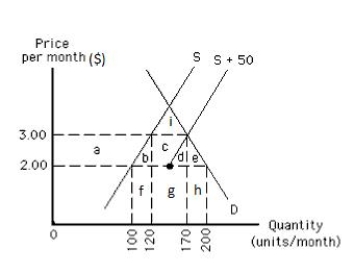 -Refer to Exhibit 17.6, which shows the demand for and the supply of a good in a country. If the world price of the good is $2.00 per unit and an import quota of 50 units per month is imposed, the welfare loss resulting from higher domestic production costs is represented by area(s) _____
 (Multiple Choice)
5.0/5 (79)
(79) Which of the following was a motive of the United States to negotiate a free trade agreement with Mexico?
(Multiple Choice)
4.8/5 (93)
(93) Exports account for _____ of the gross domestic product (GDP) in Germany, Sweden, and Switzerland.
(Multiple Choice)
4.9/5 (75)
(75) 
Filters
- Essay(0)
- Multiple Choice(0)
- Short Answer(0)
- True False(0)
- Matching(0)