



 Chat with AI
Exam 17: International Trade.

Exam 1: The Art and Science of Economic Analysis.203 Questions
Exam 2: Economic Tools and Economic Systems.209 Questions
Exam 3: Economic Decision Makers.225 Questions
Exam 4: Demand, Supply, and Markets.205 Questions
Exam 5: Introduction to Macroeconomics.201 Questions
Exam 6: Tracking the U. S. Economy.211 Questions
Exam 7: Unemployment and Inflation.199 Questions
Exam 8: Productivity and Growth.200 Questions
Exam 9: Aggregate Demand.200 Questions
Exam 10: Aggregate Supply.202 Questions
Exam 11: Fiscal Policy.202 Questions
Exam 12: Federal Budgets and Public Policy.203 Questions
Exam 13: Money and the Financial System.201 Questions
Exam 14: Banking and the Money Supply.200 Questions
Exam 15: Monetary Theory and Policy.200 Questions
Exam 16: Macro Policy Debate: Active or Passive?198 Questions
Exam 17: International Trade.200 Questions
Exam 18: International Finance.195 Questions
Exam 19: Economic Development.200 Questions
Select questions type


Which of the following is not an argument in favor of restricting trade?
(Multiple Choice)
4.9/5  (67)
(67) Exhibit 17.3
 -Refer to Exhibit 17.3, which shows the supply of and demand for baseballs in the United States. If the world price is $3 per baseball and a tariff of $1 per baseball is imposed, then the number of baseballs purchased in the United States is _____
 (Multiple Choice)
4.8/5 (85)
(85) Suppose workers in Transylvania can produce only two goods-yo-yos or sweat socks. If the Transylvanian currency is the daler, then the opportunity cost of producing yo-yos is measured in terms of _____
(Multiple Choice)
4.7/5 (80)
(80) Exhibit 17.2
 -Refer to Exhibit 17.2, which shows U.S. demand for and domestic supply of a good. Suppose the world price of the good is $1.00 per unit, and a specific tariff of $0.50 per unit is imposed on each unit of the imported good. In such a case, the government revenue from a tariff of $0.50 per unit is represented by area _____
 (Multiple Choice)
4.8/5 (76)
(76) Exhibit 17.4
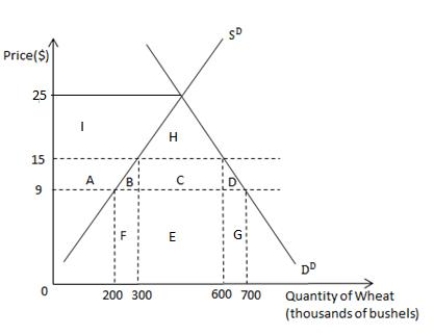 -Refer to Exhibit 17.4, which shows the market for wheat for the country of Palatino. SD is the domestic supply of wheat, and DD is the domestic demand for wheat. Suppose the world price of wheat is $9 per bushel and a specific tariff of $6 is imposed on each bushel of wheat imported. The total loss in consumer surplus after the tariff is shown by area(s) _____
 (Multiple Choice)
4.9/5 (74)
(74) If a manufacturer sells goods abroad for a lesser price than what they sell for at home, it implies that _____
(Multiple Choice)
4.9/5 (81)
(81) Which of the following was one of the objectives of the North American Free Trade Agreement (NAFTA)?
(Multiple Choice)
4.9/5 (83)
(83) Exhibit 17.b
 -Refer to Exhibit 17.b, which shows the supply of a product in the United States. With a quota of Q' or more per month, the U.S. price would _____
 (Multiple Choice)
4.9/5 (67)
(67) Which argument has been used to protect U.S. industries from import competition because their output is vital for national defense?
(Multiple Choice)
4.8/5 (63)
(63) The international treaty established to negotiate lower trade restrictions is known as the _____
(Multiple Choice)
4.9/5 (87)
(87) Unless there are barriers to prevent free international trade, a country becomes an importer _____
(Multiple Choice)
4.8/5 (83)
(83) Exhibit 17.2
-Refer to Exhibit 17.2, which shows U.S. demand for and domestic supply of a good. Suppose the world price of the good is $1.00 per unit and a specific tariff of $0.50 per unit is imposed on each unit of the imported good. In such a case, _____
-Refer to Exhibit 17.2, which shows U.S. demand for and domestic supply of a good. Suppose the world price of the good is $1.00 per unit and a specific tariff of $0.50 per unit is imposed on each unit of the imported good. In such a case, _____ (Multiple Choice)
4.8/5 (74)
(74) U.S. imports of goods and services amounted to _____ in 2016, or _____ of GDP.
(Multiple Choice)
4.9/5 (84)
(84) Consumer goods accounted for _____ of U.S. imports in 2016.
(Multiple Choice)
4.9/5 (78)
(78) Table 17.1
 -Refer to Table 17.1, which shows the per-day production data of rice and T-shirts for two countries, Cambria and Bodoni. Based on the table, it can be said that trade between Bodoni and Cambria will benefit Cambria but not Bodoni.
 (True/False)
4.9/5 (95)
(95) 
Filters
- Essay(0)
- Multiple Choice(0)
- Short Answer(0)
- True False(0)
- Matching(0)