



 Chat with AI
Exam 17: International Trade.

Exam 1: The Art and Science of Economic Analysis.203 Questions
Exam 2: Economic Tools and Economic Systems.209 Questions
Exam 3: Economic Decision Makers.225 Questions
Exam 4: Demand, Supply, and Markets.205 Questions
Exam 5: Introduction to Macroeconomics.201 Questions
Exam 6: Tracking the U. S. Economy.211 Questions
Exam 7: Unemployment and Inflation.199 Questions
Exam 8: Productivity and Growth.200 Questions
Exam 9: Aggregate Demand.200 Questions
Exam 10: Aggregate Supply.202 Questions
Exam 11: Fiscal Policy.202 Questions
Exam 12: Federal Budgets and Public Policy.203 Questions
Exam 13: Money and the Financial System.201 Questions
Exam 14: Banking and the Money Supply.200 Questions
Exam 15: Monetary Theory and Policy.200 Questions
Exam 16: Macro Policy Debate: Active or Passive?198 Questions
Exam 17: International Trade.200 Questions
Exam 18: International Finance.195 Questions
Exam 19: Economic Development.200 Questions
Select questions type


Originally, GATT members had agreed to three items. One of those was to _____
(Multiple Choice)
4.8/5  (80)
(80) The cost of the resources used by domestic producer groups, including lobbying fees, propaganda, and legal restrictions, is collectively referred to as the cost of _____
(Multiple Choice)
4.8/5 (80)
(80) International trade equalizes the opportunity cost of producing any good around the world.
(True/False)
4.9/5 (72)
(72) Suppose one worker in New Ralph Island can produce 40 walking sticks or 10 boomerangs each hour. The opportunity cost of producing 1 walking stick is _____
(Multiple Choice)
5.0/5 (77)
(77) The third largest category of U.S. exports in 2016 was _____, which accounted for _____ of total exports.
(Multiple Choice)
4.9/5 (79)
(79) International trade is most likely to occur whenever _____
(Multiple Choice)
5.0/5 (82)
(82) Relative to quotas, tariffs lead to a greater change in the quantity of a good demanded by consumers.
(True/False)
4.9/5 (83)
(83) U.S. exports of goods and services amounted to _____ in 2016, or _____ of GDP.
(Multiple Choice)
4.9/5 (79)
(79) Originally, GATT members had agreed to three items. One of those was to _____
(Multiple Choice)
4.9/5 (77)
(77) In determining comparative advantage, the cost of producing a good is measured in terms of _____
(Multiple Choice)
4.7/5 (85)
(85) Table 17.1
 -Refer to Table 17.1, which shows the per-day production data of rice and T-shirts for two countries, Cambria and Bodoni. Based on the table, it can be said that Cambria has a comparative advantage in the production of rice.
 (True/False)
4.9/5 (67)
(67) A charge levied on imports in terms of a fixed percentage of value is known as a(n) _____
(Multiple Choice)
4.9/5 (76)
(76) For each watch the country of Marina produces, it gives up the opportunity to make 50 pounds of cheese. Cambria can produce one watch for every 100 pounds of cheese it produces. If specialization and trade were to occur between these two countries, which of the following is true of opportunity costs in the two countries?
(Multiple Choice)
4.8/5 (78)
(78) Which of the following is a difference between the General Agreement on Tariffs and Trade (GATT) and the World Trade Organization (WTO)?
(Multiple Choice)
4.9/5 (79)
(79) Exports account for _____ of the gross domestic product (GDP) in Japan.
(Multiple Choice)
4.9/5 (79)
(79) Exhibit 17.1
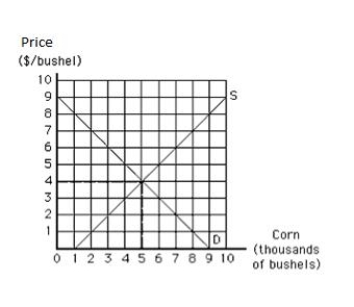 -Refer to Exhibit 17.1 which shows the market equilibrium for corn in the United States. If the world price of corn is $6 and there are no trade restrictions, the United States will _____
 (Multiple Choice)
4.9/5 (79)
(79) The top trading partner for U.S. exports in 2016 was _____
(Multiple Choice)
4.9/5 (93)
(93) Which of the following is not a reason for international specialization?
(Multiple Choice)
4.9/5 (83)
(83) Exhibit 17.3
 -Refer to Exhibit 17.3, which shows the supply of and the demand for baseballs in the United States. If the world price of a baseball is $3, then the quantity of baseballs demanded is _____.
 (Multiple Choice)
4.8/5 (87)
(87) Table 17.1
Table 17.1 Computers (units) Shoes (pairs) Aharoni 600 300 Kalinga 200 400
-Refer to Table 17.1. Suppose Aharoni and Kalinga are the only two countries in the world and they produce computers and shoes. Aharoni has 100 workers, and Kalinga has 200 workers. The table below shows the per-day production possibilities for each country. Aharoni has
(Multiple Choice)
4.7/5 (87)
(87) 
Filters
- Essay(0)
- Multiple Choice(0)
- Short Answer(0)
- True False(0)
- Matching(0)