



 Chat with AI
Exam 11: Managing Transaction Exposure

Exam 1: Multinational Financial Management: An Overview79 Questions
Exam 2: International Flow of Funds74 Questions
Exam 3: International Financial Markets101 Questions
Exam 4: Exchange Rate Determination69 Questions
Exam 5: Currency Derivatives161 Questions
Exam 6: Government Influence on Exchange Rates116 Questions
Exam 7: International Arbitrage and Interest Rate Parity92 Questions
Exam 8: Relationships among Inflation, Interest Rates, and Exchange Rates59 Questions
Exam 9: Forecasting Exchange Rates84 Questions
Exam 10: Measuring Exposure to Exchange Rate Fluctuations82 Questions
Exam 11: Managing Transaction Exposure81 Questions
Exam 12: Managing Economic Exposure and Translation Exposure58 Questions
Exam 13: Direct Foreign Investment53 Questions
Exam 14: Multinational Capital Budgeting60 Questions
Exam 15: International Corporate Governance and Control72 Questions
Exam 16: Country Risk Analysis57 Questions
Exam 17: Multinational Cost of Capital and Capital Structure68 Questions
Exam 18: Long-Term Debt Financing53 Questions
Exam 19: Financing International Trade66 Questions
Exam 20: Short-Term Financing49 Questions
Exam 21: International Cash Management50 Questions
Select questions type


Hedging the position of individual subsidiaries is generally necessary, even if the overall performance of the MNC is already insulated by the offsetting positions between subsidiaries.
(True/False)
4.8/5  (77)
(77) Assume the following information:
U.S. deposit rate for 1 year=11%
U.S. borrowing rate for 1 year=12%
Swiss deposit rate for 1 year=8%
Swiss borrowing rate for 1 year=10%
Swiss forward rate for 1 year=$.40
Swiss franc spot rate=$.39
Also assume that a U.S. exporter denominates its Swiss exports in Swiss francs and expects to receive SF600,000 in 1 year.
Using the information above, what will be the approximate value of these exports in 1 year in U.S. dollars given that the firm executes a forward hedge?
(Multiple Choice)
4.8/5 (73)
(73) You are the treasurer of Arizona Corp. and must decide how to hedge (if at all) future receivables of 350,000 Australian dollars (A$) 180 days from now. Put options are available for a premium of $.02 per unit and an exercise price of $.50 per Australian dollar. The forecasted spot rate of the Australian dollar in 180 days is:
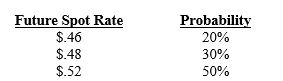 The 90-day forward rate of the Australian dollar is $.50.
What is the probability that the put option will be exercised (assuming Arizona purchased it)?
The 90-day forward rate of the Australian dollar is $.50.
What is the probability that the put option will be exercised (assuming Arizona purchased it)?
(Multiple Choice)
4.8/5 (73)
(73) Assume that Patton Co. will receive 100,000 New Zealand dollars (NZ$) in 180 days. Today's spot rate of the NZ$ is $.50, and the 180-day forward rate is $.51. A call option on NZ$ exists, with an exercise price of $.52, a premium of $.02, and a 180-day expiration date. A put option on NZ$ exists with an exercise price of $.51, a premium of $.02, and a 180-day expiration date. Patton Co. has developed the following probability distribution for the spot rate in 180 days:
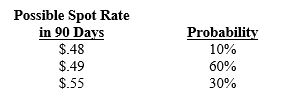 The probability that the forward hedge will result in more U.S. dollars received than the options hedge is ____ (deduct the amount paid for the premium when estimating the U.S. dollars received on the options hedge).
(Multiple Choice)
4.7/5 (62)
(62) FAB Corp. will need 200,000 Canadian dollars (C$) in 90 days to cover a payables position. Currently, a 90-day call option with an exercise price of $.75 and a premium of $.01 is available. Also, a 90-day put option with an exercise price of $.73 and a premium of $.01 is available. FAB plans to purchase options to hedge its payables position. Assuming that the spot rate in 90 days is $.71, what is the net amount paid, assuming FAB wishes to minimize its cost?
(Multiple Choice)
4.8/5 (67)
(67) Sometimes the overall performance of an MNC may already be insulated by offsetting effects between subsidiaries, and it may not be necessary to hedge the position of each individual subsidiary.
(True/False)
4.8/5 (78)
(78) Which of the following reflects a hedge of net payables in British pounds by a U.S. firm?
(Multiple Choice)
4.8/5 (72)
(72) To hedge a payables position in a foreign currency with a money market hedge, the MNC would borrow the foreign currency, convert it to dollars, and invest that amount in the United States until the payables are due.
(True/False)
4.9/5 (81)
(81) If interest rate parity exists, and transaction costs do not exist, the money market hedge will yield the same result as the ____ hedge.
(Multiple Choice)
4.7/5 (77)
(77) If an MNC is extremely risk-averse, it may decide to hedge even though its hedging analysis indicates that remaining unhedged will probably be less costly than hedging.
(True/False)
4.9/5 (73)
(73) To hedge a ____ in a foreign currency, a firm may ____ a currency futures contract for that currency.
(Multiple Choice)
4.7/5 (77)
(77) When a parent company tries to convince a subsidiary to hedge its transaction exposure, this is called leading.
(True/False)
4.8/5 (80)
(80) Quasik Corp. will be receiving 300,000 Canadian dollars (C$) in 90 days. Currently, a 90-day call option with an exercise price of $.75 and a premium of $.01 is available. Also, a 90-day put option with an exercise price of $.73 and a premium of $.01 is available. Quasik plans to purchase options to hedge its receivables position. Assuming that the spot rate in 90 days is $.71, what is the net amount received from the currency option hedge?
(Multiple Choice)
4.8/5 (71)
(71) When the real cost of hedging payables is positive, this implies that hedging was more favorable than not hedging.
(True/False)
4.9/5 (87)
(87) Assume that Cooper Co. will not use its cash balances in a money market hedge. When deciding between a forward hedge and a money market hedge, it ____ determine which hedge is preferable before implementing the hedge. It ____ determine whether either hedge will outperform an unhedged strategy before implementing the hedge.
(Multiple Choice)
4.9/5 (73)
(73) If hedging projections cause a firm to believe that it will definitely be adversely affected by its transaction exposure, a currency option hedge is more appropriate than other methods.
(True/False)
4.9/5 (80)
(80) Overhedging refers to the hedging of a larger amount in a currency than the actual transaction amount.
(True/False)
4.9/5 (69)
(69) Currency futures are very similar to forward contracts, except that they are standardized and are more appropriate for firms that prefer to hedge in smaller amounts.
(True/False)
5.0/5 (73)
(73) Cross-hedging may involve taking a forward position in a currency that is highly correlated with the currency an MNC needs to hedge.
(True/False)
4.8/5 (69)
(69) 
Filters
- Essay(0)
- Multiple Choice(0)
- Short Answer(0)
- True False(0)
- Matching(0)