



 Chat with AI
Exam 17: Glacial and Periglacial Processes and Landforms

Exam 1: Essentials of Geography185 Questions
Exam 2: Solar Energy to Earth and the Seasons145 Questions
Exam 3: Earths Modern Atmosphere168 Questions
Exam 4: Atmosphere and Surface Energy Balances130 Questions
Exam 5: Global Temperatures135 Questions
Exam 6: Atmospheric and Oceanic Circulations181 Questions
Exam 7: Water and Atmospheric Moisture145 Questions
Exam 8: Weather157 Questions
Exam 9: Water Resources176 Questions
Exam 10: Global Climate Systems149 Questions
Exam 11: Climate Change141 Questions
Exam 12: The Dynamic Planet184 Questions
Exam 13: Tectonics, Earthquakes, and Volcanism169 Questions
Exam 14: Weathering, Karst Landscapes, and Mass Movement125 Questions
Exam 15: River Systems and Landforms154 Questions
Exam 16: The Oceans, Coastal Processes, and Wind Processes159 Questions
Exam 17: Glacial and Periglacial Processes and Landforms142 Questions
Exam 18: The Geography of Soils135 Questions
Exam 19: Ecosystem Essentials128 Questions
Exam 20: Terrestrial Biomes118 Questions
Select questions type


Glaciation can take about ________ years, whereas deglaciation requires about ________ years.
(Multiple Choice)
4.7/5  (72)
(72) Elongated hills, often in the shape of an inverted spoon, streamlined in the direction of glacial movement are called
(Multiple Choice)
4.9/5 (82)
(82) Disappearance of Mount Kilimanjaro's glaciers have been attributed solely to climate change.
(True/False)
4.7/5 (85)
(85) Glacial ice forms more quickly in polar environments than in midlatitude, alpine environments.
(True/False)
4.8/5 (73)
(73) The area of sediment deposit by by glaciofluvial action beyond the glacial terminus is known as the
(Multiple Choice)
4.8/5 (82)
(82) Differentiate between alpine and continental glaciers, ice caps and ice fields.
(Essay)
4.8/5 (69)
(69) Crevasses in alpine glaciers result from friction, tension, or compression.
(True/False)
4.8/5 (83)
(83) Which of the following is evidence of recent changes in polar regions?
(Multiple Choice)
5.0/5 (75)
(75) In terms of areal extent, which of the following sequences is ordered from largest to smallest extent covered?
(Multiple Choice)
4.7/5 (80)
(80) Solifluction is most similar to which mass movement process?
(Multiple Choice)
4.9/5 (92)
(92) 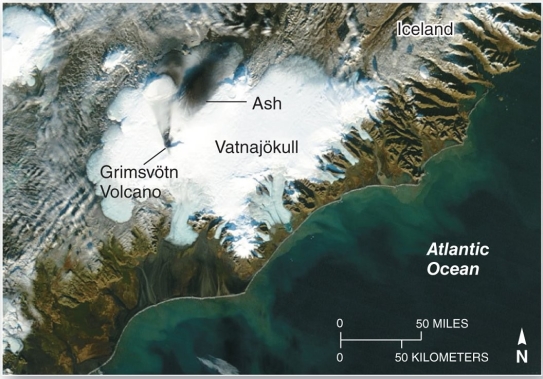 Vatnajökull is the largest and most voluminous Icelandic glacier. It is roughly circular in shape, overlays several volcanoes, and covers an area of approximately 8,100 km² (3,100 mi²) with an average thickness of 400 m (1,300 ft). This is an example of a(n)
 (Multiple Choice)
4.7/5 (88)
(88) 
Filters
- Essay(0)
- Multiple Choice(0)
- Short Answer(0)
- True False(0)
- Matching(0)