



 Chat with AI
Exam 2: Solar Energy to Earth and the Seasons

Exam 1: Essentials of Geography185 Questions
Exam 2: Solar Energy to Earth and the Seasons145 Questions
Exam 3: Earths Modern Atmosphere168 Questions
Exam 4: Atmosphere and Surface Energy Balances130 Questions
Exam 5: Global Temperatures135 Questions
Exam 6: Atmospheric and Oceanic Circulations181 Questions
Exam 7: Water and Atmospheric Moisture145 Questions
Exam 8: Weather157 Questions
Exam 9: Water Resources176 Questions
Exam 10: Global Climate Systems149 Questions
Exam 11: Climate Change141 Questions
Exam 12: The Dynamic Planet184 Questions
Exam 13: Tectonics, Earthquakes, and Volcanism169 Questions
Exam 14: Weathering, Karst Landscapes, and Mass Movement125 Questions
Exam 15: River Systems and Landforms154 Questions
Exam 16: The Oceans, Coastal Processes, and Wind Processes159 Questions
Exam 17: Glacial and Periglacial Processes and Landforms142 Questions
Exam 18: The Geography of Soils135 Questions
Exam 19: Ecosystem Essentials128 Questions
Exam 20: Terrestrial Biomes118 Questions
Select questions type


Define these terms: thermopause, insolation, solar constant, subsolar point.
(Essay)
4.7/5  (66)
(66) Which of the following is true of Earth's orbit about the Sun?
(Multiple Choice)
4.7/5 (83)
(83) In order to study the planetesimal hypothesis, astronomers study this process in other parts of the Galaxy.
(True/False)
4.7/5 (86)
(86) The electromagnetic spectrum only shows the wavelengths associated with solar radiation.
(True/False)
4.9/5 (75)
(75) Lower latitudes experience the greatest seasonal variation throughout an average year.
(True/False)
4.9/5 (78)
(78) Our solar system is located towards the middle of the Milky Way galaxy.
(True/False)
4.9/5 (83)
(83) The Earth's axis is titled 19.5° relative to the plane of the ecliptic.
(True/False)
5.0/5 (85)
(85) Which of the following is true of the number of hours of daylight?
(Multiple Choice)
4.7/5 (79)
(79) Auroras are mainly visible at lower latitudes, from the equator to about 15° N/S.
(True/False)
4.9/5 (69)
(69) Seasonality involves the variability of both daylength and the altitude of the Sun.
(True/False)
4.9/5 (82)
(82) How does the daily insolation received at the top of the atmosphere vary annual from lower to higher latitudes.
(Essay)
4.9/5 (83)
(83) According to the planetesimal hypothesis, solar systems condense from nebular dust and gas.
(True/False)
4.8/5 (64)
(64) Why are seasonal changes less noticeable near the equator than at mid-latitudes?
(Essay)
4.8/5 (84)
(84) The electromagnetic spectrum of radiant energy travels in waves at the speed of light in all directions from the Sun.
(True/False)
4.7/5 (84)
(84) 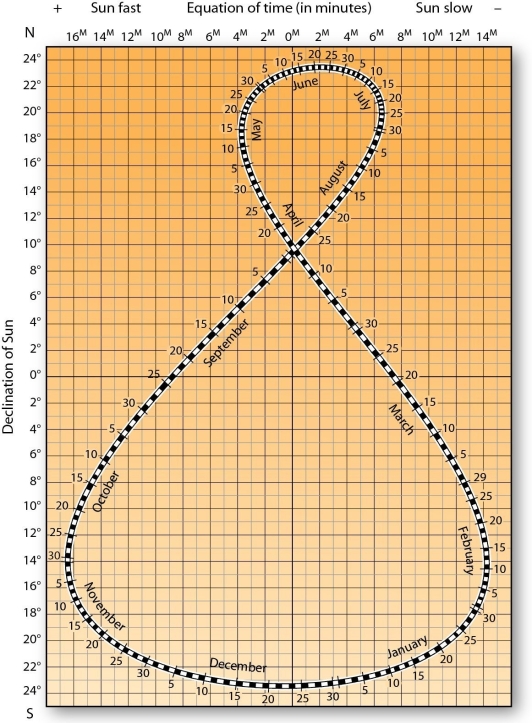 On approximately which dates is the subsolar point 16° S?

Filters
- Essay(0)
- Multiple Choice(0)
- Short Answer(0)
- True False(0)
- Matching(0)