



 Chat with AI
Exam 18: Cancer: Uncontrolled Cell Division and Differentiation

Exam 1: Human Biology, Science, and Society69 Questions
Exam 2: The Chemistry of Living Things100 Questions
Exam 3: Structure and Function of Cells107 Questions
Exam 4: From Cells to Organ Systems88 Questions
Exam 5: The Skeletal System74 Questions
Exam 6: The Muscular System83 Questions
Exam 7: Blood95 Questions
Exam 8: Heart and Blood Vessels107 Questions
Exam 9: The Immune System and Mechanisms of Defense102 Questions
Exam 10: The Respiratory System: Exchange of Gases81 Questions
Exam 11: The Nervous System: Integration and Control100 Questions
Exam 12: Sensory Mechanisms83 Questions
Exam 13: The Endocrine System82 Questions
Exam 14: The Digestive System and Nutrition80 Questions
Exam 15: The Urinary System70 Questions
Exam 16: Reproductive Systems89 Questions
Exam 17: Cell Reproduction and Differentiation78 Questions
Exam 18: Cancer: Uncontrolled Cell Division and Differentiation77 Questions
Exam 19: Genetics and Inheritance71 Questions
Exam 20: DNA Technology and Genetic Engineering71 Questions
Exam 21: Development and Aging72 Questions
Exam 22: Evolution and the Origins of Life78 Questions
Exam 23: Ecosystems and Populations74 Questions
Exam 24: Human Impacts, Biodiversity, and Environmental Issues71 Questions
Select questions type


When a cancer remains in one location, it is referred to as
(Multiple Choice)
4.8/5  (87)
(87) Using the ABCD rule for diagnosing a melanoma associated with the skin, the "D" refers to
(Multiple Choice)
5.0/5 (70)
(70) Diet, including what is and what is not consumed, is believed to play a major role in determining whether or not an individual develops cancer.
(True/False)
4.7/5 (73)
(73) In order for a cancer to develop, cells must be capable of breaking away from neighboring cells, and they must ignore growth-inhibitory signals from other cells, resulting in uncontrolled growth and cell division.
(True/False)
4.9/5 (86)
(86) Consider an individual undergoing cancer chemotherapy, taking a drug that slows or stops cell division. Which one of the following is a likely side effect of such chemotherapy?
(Multiple Choice)
4.8/5 (81)
(81) Tobacco is a carcinogen that has NOT been linked to the induction of cancer in which one of the following?
(Multiple Choice)
4.8/5 (69)
(69) If an entire tumor remains localized, it is said to be a(n) ________ cancer.
(Short Answer)
4.8/5 (85)
(85) Techniques used to increase the effectiveness of the immune system in fighting cancer are collectively known as ________.
(Short Answer)
4.9/5 (88)
(88) 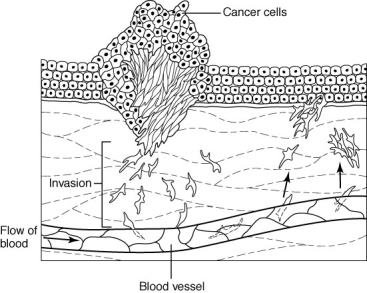 -Which one of the following is shown in the figure above?
Unlike traditional vaccines, cancer vaccines are administered to an individual after he or she has developed the illness.
(True/False)
4.7/5 (80)
(80) The process by which cells of a tumor invade normal tissue and travel via blood or lymph vessels to other parts of the body is ________.
(Short Answer)
4.8/5 (85)
(85) The chance that an individual in the United States will experience some form of cancer in his or her lifetime is
(Multiple Choice)
4.8/5 (82)
(82) A mass of rapidly dividing cells that have potentially lost the ability to regulate cell division is called a
(Multiple Choice)
4.8/5 (81)
(81) An X-ray of breast tissue used in the diagnosis of breast cancer is a(n) ________.
(Short Answer)
5.0/5 (90)
(90) Mutated forms of the ________ gene (a tumor suppressor gene) are associated with cancers of the cervix, colon, skin, bladder, and breast.
(Short Answer)
4.8/5 (64)
(64) Many viral and bacterial infections are believed to increase the risk of cancer. Match the following viruses and bacteria to the type of cancer with which they are associated.
Correct Answer: Verified
Premises:
Responses:
(Matching)
4.9/5 (84)
(84) 
Filters
- Essay(0)
- Multiple Choice(0)
- Short Answer(0)
- True False(0)
- Matching(0)