



 Chat with AI
Exam 12: Sensory Mechanisms

Exam 1: Human Biology, Science, and Society69 Questions
Exam 2: The Chemistry of Living Things100 Questions
Exam 3: Structure and Function of Cells107 Questions
Exam 4: From Cells to Organ Systems88 Questions
Exam 5: The Skeletal System74 Questions
Exam 6: The Muscular System83 Questions
Exam 7: Blood95 Questions
Exam 8: Heart and Blood Vessels107 Questions
Exam 9: The Immune System and Mechanisms of Defense102 Questions
Exam 10: The Respiratory System: Exchange of Gases81 Questions
Exam 11: The Nervous System: Integration and Control100 Questions
Exam 12: Sensory Mechanisms83 Questions
Exam 13: The Endocrine System82 Questions
Exam 14: The Digestive System and Nutrition80 Questions
Exam 15: The Urinary System70 Questions
Exam 16: Reproductive Systems89 Questions
Exam 17: Cell Reproduction and Differentiation78 Questions
Exam 18: Cancer: Uncontrolled Cell Division and Differentiation77 Questions
Exam 19: Genetics and Inheritance71 Questions
Exam 20: DNA Technology and Genetic Engineering71 Questions
Exam 21: Development and Aging72 Questions
Exam 22: Evolution and the Origins of Life78 Questions
Exam 23: Ecosystems and Populations74 Questions
Exam 24: Human Impacts, Biodiversity, and Environmental Issues71 Questions
Select questions type


Which one of the following parts of the eye is affected by cataracts?
(Multiple Choice)
4.8/5  (72)
(72) Which one of the following receive(s) a physical or chemical stimulus and ultimately cause(s) nerve impulses to be generated in sensory neurons?
(Multiple Choice)
4.8/5 (77)
(77) 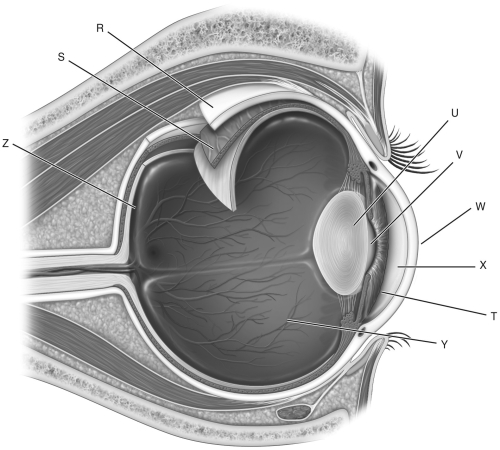 Using the figure above, identify the structures of the eye.
A) retina
B) sclera
C) lens
D) aqueous humor
E) pupil
F) cornea
G) choroid
H) iris
I) vitreous humor
10) Label R represents the ________.
11) Label S represents the ________.
12) Label T represents the ________.
13) Label U represents the ________.
14) Label V represents the ________.
15) Label W represents the ________.
16) Label X represents the ________.
17) Label Y represents the ________.
18) Label Z represents the ________.
Using the figure above, identify the structures of the eye.
A) retina
B) sclera
C) lens
D) aqueous humor
E) pupil
F) cornea
G) choroid
H) iris
I) vitreous humor
10) Label R represents the ________.
11) Label S represents the ________.
12) Label T represents the ________.
13) Label U represents the ________.
14) Label V represents the ________.
15) Label W represents the ________.
16) Label X represents the ________.
17) Label Y represents the ________.
18) Label Z represents the ________. (Short Answer)
5.0/5 (74)
(74) 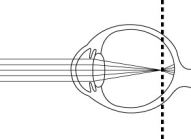 -The figure above is a diagram of an abnormal eye that would result in vision problems. A person with this condition would be considered farsighted and would require convex lenses in order to see objects in the distance.
 (True/False)
4.9/5 (88)
(88) A student is staring directly at a bird outside the classroom window. The image of the bird is focused on the ________ of the retina.
(Short Answer)
4.9/5 (73)
(73) Which one of the following parts of the eye is continuous with the cornea and forms the outer surface of the back of the eye?
(Multiple Choice)
4.8/5 (75)
(75) Vibration of the ________ bends hairs of the hair cells, which ultimately generate impulses in ________.
(Multiple Choice)
4.9/5 (76)
(76) Olfactory receptors are located in which one of the following?
(Multiple Choice)
4.8/5 (79)
(79) Which of the following receptors are MOST likely to demonstrate receptor adaptation?
(Multiple Choice)
4.9/5 (85)
(85) Somatic sensations include temperature, touch, vibration, pressure, and pain; these sensations originate from receptors found in certain localized areas of the body.
(True/False)
4.8/5 (92)
(92) The "blind spot" is associated with which one of the following?
(Multiple Choice)
4.9/5 (70)
(70) The two structures of the eye that focus light are the ________ and ________.
(Short Answer)
4.8/5 (79)
(79) Pain receptors and receptors that monitor and maintain homeostasis typically do not adapt.
(True/False)
4.9/5 (84)
(84) The vestibular apparatus located in the middle ear is a system of fluid-filled chambers that is essential to the sense of hearing.
(True/False)
4.9/5 (77)
(77) ________ neurons transmit information about stimuli, in the form of electrical impulses, to integration centers.
(Short Answer)
4.8/5 (78)
(78) Different pitched (high or low) sounds are discriminated by the
(Multiple Choice)
4.9/5 (80)
(80) Somatic receptors distributed throughout the body are linked to sensory neurons that send impulses to which one of the following regions of the brain?
(Multiple Choice)
4.8/5 (93)
(93) 
Filters
- Essay(0)
- Multiple Choice(0)
- Short Answer(0)
- True False(0)
- Matching(0)