



 Chat with AI
Exam 11: Surveying the Stars

Exam 1: Our Place in the Universe102 Questions
Exam 2: Discovering the Universe for Yourself135 Questions
Exam 3: The Science of Astronomy97 Questions
Exam 4: Making Sense of the Universe: Understanding Motion, Energy, and Gravity103 Questions
Exam 5: Light: the Cosmic Messenger139 Questions
Exam 6: Formation of Planetary Systems: Our Solar System and Beyond174 Questions
Exam 7: Earth and the Terrestrial Worlds180 Questions
Exam 8: Jovian Planet Systems85 Questions
Exam 9: Asteroids, Comets, and Dwarf Planets: Their Nature, Orbits, and Impacts118 Questions
Exam 10: Our Star101 Questions
Exam 11: Surveying the Stars129 Questions
Exam 12: Star Stuff137 Questions
Exam 13: Bizarre Stellar Graveyard110 Questions
Exam 14: Our Galaxy112 Questions
Exam 15: Galaxies and the Foundation of Modern Cosmology152 Questions
Exam 16: Dark Matter, Dark Energy, and the Fate of the Universe97 Questions
Exam 17: The Beginning of Time105 Questions
Exam 18: Life in the Universe82 Questions
Select questions type


The choices below each describe the appearance of an H-R diagram for a different star cluster. Which cluster is most likely to be located in the halo of our galaxy?
(Multiple Choice)
5.0/5  (68)
(68) The star Vega has an absolute magnitude of about 4 and an apparent magnitude of about 0. Based on the definitions of absolute and apparent magnitude, we can conclude that ________.
(Multiple Choice)
5.0/5 (73)
(73) The following questions refer to the sketch of the H-R diagram below. Choose the best answer in each case. Note that choice (a) refers to the entire main sequence, while (c) and (d) refer to only small parts of the main sequence. If choice (c) or (d) offers a better answer to a particular question than (a) , use the best choice. You may use the same choice more than once.
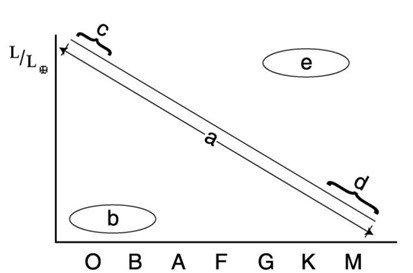 -Which group represents stars that are hot and very bright?
 (Short Answer)
4.8/5 (83)
(83) On a Hertzsprung-Russell diagram, where would you find white dwarfs?
(Multiple Choice)
4.9/5 (82)
(82) Which of the following stellar properties has the greatest range in values?
(Multiple Choice)
5.0/5 (83)
(83) The following questions refer to the sketch of the H-R diagram below. Choose the best answer in each case. Note that choice (a) refers to the entire main sequence, while (c) and (d) refer to only small parts of the main sequence. If choice (c) or (d) offers a better answer to a particular question than (a) , use the best choice. You may use the same choice more than once.
-Which group represents stars that are hot but dim?
-Which group represents stars that are hot but dim? (Short Answer)
4.7/5 (64)
(64) You measure the parallax angle for a star to be 0.1 arcseconds. The distance to this star is
(Multiple Choice)
4.9/5 (66)
(66) Which of the following statements about globular clusters is true?
(Multiple Choice)
4.7/5 (69)
(69) Which of the following is the most numerous type of main-sequence star?
(Multiple Choice)
4.9/5 (77)
(77) The size of the Earth's orbit is doubled. This will allow the parallaxes of more distant stars to be measured.
(True/False)
4.7/5 (63)
(63) The total amount of power (in watts, for example) that a star radiates into space is called its ________.
(Multiple Choice)
4.9/5 (88)
(88) On a Hertzsprung-Russell diagram, where would you find stars that are cool and dim?
(Multiple Choice)
4.9/5 (80)
(80) Each choice below lists a spectral type and luminosity class for a star. Which one is a red supergiant?
(Multiple Choice)
4.8/5 (61)
(61) Some stars are cool enough to have molecules in their atmosphere.
(True/False)
4.9/5 (82)
(82) You measure the parallax angle for a star to be 0.5 arcseconds. The distance to this star is
(Multiple Choice)
4.8/5 (71)
(71) The following questions refer to the sketch of the H-R diagram below. Choose the best answer in each case. Note that choice (a) refers to the entire main sequence, while (c) and (d) refer to only small parts of the main sequence. If choice (c) or (d) offers a better answer to a particular question than (a) , use the best choice. You may use the same choice more than once.
-Which group includes stars that are burning elements besides hydrogen in their cores?
-Which group includes stars that are burning elements besides hydrogen in their cores? (Short Answer)
4.8/5 (83)
(83) 
Filters
- Essay(0)
- Multiple Choice(0)
- Short Answer(0)
- True False(0)
- Matching(0)