



 Chat with AI
Exam 11: Surveying the Stars

Exam 1: Our Place in the Universe102 Questions
Exam 2: Discovering the Universe for Yourself135 Questions
Exam 3: The Science of Astronomy97 Questions
Exam 4: Making Sense of the Universe: Understanding Motion, Energy, and Gravity103 Questions
Exam 5: Light: the Cosmic Messenger139 Questions
Exam 6: Formation of Planetary Systems: Our Solar System and Beyond174 Questions
Exam 7: Earth and the Terrestrial Worlds180 Questions
Exam 8: Jovian Planet Systems85 Questions
Exam 9: Asteroids, Comets, and Dwarf Planets: Their Nature, Orbits, and Impacts118 Questions
Exam 10: Our Star101 Questions
Exam 11: Surveying the Stars129 Questions
Exam 12: Star Stuff137 Questions
Exam 13: Bizarre Stellar Graveyard110 Questions
Exam 14: Our Galaxy112 Questions
Exam 15: Galaxies and the Foundation of Modern Cosmology152 Questions
Exam 16: Dark Matter, Dark Energy, and the Fate of the Universe97 Questions
Exam 17: The Beginning of Time105 Questions
Exam 18: Life in the Universe82 Questions
Select questions type


How is the lifetime of a star related to its mass?

Free
(Multiple Choice)
5.0/5  (83)
(83) Correct Answer: Verified
A
Sirius is a star with spectral type A star and Rigel is a star with spectral type B star. What can we conclude?
Free
(Multiple Choice)
4.9/5 (89)
(89) Correct Answer:Verified
VerifiedA
The sketch above shows groups of stars on the H-R diagram, labeled (a) through (e); note that (a) represents the entire main sequence while (c) and (d) represent only small parts of the main sequence. Which group represents stars that are cool and dim?
Free
(Multiple Choice)
4.8/5 (83)
(83) Correct Answer:Verified
VerifiedD
Suppose our Sun were suddenly replaced by a supergiant star. Which of the following would be true?
(Multiple Choice)
4.7/5 (75)
(75) All stars are born with the same basic composition, yet stars can look quite different from one another. Which two factors primarily determine the characteristics of a star?
(Multiple Choice)
5.0/5 (80)
(80) Two stars, Fred and Barney, are of the same size. Fred has spectral type F, while Barney has spectral type B. Which one is more luminous?
(Essay)
4.8/5 (64)
(64) You observe a star cluster with a main-sequence turn-off point at spectral type G2 (the same spectral type as the Sun). What is the age of this star cluster?
(Multiple Choice)
5.0/5 (81)
(81) The following questions refer to the sketch of the H-R diagram below. Choose the best answer in each case. Note that choice (a) refers to the entire main sequence, while (c) and (d) refer to only small parts of the main sequence. If choice (c) or (d) offers a better answer to a particular question than (a) , use the best choice. You may use the same choice more than once.
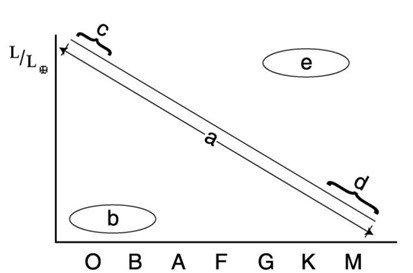 -Which group represents stars of the smallest radii?
 (Short Answer)
4.9/5 (78)
(78) Which of the following correctly states the relationship between the apparent brightness, luminosity, and distance of a star?
(Multiple Choice)
4.8/5 (80)
(80) What can we infer, at least roughly, from a star's luminosity class?
(Multiple Choice)
4.8/5 (80)
(80) On a Hertzsprung-Russell diagram, where would you find stars that have the largest radii?
(Multiple Choice)
4.9/5 (87)
(87) Which of the following statements about spectral types of stars is true?
(Multiple Choice)
4.9/5 (72)
(72) The Earth is about 150 million km from the Sun, and the apparent brightness of the Sun in our sky is about 1,300 watts per square meter. Determine the apparent brightness we would measure for the Sun if we were located half the earth's distance from the Sun.
(Essay)
4.8/5 (59)
(59) According to the inverse square law of light, how will the apparent brightness of an object change if its distance to us triples?
(Multiple Choice)
4.9/5 (72)
(72) Which of the following best describes the axes of a Hertzsprung-Russell (H-R) diagram?
(Multiple Choice)
4.8/5 (72)
(72) If the Sun-Earth separation was 10 AU instead of 1 AU, what would the flux of sunlight (energy per second per square meter) be at the Earth, compared to what it is today?
(Multiple Choice)
4.9/5 (92)
(92) An O-star has a hotter surface temperature than the Sun. Therefore, compared to the Sun,
(Multiple Choice)
4.8/5 (64)
(64) From hottest to coolest, the order of the spectral types of stars is ________.
(Multiple Choice)
4.9/5 (75)
(75) 
Filters
- Essay(0)
- Multiple Choice(0)
- Short Answer(0)
- True False(0)
- Matching(0)