



 Chat with AI
Exam 11: Surveying the Stars

Exam 1: Our Place in the Universe102 Questions
Exam 2: Discovering the Universe for Yourself135 Questions
Exam 3: The Science of Astronomy97 Questions
Exam 4: Making Sense of the Universe: Understanding Motion, Energy, and Gravity103 Questions
Exam 5: Light: the Cosmic Messenger139 Questions
Exam 6: Formation of Planetary Systems: Our Solar System and Beyond174 Questions
Exam 7: Earth and the Terrestrial Worlds180 Questions
Exam 8: Jovian Planet Systems85 Questions
Exam 9: Asteroids, Comets, and Dwarf Planets: Their Nature, Orbits, and Impacts118 Questions
Exam 10: Our Star101 Questions
Exam 11: Surveying the Stars129 Questions
Exam 12: Star Stuff137 Questions
Exam 13: Bizarre Stellar Graveyard110 Questions
Exam 14: Our Galaxy112 Questions
Exam 15: Galaxies and the Foundation of Modern Cosmology152 Questions
Exam 16: Dark Matter, Dark Energy, and the Fate of the Universe97 Questions
Exam 17: The Beginning of Time105 Questions
Exam 18: Life in the Universe82 Questions
Select questions type


The Earth is about 150 million km from the Sun, and the apparent brightness of the Sun in our sky is about 1,300 watts per square meter. Determine the apparent brightness we would measure for the Sun if we were located one-third of the earth's distance from the Sun.
(Essay)
4.8/5  (79)
(79) The sketch above shows groups of stars on the H-R diagram, labeled (a) through (e); note that (a) represents the entire main sequence while (c) and (d) represent only small parts of the main sequence. Which group represents stars of the largest radii?
(Multiple Choice)
4.9/5 (70)
(70) Spectral type, surface temperature, and color all describe the same basic characteristic of a star.
(True/False)
4.9/5 (86)
(86) Explain why stars more massive than the Sun live shorter main sequence lives than stars less massive than the Sun, despite having more fuel available for nuclear reactions.
(Essay)
4.8/5 (100)
(100) Our Sun, An Average Star: Often in science it is helpful to talk about a representative example of the objects or phenomena being studied. However, you must always keep in mind that the average case is not always representative. For example, our Sun is often described as an "average" star in the Milky Way. In what sense is this statement true? In what sense is this statement seriously misleading? Do you think it is useful to characterize the stars in the Milky Way by simply citing our "average" Sun?
(Essay)
4.9/5 (66)
(66) Which of the following statements about open clusters is true?
(Multiple Choice)
4.8/5 (73)
(73) The following questions refer to the sketch of the H-R diagram below. Choose the best answer in each case. Note that choice (a) refers to the entire main sequence, while (c) and (d) refer to only small parts of the main sequence. If choice (c) or (d) offers a better answer to a particular question than (a) , use the best choice. You may use the same choice more than once.
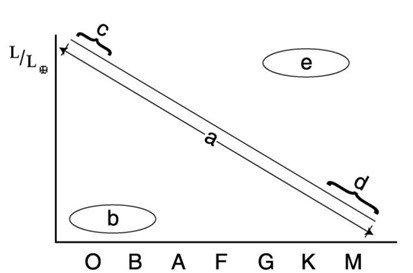 -Which group includes stars that are burning helium in their cores?
 (Short Answer)
4.9/5 (80)
(80) Star A has an apparent magnitude of 3, and Star B has an apparent magnitude of 5. Which star is brighter in our sky?
(Multiple Choice)
4.8/5 (90)
(90) Which of the following statements about spectral types of stars is not generally true?
(Multiple Choice)
4.8/5 (83)
(83) If Star A is closer to us than Star B, then Star A's parallax angle is ________.
(Multiple Choice)
4.8/5 (78)
(78) What is the approximate age of a star cluster where the brightest main sequence stars are G stars?
(Multiple Choice)
4.9/5 (81)
(81) Careful measurements reveal that a star maintains a steady apparent brightness at most times, except that at precise intervals of 73 hours the star becomes dimmer for about 2 hours. The most likely explanation is that ________.
(Multiple Choice)
4.7/5 (85)
(85) Two stars both lie on the main sequence. Star X is spectral type A, while Star Y is spectral type G. Star X must be more massive than Star Y.
(True/False)
4.9/5 (91)
(91) A star of spectral type B with a mass of 10 times the mass of the Sun lives approximately how long on the main sequence?
(Multiple Choice)
4.9/5 (66)
(66) Which of the following terms is given to a pair of stars that we can determine are orbiting each other only by measuring their periodic Doppler shifts?
(Multiple Choice)
4.9/5 (82)
(82) Assuming that we can measure the apparent brightness of a star, what does the inverse square law for light allow us to do?
(Multiple Choice)
4.9/5 (81)
(81) The sketch above shows groups of stars on the H-R diagram, labeled (a) through (e); note that (a) represents the entire main sequence while (c) and (d) represent only small parts of the main sequence. Which group represents stars that are extremely bright and emit most of their radiation as ultraviolet light?
(Multiple Choice)
5.0/5 (74)
(74) 
Filters
- Essay(0)
- Multiple Choice(0)
- Short Answer(0)
- True False(0)
- Matching(0)