



 Chat with AI
Exam 11: Surveying the Stars

Exam 1: Our Place in the Universe102 Questions
Exam 2: Discovering the Universe for Yourself135 Questions
Exam 3: The Science of Astronomy97 Questions
Exam 4: Making Sense of the Universe: Understanding Motion, Energy, and Gravity103 Questions
Exam 5: Light: the Cosmic Messenger139 Questions
Exam 6: Formation of Planetary Systems: Our Solar System and Beyond174 Questions
Exam 7: Earth and the Terrestrial Worlds180 Questions
Exam 8: Jovian Planet Systems85 Questions
Exam 9: Asteroids, Comets, and Dwarf Planets: Their Nature, Orbits, and Impacts118 Questions
Exam 10: Our Star101 Questions
Exam 11: Surveying the Stars129 Questions
Exam 12: Star Stuff137 Questions
Exam 13: Bizarre Stellar Graveyard110 Questions
Exam 14: Our Galaxy112 Questions
Exam 15: Galaxies and the Foundation of Modern Cosmology152 Questions
Exam 16: Dark Matter, Dark Energy, and the Fate of the Universe97 Questions
Exam 17: The Beginning of Time105 Questions
Exam 18: Life in the Universe82 Questions
Select questions type


Which of the following statements about apparent and absolute magnitudes is true?
(Multiple Choice)
4.9/5  (90)
(90) The sketch above shows groups of stars on the H-R diagram, labeled (a) through (e); note that (a) represents the entire main sequence while (c) and (d) represent only small parts of the main sequence. Which group represents stars that have no ongoing nuclear fusion?
(Multiple Choice)
4.8/5 (82)
(82) The approximate main-sequence lifetime of a star of spectral type O is ________.
(Multiple Choice)
4.8/5 (69)
(69) Confusing Terminology in Science: Scientists' love of jargon and acronyms often confounds the public and makes it impossible for them to read scientific literature. Use the example of spectral types introduced in this chapter (i.e. the Sun is a "G2" star) as a case study in jargon. What is the historical origin of the spectral types? Why are the letters in a confusing, non-alphabetical order? Why do you think astronomers persist in using spectral types? Do you think astronomers should drop this notation, and, if so, what should replace it?
(Not Answered)
This question doesn't have any answer yet
Which of the following comparisons between low-mass stars and high-mass stars is true?
(Multiple Choice)
4.8/5 (78)
(78) On a Hertzsprung-Russell diagram, where would you find stars that are cool and luminous?
(Multiple Choice)
4.8/5 (78)
(78) The Earth is about 150 million km from the Sun, and the apparent brightness of the Sun in our sky is about 1,300 watts per square meter. Determine the apparent brightness we would measure for the Sun if we were located five times the earth's distance from the Sun.
(Essay)
4.8/5 (100)
(100) Two stars, Betty and Wilma, are both on the main sequence. Betty is more luminous than Wilma. Which one has a hotter surface temperature? Which one is more massive? Which one is bigger? If they both formed at the same time, which one will evolve off the main sequence first?
(Essay)
4.7/5 (80)
(80) A star with a parallax angle of 1/20 arcsecond is ________.
(Multiple Choice)
4.8/5 (84)
(84) The sketch above shows groups of stars on the H-R diagram, labeled (a) through (e); note that (a) represents the entire main sequence while (c) and (d) represent only small parts of the main sequence. Which group represents the most common type of stars?
(Multiple Choice)
4.9/5 (72)
(72) The faintest visible stars to the naked eye have an apparent magnitude of about 6
(True/False)
4.8/5 (78)
(78) The following questions refer to the sketch of the H-R diagram below. Choose the best answer in each case. Note that choice (a) refers to the entire main sequence, while (c) and (d) refer to only small parts of the main sequence. If choice (c) or (d) offers a better answer to a particular question than (a) , use the best choice. You may use the same choice more than once.
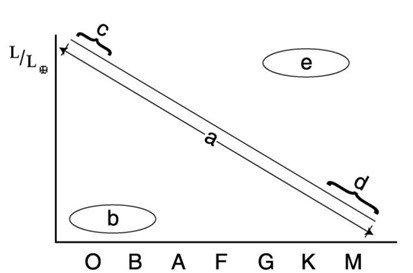 -Which group represents hydrogen-burning stars with the shortest lifetimes?
 (Short Answer)
4.8/5 (78)
(78) Based on the definition of apparent brightness, which units are appropriate for its measurement?
(Multiple Choice)
4.9/5 (79)
(79) Which star cluster is the youngest star cluster? The one where the brightest main sequence stars are . . .
(Multiple Choice)
4.7/5 (66)
(66) The following questions refer to the representations below of H-R diagrams for different clusters of stars. In each diagram, the dotted lines locate the position of the Sun.
-Which cluster is the youngest?
(Multiple Choice)
4.7/5 (74)
(74) Which of the following luminosity classes refers to stars on the main sequence?
(Multiple Choice)
4.9/5 (76)
(76) The following questions refer to the representations below of H-R diagrams for different clusters of stars. In each diagram, the dotted lines locate the position of the Sun.
-Which cluster is 10 billion years old?
(Multiple Choice)
4.9/5 (88)
(88) The sketch above shows groups of stars on the H-R diagram, labeled (a) through (e); note that (a) represents the entire main sequence while (c) and (d) represent only small parts of the main sequence. Which group represents stars with the longest main-sequence lifetimes?
(Multiple Choice)
4.9/5 (84)
(84) 
Filters
- Essay(0)
- Multiple Choice(0)
- Short Answer(0)
- True False(0)
- Matching(0)