



 Chat with AI
Exam 36: Nursing Management: Dysrhythmias

Exam 1: Professional Nursing Practice21 Questions
Exam 2: Health Disparities and Culturally Competent Care18 Questions
Exam 3: Health History and Physical Examination15 Questions
Exam 4: Patient and Caregiver Teaching21 Questions
Exam 5: Chronic Illness and Older Adults21 Questions
Exam 6: Complementary and Alternative Therapies13 Questions
Exam 7: Stress and Stress Management12 Questions
Exam 8: Sleep and Sleep Disorders11 Questions
Exam 9: Pain26 Questions
Exam 10: Palliative Care at End of Life16 Questions
Exam 11: Substance Abuse25 Questions
Exam 12: Inflammation and Wound Healing22 Questions
Exam 13: Genetics and Genomics7 Questions
Exam 14: Altered Immune Responses, and Transplantation26 Questions
Exam 15: Infection and Human Immunodeficiency Virus Infection26 Questions
Exam 16: Cancer43 Questions
Exam 17: Fluid, Electrolyte, and Acid-Base Imbalances37 Questions
Exam 18: Nursing Management: Preoperative Care21 Questions
Exam 19: Nursing Management: Intraoperative Care18 Questions
Exam 20: Nursing Management: Postoperative Care25 Questions
Exam 21: Nursing Assessment: Visual and Auditory Systems26 Questions
Exam 22: Nursing Management: Visual and Auditory Problems47 Questions
Exam 23: Nursing Assessment: Integumentary System13 Questions
Exam 24: Nursing Management: Integumentary Problems26 Questions
Exam 25: Nursing Management: Burns31 Questions
Exam 26: Nursing Assessment: Respiratory System24 Questions
Exam 27: Nursing Management: Upper Respiratory Problems25 Questions
Exam 28: Nursing Management: Lower Respiratory Problems51 Questions
Exam 29: Nursing Management: Obstructive Pulmonary Diseases44 Questions
Exam 30: Nursing Assessment: Hematologic System16 Questions
Exam 31: Nursing Management: Hematologic Problems48 Questions
Exam 32: Nursing Assessment: Cardiovascular System24 Questions
Exam 33: Nursing Management: Hypertension24 Questions
Exam 34: Nursing Management: Coronary Artery Disease and Acute Coronary Syndrome43 Questions
Exam 35: Nursing Management: Heart Failure26 Questions
Exam 36: Nursing Management: Dysrhythmias31 Questions
Exam 37: Nursing Management: Inflammatory and Structural Heart Disorders35 Questions
Exam 38: Nursing Management: Vascular Disorders36 Questions
Exam 39: Nursing Assessment: Gastrointestinal System18 Questions
Exam 40: Nursing Management: Nutritional Problems24 Questions
Exam 41: Nursing Management: Obesity20 Questions
Exam 42: Nursing Management: Upper Gastrointestinal Problems47 Questions
Exam 43: Nursing Management: Lower Gastrointestinal Problems56 Questions
Exam 44: Nursing Management: Liver,Pancreas,and Biliary Tract Problems46 Questions
Exam 45: Nursing Assessment: Urinary System24 Questions
Exam 46: Nursing Management: Renal and Urologic Problems45 Questions
Exam 47: Nursing Management: Acute Kidney Injury and Chronic Kidney Disease39 Questions
Exam 48: Nursing Assessment: Endocrine System22 Questions
Exam 49: Nursing Management: Diabetes Mellitus49 Questions
Exam 50: Nursing Management: Endocrine Problems46 Questions
Exam 51: Nursing Assessment: Reproductive System19 Questions
Exam 52: Nursing Management: Breast Disorders28 Questions
Exam 53: Nursing Management: Sexually Transmitted Infections19 Questions
Exam 54: Nursing Management: Female Reproductive Problems49 Questions
Exam 55: Nursing Management: Male Reproductive Problems35 Questions
Exam 56: Nursing Assessment: Nervous System21 Questions
Exam 57: Nursing Management: Acute Intracranial Problems40 Questions
Exam 58: Nursing Management: Stroke30 Questions
Exam 59: Nursing Management: Chronic Neurologic Problems36 Questions
Exam 60: Nursing Management: Alzheimer's Disease,Dementia,and Delirium21 Questions
Exam 61: Nursing Management: Peripheral Nerve and Spinal Cord Problems33 Questions
Exam 62: Nursing Assessment: Musculoskeletal System15 Questions
Exam 63: Nursing Management: Musculoskeletal Trauma and Orthopedic Surgery47 Questions
Exam 64: Nursing Management: Musculoskeletal Problems25 Questions
Exam 65: Nursing Management: Arthritis and Connective Tissue Diseases47 Questions
Exam 66: Nursing Management: Critical Care41 Questions
Exam 67: Nursing Management: Shock, Systemic Inflammatory Response Syndrome, and Multiple Organ Dysfunction Syndrome29 Questions
Exam 68: Nursing Management: Respiratory Failure and Acute Respiratory Distress Syndrome27 Questions
Exam 69: Nursing Management: Emergency, Terrorism, and Disaster Nursing26 Questions
Select questions type


A patient reports dizziness and shortness of breath for several days.During cardiac monitoring in the emergency department (ED),the nurse obtains the following electrocardiographic (ECG)tracing.
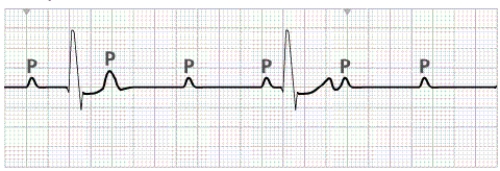 The nurse interprets this heart rhythm as
 (Multiple Choice)
4.8/5  (83)
(83) When analyzing an electrocardiographic (ECG)rhythm strip of a patient with a regular heart rhythm,the nurse counts 30 small blocks from one R wave to the next.The nurse calculates the patient's heart rate as ____.
(Short Answer)
4.8/5 (91)
(91) A patient's cardiac monitor shows sinus rhythm,rate 64.The P-R interval is 0.18 seconds at 1:00 AM,0.22 seconds at 2:30 PM,and 0.28 seconds at 4:00 PM.Which action should the nurse take next?
(Multiple Choice)
4.9/5 (74)
(74) The nurse has received change-of-shift report about the following patients on the progressive care unit.Which patient should the nurse see first?
(Multiple Choice)
4.7/5 (86)
(86) Which action should the nurse perform when preparing a patient with supraventricular tachycardia for cardioversion who is alert and has a blood pressure of 110/66 mm Hg?
(Multiple Choice)
4.9/5 (93)
(93) To determine whether there is a delay in impulse conduction through the atria,the nurse will measure the duration of the patient's
(Multiple Choice)
4.9/5 (73)
(73) Which action by a new registered nurse (RN)who is orienting to the progressive care unit indicates a good understanding of the treatment of cardiac dysrhythmias?
(Multiple Choice)
4.9/5 (75)
(75) Which information will the nurse include when teaching a patient who is scheduled for a radiofrequency catheter ablation for treatment of atrial flutter?
(Multiple Choice)
4.7/5 (87)
(87) A patient's cardiac monitor shows a pattern of undulations of varying contours and amplitude with no measurable ECG pattern.The patient is unconscious and pulseless.Which action should the nurse take first?
(Multiple Choice)
4.9/5 (91)
(91) A patient who was admitted with a myocardial infarction experiences a 45-second episode of ventricular tachycardia,then converts to sinus rhythm with a heart rate of 98 beats/minute.Which of the following actions should the nurse take next?
(Multiple Choice)
4.9/5 (73)
(73) A patient who is complaining of a "racing" heart and feeling "anxious" comes to the emergency department.The nurse places the patient on a heart monitor and obtains the following electrocardiographic (ECG)tracing.
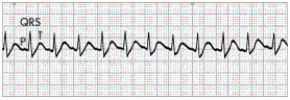 Which action should the nurse take next?
 (Multiple Choice)
4.9/5 (89)
(89) 
Filters
- Essay(0)
- Multiple Choice(0)
- Short Answer(0)
- True False(0)
- Matching(0)