



 Chat with AI
Exam 57: Nursing Management: Acute Intracranial Problems

Exam 1: Professional Nursing Practice21 Questions
Exam 2: Health Disparities and Culturally Competent Care18 Questions
Exam 3: Health History and Physical Examination15 Questions
Exam 4: Patient and Caregiver Teaching21 Questions
Exam 5: Chronic Illness and Older Adults21 Questions
Exam 6: Complementary and Alternative Therapies13 Questions
Exam 7: Stress and Stress Management12 Questions
Exam 8: Sleep and Sleep Disorders11 Questions
Exam 9: Pain26 Questions
Exam 10: Palliative Care at End of Life16 Questions
Exam 11: Substance Abuse25 Questions
Exam 12: Inflammation and Wound Healing22 Questions
Exam 13: Genetics and Genomics7 Questions
Exam 14: Altered Immune Responses, and Transplantation26 Questions
Exam 15: Infection and Human Immunodeficiency Virus Infection26 Questions
Exam 16: Cancer43 Questions
Exam 17: Fluid, Electrolyte, and Acid-Base Imbalances37 Questions
Exam 18: Nursing Management: Preoperative Care21 Questions
Exam 19: Nursing Management: Intraoperative Care18 Questions
Exam 20: Nursing Management: Postoperative Care25 Questions
Exam 21: Nursing Assessment: Visual and Auditory Systems26 Questions
Exam 22: Nursing Management: Visual and Auditory Problems47 Questions
Exam 23: Nursing Assessment: Integumentary System13 Questions
Exam 24: Nursing Management: Integumentary Problems26 Questions
Exam 25: Nursing Management: Burns31 Questions
Exam 26: Nursing Assessment: Respiratory System24 Questions
Exam 27: Nursing Management: Upper Respiratory Problems25 Questions
Exam 28: Nursing Management: Lower Respiratory Problems51 Questions
Exam 29: Nursing Management: Obstructive Pulmonary Diseases44 Questions
Exam 30: Nursing Assessment: Hematologic System16 Questions
Exam 31: Nursing Management: Hematologic Problems48 Questions
Exam 32: Nursing Assessment: Cardiovascular System24 Questions
Exam 33: Nursing Management: Hypertension24 Questions
Exam 34: Nursing Management: Coronary Artery Disease and Acute Coronary Syndrome43 Questions
Exam 35: Nursing Management: Heart Failure26 Questions
Exam 36: Nursing Management: Dysrhythmias31 Questions
Exam 37: Nursing Management: Inflammatory and Structural Heart Disorders35 Questions
Exam 38: Nursing Management: Vascular Disorders36 Questions
Exam 39: Nursing Assessment: Gastrointestinal System18 Questions
Exam 40: Nursing Management: Nutritional Problems24 Questions
Exam 41: Nursing Management: Obesity20 Questions
Exam 42: Nursing Management: Upper Gastrointestinal Problems47 Questions
Exam 43: Nursing Management: Lower Gastrointestinal Problems56 Questions
Exam 44: Nursing Management: Liver,Pancreas,and Biliary Tract Problems46 Questions
Exam 45: Nursing Assessment: Urinary System24 Questions
Exam 46: Nursing Management: Renal and Urologic Problems45 Questions
Exam 47: Nursing Management: Acute Kidney Injury and Chronic Kidney Disease39 Questions
Exam 48: Nursing Assessment: Endocrine System22 Questions
Exam 49: Nursing Management: Diabetes Mellitus49 Questions
Exam 50: Nursing Management: Endocrine Problems46 Questions
Exam 51: Nursing Assessment: Reproductive System19 Questions
Exam 52: Nursing Management: Breast Disorders28 Questions
Exam 53: Nursing Management: Sexually Transmitted Infections19 Questions
Exam 54: Nursing Management: Female Reproductive Problems49 Questions
Exam 55: Nursing Management: Male Reproductive Problems35 Questions
Exam 56: Nursing Assessment: Nervous System21 Questions
Exam 57: Nursing Management: Acute Intracranial Problems40 Questions
Exam 58: Nursing Management: Stroke30 Questions
Exam 59: Nursing Management: Chronic Neurologic Problems36 Questions
Exam 60: Nursing Management: Alzheimer's Disease,Dementia,and Delirium21 Questions
Exam 61: Nursing Management: Peripheral Nerve and Spinal Cord Problems33 Questions
Exam 62: Nursing Assessment: Musculoskeletal System15 Questions
Exam 63: Nursing Management: Musculoskeletal Trauma and Orthopedic Surgery47 Questions
Exam 64: Nursing Management: Musculoskeletal Problems25 Questions
Exam 65: Nursing Management: Arthritis and Connective Tissue Diseases47 Questions
Exam 66: Nursing Management: Critical Care41 Questions
Exam 67: Nursing Management: Shock, Systemic Inflammatory Response Syndrome, and Multiple Organ Dysfunction Syndrome29 Questions
Exam 68: Nursing Management: Respiratory Failure and Acute Respiratory Distress Syndrome27 Questions
Exam 69: Nursing Management: Emergency, Terrorism, and Disaster Nursing26 Questions
Select questions type


The public health nurse is planning a program to decrease the incidence of meningitis in adolescents and young adults.Which action is most important?

Free
(Multiple Choice)
4.8/5  (83)
(83) Correct Answer: Verified
C
Which action will the emergency department nurse anticipate for a patient diagnosed with a concussion who did not lose consciousness?
Free
(Multiple Choice)
4.9/5 (73)
(73) Correct Answer:Verified
VerifiedB
Which finding for a patient who has a head injury should the nurse report immediately to the health care provider?
Free
(Multiple Choice)
4.8/5 (81)
(81) Correct Answer:Verified
VerifiedB
The nurse is admitting a patient with a basal skull fracture.The nurse notes ecchymoses around both eyes and clear drainage from the patient's nose.Which admission order should the nurse question?
(Multiple Choice)
4.7/5 (77)
(77) During change-of-shift report,the nurse learns that a patient with a head injury has decorticate posturing to noxious stimulation.Which positioning shown in the accompanying figure will the nurse expect to observe?
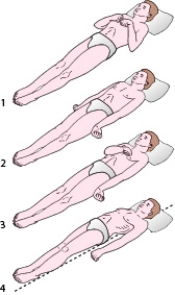
(Multiple Choice)
4.8/5 (80)
(80) A 41-year-old patient who is unconscious has a nursing diagnosis of ineffective cerebral tissue perfusion related to cerebral tissue swelling.Which nursing intervention will be included in the plan of care?
(Multiple Choice)
4.7/5 (84)
(84) After endotracheal suctioning,the nurse notes that the intracranial pressure for a patient with a traumatic head injury has increased from 14 to 17 mm Hg.Which action should the nurse take first?
(Multiple Choice)
4.9/5 (71)
(71) A patient being admitted with bacterial meningitis has a temperature of 102.5° F (39.2° C)and a severe headache.Which order for collaborative intervention should the nurse implement first?
(Multiple Choice)
4.9/5 (69)
(69) Which action will the public health nurse take to reduce the incidence of epidemic encephalitis in a community?
(Multiple Choice)
4.8/5 (66)
(66) The nurse has administered prescribed IV mannitol (Osmitrol)to an unconscious patient.Which parameter should the nurse monitor to determine the medication's effectiveness?
(Multiple Choice)
4.8/5 (81)
(81) When a brain-injured patient responds to nail bed pressure with internal rotation,adduction,and flexion of the arms,the nurse reports the response as
(Multiple Choice)
4.7/5 (90)
(90) A 20-year-old male patient is admitted with a head injury after a collision while playing football.After noting that the patient has developed clear nasal drainage,which action should the nurse take?
(Multiple Choice)
4.9/5 (80)
(80) A 46-year-old patient with a head injury opens the eyes to verbal stimulation,curses when stimulated,and does not respond to a verbal command to move but attempts to push away a painful stimulus.The nurse records the patient's Glasgow Coma Scale score as
(Multiple Choice)
4.8/5 (94)
(94) After the emergency department nurse has received a status report on the following patients who have been admitted with head injuries,which patient should the nurse assess first?
(Multiple Choice)
4.9/5 (78)
(78) A 68-year-old male patient is brought to the emergency department (ED)by ambulance after being found unconscious on the bathroom floor by his spouse.Which action will the nurse take first?
(Multiple Choice)
4.8/5 (78)
(78) A 42-year-old patient who has bacterial meningitis is disoriented and anxious.Which nursing action will be included in the plan of care?
(Multiple Choice)
5.0/5 (84)
(84) A patient admitted with a diffuse axonal injury has a systemic blood pressure (BP)of 106/52 mm Hg and an intracranial pressure (ICP)of 14 mm Hg.Which action should the nurse take first?
(Multiple Choice)
5.0/5 (87)
(87) A 23-year-old patient who is suspected of having an epidural hematoma is admitted to the emergency department.Which action will the nurse plan to take?
(Multiple Choice)
4.9/5 (84)
(84) When assessing a 53-year-old patient with bacterial meningitis,the nurse obtains the following data.Which finding should be reported immediately to the health care provider?
(Multiple Choice)
4.7/5 (68)
(68) To assess for functional deficits,which question will the nurse ask a patient who has been admitted for treatment of a benign occipital lobe tumor?
(Multiple Choice)
4.8/5 (76)
(76) 
Filters
- Essay(0)
- Multiple Choice(0)
- Short Answer(0)
- True False(0)
- Matching(0)