



 Chat with AI
Exam 38: Nursing Management: Vascular Disorders

Exam 1: Professional Nursing Practice21 Questions
Exam 2: Health Disparities and Culturally Competent Care18 Questions
Exam 3: Health History and Physical Examination15 Questions
Exam 4: Patient and Caregiver Teaching21 Questions
Exam 5: Chronic Illness and Older Adults21 Questions
Exam 6: Complementary and Alternative Therapies13 Questions
Exam 7: Stress and Stress Management12 Questions
Exam 8: Sleep and Sleep Disorders11 Questions
Exam 9: Pain26 Questions
Exam 10: Palliative Care at End of Life16 Questions
Exam 11: Substance Abuse25 Questions
Exam 12: Inflammation and Wound Healing22 Questions
Exam 13: Genetics and Genomics7 Questions
Exam 14: Altered Immune Responses, and Transplantation26 Questions
Exam 15: Infection and Human Immunodeficiency Virus Infection26 Questions
Exam 16: Cancer43 Questions
Exam 17: Fluid, Electrolyte, and Acid-Base Imbalances37 Questions
Exam 18: Nursing Management: Preoperative Care21 Questions
Exam 19: Nursing Management: Intraoperative Care18 Questions
Exam 20: Nursing Management: Postoperative Care25 Questions
Exam 21: Nursing Assessment: Visual and Auditory Systems26 Questions
Exam 22: Nursing Management: Visual and Auditory Problems47 Questions
Exam 23: Nursing Assessment: Integumentary System13 Questions
Exam 24: Nursing Management: Integumentary Problems26 Questions
Exam 25: Nursing Management: Burns31 Questions
Exam 26: Nursing Assessment: Respiratory System24 Questions
Exam 27: Nursing Management: Upper Respiratory Problems25 Questions
Exam 28: Nursing Management: Lower Respiratory Problems51 Questions
Exam 29: Nursing Management: Obstructive Pulmonary Diseases44 Questions
Exam 30: Nursing Assessment: Hematologic System16 Questions
Exam 31: Nursing Management: Hematologic Problems48 Questions
Exam 32: Nursing Assessment: Cardiovascular System24 Questions
Exam 33: Nursing Management: Hypertension24 Questions
Exam 34: Nursing Management: Coronary Artery Disease and Acute Coronary Syndrome43 Questions
Exam 35: Nursing Management: Heart Failure26 Questions
Exam 36: Nursing Management: Dysrhythmias31 Questions
Exam 37: Nursing Management: Inflammatory and Structural Heart Disorders35 Questions
Exam 38: Nursing Management: Vascular Disorders36 Questions
Exam 39: Nursing Assessment: Gastrointestinal System18 Questions
Exam 40: Nursing Management: Nutritional Problems24 Questions
Exam 41: Nursing Management: Obesity20 Questions
Exam 42: Nursing Management: Upper Gastrointestinal Problems47 Questions
Exam 43: Nursing Management: Lower Gastrointestinal Problems56 Questions
Exam 44: Nursing Management: Liver,Pancreas,and Biliary Tract Problems46 Questions
Exam 45: Nursing Assessment: Urinary System24 Questions
Exam 46: Nursing Management: Renal and Urologic Problems45 Questions
Exam 47: Nursing Management: Acute Kidney Injury and Chronic Kidney Disease39 Questions
Exam 48: Nursing Assessment: Endocrine System22 Questions
Exam 49: Nursing Management: Diabetes Mellitus49 Questions
Exam 50: Nursing Management: Endocrine Problems46 Questions
Exam 51: Nursing Assessment: Reproductive System19 Questions
Exam 52: Nursing Management: Breast Disorders28 Questions
Exam 53: Nursing Management: Sexually Transmitted Infections19 Questions
Exam 54: Nursing Management: Female Reproductive Problems49 Questions
Exam 55: Nursing Management: Male Reproductive Problems35 Questions
Exam 56: Nursing Assessment: Nervous System21 Questions
Exam 57: Nursing Management: Acute Intracranial Problems40 Questions
Exam 58: Nursing Management: Stroke30 Questions
Exam 59: Nursing Management: Chronic Neurologic Problems36 Questions
Exam 60: Nursing Management: Alzheimer's Disease,Dementia,and Delirium21 Questions
Exam 61: Nursing Management: Peripheral Nerve and Spinal Cord Problems33 Questions
Exam 62: Nursing Assessment: Musculoskeletal System15 Questions
Exam 63: Nursing Management: Musculoskeletal Trauma and Orthopedic Surgery47 Questions
Exam 64: Nursing Management: Musculoskeletal Problems25 Questions
Exam 65: Nursing Management: Arthritis and Connective Tissue Diseases47 Questions
Exam 66: Nursing Management: Critical Care41 Questions
Exam 67: Nursing Management: Shock, Systemic Inflammatory Response Syndrome, and Multiple Organ Dysfunction Syndrome29 Questions
Exam 68: Nursing Management: Respiratory Failure and Acute Respiratory Distress Syndrome27 Questions
Exam 69: Nursing Management: Emergency, Terrorism, and Disaster Nursing26 Questions
Select questions type


A patient with a venous thromboembolism (VTE)is started on enoxaparin (Lovenox)and warfarin (Coumadin).The patient asks the nurse why two medications are necessary.Which response by the nurse is most appropriate?

Free
(Multiple Choice)
4.9/5  (74)
(74) Correct Answer: Verified
C
A patient in the outpatient clinic has a new diagnosis of peripheral artery disease (PAD).Which group of medications will the nurse plan to include when providing patient teaching about PAD management?
Free
(Multiple Choice)
4.8/5 (78)
(78) Correct Answer:Verified
VerifiedA
Which assessment finding for a patient who has been admitted with a right calf venous thromboembolism (VTE)requires immediate action by the nurse?
Free
(Multiple Choice)
4.8/5 (87)
(87) Correct Answer:Verified
VerifiedC
Which action by a nurse who is giving fondaparinux (Arixtra)to a patient with a lower leg venous thromboembolism (VTE)indicates that more education about the drug is needed?
(Multiple Choice)
4.9/5 (68)
(68) The health care provider prescribes an infusion of heparin (Hep-Lock)and daily partial thromboplastin time (PTT)testing for a patient with venous thromboembolism (VTE).The nurse will plan to
(Multiple Choice)
4.8/5 (79)
(79) Which nursing intervention for a patient who had an open repair of an abdominal aortic aneurysm 2 days previously is appropriate for the nurse to delegate to unlicensed assistive personnel (UAP)?
(Multiple Choice)
4.8/5 (78)
(78) The nurse is caring for a patient with critical limb ischemia who has just arrived on the nursing unit after having percutaneous transluminal balloon angioplasty.Which action should the nurse perform first?
(Multiple Choice)
4.7/5 (86)
(86) The nurse who works in the vascular clinic has several patients with venous insufficiency scheduled today.Which patient should the nurse assign to an experienced licensed practical/vocational nurse (LPN/LVN)?
(Multiple Choice)
4.8/5 (83)
(83) A 67-year-old patient is admitted to the hospital with a diagnosis of venous insufficiency.Which patient statement is most supportive of the diagnosis?
(Multiple Choice)
4.8/5 (87)
(87) The health care provider has prescribed bed rest with the feet elevated for a patient admitted to the hospital with venous thromboembolism.Which action by the nurse to elevate the patient's feet is best?
(Multiple Choice)
4.8/5 (71)
(71) Several hours after an open surgical repair of an abdominal aortic aneurysm,the UAP reports to the nurse that urinary output for the past 2 hours has been 40 mL.The nurse notifies the health care provider and anticipates an order for a(n)
(Multiple Choice)
4.8/5 (75)
(75) After receiving report,which patient admitted to the emergency department should the nurse assess first?
(Multiple Choice)
4.9/5 (84)
(84) When discussing risk factor modification for a 63-year-old patient who has a 5-cm abdominal aortic aneurysm,the nurse will focus discharge teaching on which patient risk factor?
(Multiple Choice)
4.8/5 (78)
(78) The nurse reviews the admission orders shown in the accompanying figure for a patient newly diagnosed with peripheral artery disease.Which admission order should the nurse question?
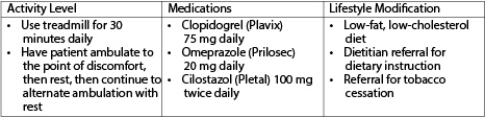
(Multiple Choice)
4.9/5 (66)
(66) Which topic should the nurse include in patient teaching for a patient with a venous stasis ulcer on the left lower leg?
(Multiple Choice)
4.8/5 (80)
(80) When caring for a patient on the first postoperative day after an abdominal aortic aneurysm repair,which assessment finding is most important for the nurse to communicate to the health care provider?
(Multiple Choice)
5.0/5 (68)
(68) The nurse has started discharge teaching for a patient who is to continue warfarin (Coumadin)following hospitalization for venous thromboembolism (VTE).The nurse determines that additional teaching is needed when the patient says which of the following?
(Multiple Choice)
4.8/5 (74)
(74) An 80-year-old patient with a history of an abdominal aortic aneurysm arrives at the emergency department (ED)with severe back pain and absent pedal pulses.Which actions should the nurse take first?
(Multiple Choice)
4.8/5 (90)
(90) The nurse performing an assessment with a patient who has chronic peripheral artery disease (PAD)of the legs and an ulcer on the right second toe would expect to find
(Multiple Choice)
4.7/5 (93)
(93) A patient has a 6-cm thoracic aortic aneurysm that was discovered during a routine chest x-ray.When obtaining an admission history from the patient,it will be most important for the nurse to ask about
(Multiple Choice)
4.8/5 (71)
(71) 
Filters
- Essay(0)
- Multiple Choice(0)
- Short Answer(0)
- True False(0)
- Matching(0)