



 Chat with AI
Exam 58: Nursing Management: Stroke

Exam 1: Professional Nursing Practice21 Questions
Exam 2: Health Disparities and Culturally Competent Care18 Questions
Exam 3: Health History and Physical Examination15 Questions
Exam 4: Patient and Caregiver Teaching21 Questions
Exam 5: Chronic Illness and Older Adults21 Questions
Exam 6: Complementary and Alternative Therapies13 Questions
Exam 7: Stress and Stress Management12 Questions
Exam 8: Sleep and Sleep Disorders11 Questions
Exam 9: Pain26 Questions
Exam 10: Palliative Care at End of Life16 Questions
Exam 11: Substance Abuse25 Questions
Exam 12: Inflammation and Wound Healing22 Questions
Exam 13: Genetics and Genomics7 Questions
Exam 14: Altered Immune Responses, and Transplantation26 Questions
Exam 15: Infection and Human Immunodeficiency Virus Infection26 Questions
Exam 16: Cancer43 Questions
Exam 17: Fluid, Electrolyte, and Acid-Base Imbalances37 Questions
Exam 18: Nursing Management: Preoperative Care21 Questions
Exam 19: Nursing Management: Intraoperative Care18 Questions
Exam 20: Nursing Management: Postoperative Care25 Questions
Exam 21: Nursing Assessment: Visual and Auditory Systems26 Questions
Exam 22: Nursing Management: Visual and Auditory Problems47 Questions
Exam 23: Nursing Assessment: Integumentary System13 Questions
Exam 24: Nursing Management: Integumentary Problems26 Questions
Exam 25: Nursing Management: Burns31 Questions
Exam 26: Nursing Assessment: Respiratory System24 Questions
Exam 27: Nursing Management: Upper Respiratory Problems25 Questions
Exam 28: Nursing Management: Lower Respiratory Problems51 Questions
Exam 29: Nursing Management: Obstructive Pulmonary Diseases44 Questions
Exam 30: Nursing Assessment: Hematologic System16 Questions
Exam 31: Nursing Management: Hematologic Problems48 Questions
Exam 32: Nursing Assessment: Cardiovascular System24 Questions
Exam 33: Nursing Management: Hypertension24 Questions
Exam 34: Nursing Management: Coronary Artery Disease and Acute Coronary Syndrome43 Questions
Exam 35: Nursing Management: Heart Failure26 Questions
Exam 36: Nursing Management: Dysrhythmias31 Questions
Exam 37: Nursing Management: Inflammatory and Structural Heart Disorders35 Questions
Exam 38: Nursing Management: Vascular Disorders36 Questions
Exam 39: Nursing Assessment: Gastrointestinal System18 Questions
Exam 40: Nursing Management: Nutritional Problems24 Questions
Exam 41: Nursing Management: Obesity20 Questions
Exam 42: Nursing Management: Upper Gastrointestinal Problems47 Questions
Exam 43: Nursing Management: Lower Gastrointestinal Problems56 Questions
Exam 44: Nursing Management: Liver,Pancreas,and Biliary Tract Problems46 Questions
Exam 45: Nursing Assessment: Urinary System24 Questions
Exam 46: Nursing Management: Renal and Urologic Problems45 Questions
Exam 47: Nursing Management: Acute Kidney Injury and Chronic Kidney Disease39 Questions
Exam 48: Nursing Assessment: Endocrine System22 Questions
Exam 49: Nursing Management: Diabetes Mellitus49 Questions
Exam 50: Nursing Management: Endocrine Problems46 Questions
Exam 51: Nursing Assessment: Reproductive System19 Questions
Exam 52: Nursing Management: Breast Disorders28 Questions
Exam 53: Nursing Management: Sexually Transmitted Infections19 Questions
Exam 54: Nursing Management: Female Reproductive Problems49 Questions
Exam 55: Nursing Management: Male Reproductive Problems35 Questions
Exam 56: Nursing Assessment: Nervous System21 Questions
Exam 57: Nursing Management: Acute Intracranial Problems40 Questions
Exam 58: Nursing Management: Stroke30 Questions
Exam 59: Nursing Management: Chronic Neurologic Problems36 Questions
Exam 60: Nursing Management: Alzheimer's Disease,Dementia,and Delirium21 Questions
Exam 61: Nursing Management: Peripheral Nerve and Spinal Cord Problems33 Questions
Exam 62: Nursing Assessment: Musculoskeletal System15 Questions
Exam 63: Nursing Management: Musculoskeletal Trauma and Orthopedic Surgery47 Questions
Exam 64: Nursing Management: Musculoskeletal Problems25 Questions
Exam 65: Nursing Management: Arthritis and Connective Tissue Diseases47 Questions
Exam 66: Nursing Management: Critical Care41 Questions
Exam 67: Nursing Management: Shock, Systemic Inflammatory Response Syndrome, and Multiple Organ Dysfunction Syndrome29 Questions
Exam 68: Nursing Management: Respiratory Failure and Acute Respiratory Distress Syndrome27 Questions
Exam 69: Nursing Management: Emergency, Terrorism, and Disaster Nursing26 Questions
Select questions type


Which information about the patient who has had a subarachnoid hemorrhage is most important to communicate to the health care provider?

Free
(Multiple Choice)
4.7/5  (79)
(79) Correct Answer: Verified
B
A 40-year-old patient has a ruptured cerebral aneurysm and subarachnoid hemorrhage.Which intervention will be included in the care plan?
Free
(Multiple Choice)
4.7/5 (77)
(77) Correct Answer:Verified
VerifiedA
A 68-year-old patient is being admitted with a possible stroke.Which information from the assessment indicates that the nurse should consult with the health care provider before giving the prescribed aspirin?
Free
(Multiple Choice)
4.9/5 (70)
(70) Correct Answer:Verified
VerifiedC
A male patient who has right-sided weakness after a stroke is making progress in learning to use the left hand for feeding and other activities.The nurse observes that when the patient's wife is visiting,she feeds and dresses him.Which nursing diagnosis is most appropriate for the patient?
(Multiple Choice)
4.8/5 (81)
(81) Which stroke risk factor for a 48-year-old male patient in the clinic is most important for the nurse to address?
(Multiple Choice)
4.9/5 (85)
(85) Several weeks after a stroke,a 50-year-old male patient has impaired awareness of bladder fullness,resulting in urinary incontinence.Which nursing intervention will be best to include in the initial plan for an effective bladder training program?
(Multiple Choice)
4.7/5 (75)
(75) When teaching about clopidogrel (Plavix),the nurse will tell the patient with cerebral atherosclerosis
(Multiple Choice)
4.7/5 (81)
(81) A 58-year-old patient with a left-brain stroke suddenly bursts into tears when family members visit.The nurse should
(Multiple Choice)
4.9/5 (91)
(91) During the change of shift report a nurse is told that a patient has an occluded left posterior cerebral artery.The nurse will anticipate that the patient may have
(Multiple Choice)
4.9/5 (83)
(83) The nurse identifies the nursing diagnosis of imbalanced nutrition: less than body requirements related to impaired self-feeding ability for a left-handed patient with left-sided hemiplegia.Which intervention should be included in the plan of care?
(Multiple Choice)
4.8/5 (73)
(73) After receiving change-of-shift report on the following four patients,which patient should the nurse see first?
(Multiple Choice)
4.7/5 (97)
(97) A patient admitted with possible stroke has been aphasic for 3 hours and his current blood pressure (BP)is 174/94 mm Hg.Which order by the health care provider should the nurse question?
(Multiple Choice)
5.0/5 (77)
(77) For a patient who had a right hemisphere stroke the nurse establishes a nursing diagnosis of
(Multiple Choice)
4.9/5 (80)
(80) A patient in the emergency department with sudden-onset right-sided weakness is diagnosed with an intracerebral hemorrhage.Which information about the patient is most important to communicate to the health care provider?
(Multiple Choice)
4.9/5 (70)
(70) The nurse is caring for a patient who has just returned after having left carotid artery angioplasty and stenting.Which assessment information is of most concern to the nurse?
(Multiple Choice)
4.8/5 (80)
(80) The nurse is caring for a patient who has been experiencing stroke symptoms for 60 minutes.Which action can the nurse delegate to a licensed practical/vocational nurse (LPN/LVN)?
(Multiple Choice)
4.8/5 (78)
(78) When caring for a patient with a new right-sided homonymous hemianopsia resulting from a stroke,which intervention should the nurse include in the plan of care?
(Multiple Choice)
4.8/5 (79)
(79) A 63-year-old patient who began experiencing right arm and leg weakness is admitted to the emergency department.In which order will the nurse implement these actions included in the stroke protocol? (Put a comma and a space between each answer choice [A,B,C,D].)
A) Obtain computed tomography (CT) scan without contrast.
B) Infuse tissue plasminogen activator (tPA).
C) Administer oxygen to keep O2 saturation >95%.
D) Use National Institute of Health Stroke Scale to assess patient.
(Short Answer)
4.8/5 (75)
(75) A 72-year-old patient who has a history of a transient ischemic attack (TIA)has an order for aspirin 160 mg daily.When the nurse is administering medications,the patient says,"I don't need the aspirin today.I don't have a fever." Which action should the nurse take?
(Multiple Choice)
4.9/5 (87)
(87) The home health nurse is caring for an 81-year-old who had a stroke 2 months ago.Based on information shown in the accompanying figure from the history,physical assessment,and physical therapy/occupational therapy,which nursing diagnosis is the highest priority for this patient?
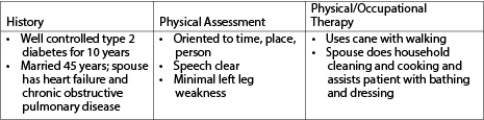
(Multiple Choice)
4.9/5 (73)
(73) 
Filters
- Essay(0)
- Multiple Choice(0)
- Short Answer(0)
- True False(0)
- Matching(0)