



 Chat with AI
Exam 12: Chemical Reactions, Oxidation, and Reduction: Bringing Molecules to Life

Exam 18: Chemical Analysis: Characterizing Chemical Compounds26 Questions
Exam 17: Acids, Bases, and Buffer Solutions: Life in an Aqueous Environment21 Questions
Exam 16: Kinetics: What Affects the Speed of a Reaction20 Questions
Exam 15: Equilibria: How Far Do Reactions Go17 Questions
Exam 14: Energy: What Makes Reactions Go22 Questions
Exam 13: Reaction Mechanisms: The Chemical Changes That Drive the Chemistry of Life26 Questions
Exam 12: Chemical Reactions, Oxidation, and Reduction: Bringing Molecules to Life18 Questions
Exam 11: Metals in Biology: Life Beyond Carbon8 Questions
Exam 10: Biological Macromolecules: The Infrastructure of Life27 Questions
Exam 9: Isomerism: Generating Chemical Variety20 Questions
Exam 8: Molecular Shape and Structure: Life in Three Dimensions21 Questions
Exam 7: Functional Groups: Adding Function to the Framework of Life32 Questions
Exam 6: Hydrocarbons: The Framework of Life16 Questions
Exam 5: Moles, Concentrations, and Dilutions: Making Sense of Chemical Numbers22 Questions
Exam 4: Molecular Interactions: Holding It All Together15 Questions
Exam 3: Compounds and Chemical Bonding: Bringing Atoms Together21 Questions
Exam 2: Atoms: The Foundations of Life15 Questions
Exam 1: Introduction: Why Biologists Need Chemistry9 Questions
Select questions type


The cleavage of the H-Br bond is most likely to generate which of the following pairs of species?

Free
(Multiple Choice)
4.9/5  (84)
(84) Correct Answer: Verified
A
Match the correct terms with the following descriptions.
-A loss of electrons during the course of a reaction
Free
(Multiple Choice)
4.7/5 (70)
(70) Correct Answer:Verified
VerifiedA
Match the correct terms with the following descriptions.
-A gain of electrons during the course of a reaction
Free
(Multiple Choice)
4.8/5 (75)
(75) Correct Answer:Verified
VerifiedB
Which of the following statements about valence electrons are false? Select all that apply.
(Multiple Choice)
4.8/5 (75)
(75) Which of the following statements about chemical reactions are true? Select all that apply.
(Multiple Choice)
4.7/5 (80)
(80) Which of the following species behave as electrophiles? Select all that apply.
(Multiple Choice)
4.9/5 (87)
(87) The following reaction represents which stage in a free-radical reaction?
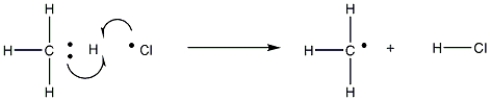
(Multiple Choice)
4.9/5 (68)
(68) Which of the following statements are true? Select all that apply.
(Multiple Choice)
4.9/5 (78)
(78) Electromagnetic radiation in which of the following regions of the electromagnetic spectrum is most able to generate free radicals?
(Multiple Choice)
5.0/5 (78)
(78) Which of the following species behave as nucleophiles? Select all that apply.
(Multiple Choice)
4.9/5 (67)
(67) Which of the following bonds are most likely to break homolytically? Select any that apply.
(Multiple Choice)
5.0/5 (81)
(81) The stoichiometry of a reaction tells us which of the following?
(Multiple Choice)
4.9/5 (66)
(66) Based on the following standard reduction potentials, which of the following species acts as the strongest oxidizing agent?
Zn2+(aq) + 2e- ⇌ Zn(s); E° = -0.34v
Cl2(g) + 2e- ⇌ 2Cl-(aq); E° = 1.36v
Ca2+(aq) + 2e- ⇌ Ca(s); E° = -2.87v
2H+(aq) + 2e- ⇌ H2(g); E° = 0.00v
(Multiple Choice)
4.8/5 (86)
(86) During the course of a reaction, the oxidation number of oxygen increases from -2 to 0. Is oxygen being oxidized or reduced during this reaction?
(Multiple Choice)
4.9/5 (80)
(80) Which of the following statements regarding free radicals are true? Select all that apply.
(Multiple Choice)
4.9/5 (93)
(93) The reference electrode against which other standard reduction potentials are measured is which of the following?
(Multiple Choice)
5.0/5 (85)
(85) When we forcibly increase the proportion of free radicals entering the termination step of a free-radical reaction we are said to be doing what?
(Multiple Choice)
4.8/5 (75)
(75) During the process NADH → NAD+ the electron carrier NAD is being reduced.
(True/False)
4.7/5 (80)
(80) 
Filters
- Essay(0)
- Multiple Choice(0)
- Short Answer(0)
- True False(0)
- Matching(0)