



 Chat with AI
Exam 7: Behavior and Its Consequences

Exam 1: Learning Theory: What It Is and How It Got This Way96 Questions
Exam 2: Learning and Adaptation97 Questions
Exam 3: The Nuts and Bolts of Classical Conditioning102 Questions
Exam 4: Theories of Conditioning118 Questions
Exam 5: What Ever Happened to Behavior Anyway97 Questions
Exam 6: Are the Laws of Conditioning General94 Questions
Exam 7: Behavior and Its Consequences105 Questions
Exam 8: How Stimuli Guide Instrumental Action109 Questions
Exam 9: The Motivation of Instrumental Action102 Questions
Exam 10: A Synthetic Perspective on Instrumental Action109 Questions
Select questions type


You have used your mother's brownies to shape your roommate to do the dishes. Your brownie supply is getting low. How can you reinforce your roommate to continue to clean the dishes after every meal with this limited suppy, and why will you do it that way?
(Essay)
4.8/5  (80)
(80) Edwin Guthrie argued that learning occurs as a gradual process because
(Multiple Choice)
5.0/5 (84)
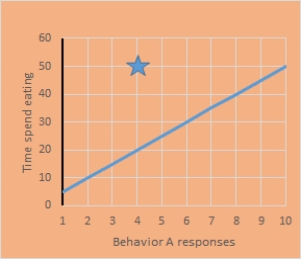
(84) The figure below shows the time spent eating as a function of lever pressing on an FR 5 schedule. The star is the bliss point. How many responses should you expect to get out of the animal before it stops, and why?
(Essay)
4.8/5 (82)
(82) A pigeon pecks a red key and is reinforced for a peck after either 5 seconds, 10 seconds, 15 seconds, 25 seconds, 30 seconds, or 40 seconds, with these times arranged in random order. The pigeon is on a(n) _______ schedule.
(Multiple Choice)
4.8/5 (69)
(69) A subject receives a series of schedules that are presented one at a time in a fixed order. The subject must complete the schedule requirement in each component before the next schedule begins. When it completes the schedule requirement on the last component, the subject then receives the reinforcement. This procedure uses a _______ schedule.
(Multiple Choice)
5.0/5 (64)
(64) Explain the assumptions of the "selection by consequences" model of reinforcement and how this model has affected learning research.
(Essay)
4.9/5 (88)
(88) The observation that reinforcement contingencies always deprive an organism of the chance to engage in a behavior was fundamental in the development of
(Multiple Choice)
4.9/5 (82)
(82) Which scenario illustrates the learning/performance distinction?
(Multiple Choice)
4.7/5 (67)
(67) In an operant conditioning procedure, which variable below has the least control over the nature of the operant that is produced?
(Multiple Choice)
4.7/5 (87)
(87) What are the three important conclusions about instrumental learning that were suggested by Tolman's latent-learning experiment?
(Essay)
4.9/5 (83)
(83) Precommitment strategies, use of secondary reinforcers, and responses that hasten delayed rewards are examples of the use of _______ to combat impulsiveness.
(Multiple Choice)
4.8/5 (71)
(71) As the response requirement for a behavior is increased steadily,
(Multiple Choice)
4.8/5 (79)
(79) Sydney spends about as much time studying as she does with her boyfriend. Her boyfriend starts to demand more time, so she breaks up with him and spends that time studying. From the perspective of behavior regulation theory, which statement best explains Sydney's choice?
(Multiple Choice)
4.7/5 (89)
(89) A student finds that his purchase of drawing pencils for art class is directly related to the amount of art paper he buys. According to behavioral economics, these art supplies would be classified as
(Multiple Choice)
4.8/5 (68)
(68) A local health food store has a 30% off sale on the first Monday of each month. Customers who do not purchase their vitamins and nutritional supplements at the monthly sale must wait to make their purchases until the following month. Buying supplements at a discount is on a _______ schedule.
(Multiple Choice)
4.9/5 (83)
(83) Skinner's definition of a reinforcer and the matching law both can be characterized as circular because
(Multiple Choice)
4.7/5 (74)
(74) Whenever the price of hamburger rises too much, you are willing to buy hotdogs for your summer picnics. From a behavioral economics perspective, hamburgers and hotdogs would be considered
(Multiple Choice)
4.9/5 (73)
(73) Outline the strengths and weaknesses of Hull's and Skinner's definitions of reinforcement. Which you think is better? Why?
(Essay)
4.8/5 (65)
(65) Impulsive organisms show greater _______ than other organisms.
(Multiple Choice)
4.8/5 (77)
(77) 
Filters
- Essay(0)
- Multiple Choice(0)
- Short Answer(0)
- True False(0)
- Matching(0)