



 Chat with AI
Exam 3: Neurophysiology: The Generation, Transmission, and Integration of Neural Signals

Exam 1: Behavioral Neuroscience Scope and Outlook99 Questions
Exam 2: Functional Neuroanatomy: The Cells and Structures of the Nervous System143 Questions
Exam 3: Neurophysiology: The Generation, Transmission, and Integration of Neural Signals136 Questions
Exam 4: The Chemistry of Behavior: Neurotransmitters and Neuropharmacology130 Questions
Exam 5: Hormones and the Brain130 Questions
Exam 6: Evolution of the Brain and Behavior125 Questions
Exam 7: Life-Span Development of the Brain and Behavior127 Questions
Exam 8: General Principles of Sensory Processing, Touch, and Pain127 Questions
Exam 9: Hearing, Balance, Taste, and Smell125 Questions
Exam 10: Vision: From Eye to Brain124 Questions
Exam 11: Motor Control and Plasticity132 Questions
Exam 12: Sex: Evolutionary, Hormonal, and Neural Bases139 Questions
Exam 13: Homeostasis: Active Regulation of the Internal Environment126 Questions
Exam 14: Biological Rhythms, Sleep, and Dreaming138 Questions
Exam 15: Emotions, Aggression, and Stress136 Questions
Exam 16: Psychopathology: Biological Basis of Behavioral Disorders127 Questions
Exam 17: Learning and Memory129 Questions
Exam 18: Attention and Higher Cognition127 Questions
Exam 19: Language and Lateralization127 Questions
Select questions type


The short-latency components of event-related potentials appear to be influenced primarily by
(Multiple Choice)
4.9/5  (80)
(80) _______ synapses work with practically no time delay, whereas _______ synapses have a delay on the order of about a millisecond.
(Multiple Choice)
4.8/5 (84)
(84) Which compound would prevent the release of neurotransmitters from stimulated neurons?
(Multiple Choice)
4.9/5 (83)
(83) What are event-related potentials, and how are they useful in studying the workings of the normal brain?
(Short Answer)
4.9/5 (80)
(80) The _______ are regularly spaced along the length of myelinated axons.
(Short Answer)
4.8/5 (88)
(88) A patient has a seizure that does not involve the entire brain. Just before the seizure, the patient had an unusual sensation, and at the height of the seizure the patient was unresponsive. This patient most likely experienced a _______ seizure.
(Multiple Choice)
4.8/5 (91)
(91) Ions are atoms or molecules that carry an electric charge due to the gain or loss of
(Multiple Choice)
4.9/5 (84)
(84) The giant axons of squids have been used in neurophysiological research because they attain diameters of _______ mm.
(Multiple Choice)
4.8/5 (72)
(72) The giant axons of some invertebrates conduct action potentials at speeds up to _______ m/s.
(Multiple Choice)
4.8/5 (72)
(72) Describe the voltage clamping procedure. Describe and explain what can be learned from two different patch clamping techniques.
(Essay)
4.7/5 (76)
(76) Describe channelopathies and give two examples of channelopathies, including symptoms that accompany each.
(Essay)
4.9/5 (89)
(89) Discuss three factors that account for the rapidity of the knee-jerk reflex.
(Essay)
5.0/5 (79)
(79) _______ inform the presynaptic neurons about the net concentration of transmitter in the synaptic cleft and help regulate future transmitter release.
(Short Answer)
4.8/5 (95)
(95) The electrical potential across a semipermeable membrane separating different concentrations of ions is most accurately predicted by the _______ equation.
(Short Answer)
5.0/5 (64)
(64) In the knee-jerk reflex, the total time between the stimulus and the initiation of the response is about _______ ms.
(Multiple Choice)
4.8/5 (94)
(94) _______ receptors recognize the synaptic transmitter, but they do not themselves contain any ion channels.
(Multiple Choice)
5.0/5 (79)
(79) Refer to the figure, which shows two voltage-gated Na+ channels (in blue) in the center.
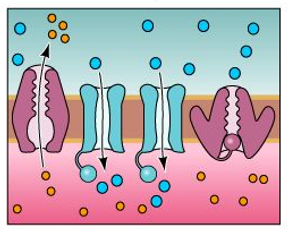 What is taking place in this figure?
 (Multiple Choice)
4.8/5 (69)
(69) In an animal research study, channelrhodopsin is inserted into neurons that make GABA (which inhibits neurons), and halorhodopsin is inserted into neurons that make glutamate (which excites neurons). Both sets of neurons make connections with a set of neurons responsible for eye blinking. If the eye-blink neurons are stimulated by blue light, the animal will _______ because the _______ neurons will be _______.
(Multiple Choice)
4.8/5 (79)
(79) 
Filters
- Essay(0)
- Multiple Choice(0)
- Short Answer(0)
- True False(0)
- Matching(0)