



 Chat with AI
Exam 8: General Principles of Sensory Processing, Touch, and Pain

Exam 1: Behavioral Neuroscience Scope and Outlook99 Questions
Exam 2: Functional Neuroanatomy: The Cells and Structures of the Nervous System143 Questions
Exam 3: Neurophysiology: The Generation, Transmission, and Integration of Neural Signals136 Questions
Exam 4: The Chemistry of Behavior: Neurotransmitters and Neuropharmacology130 Questions
Exam 5: Hormones and the Brain130 Questions
Exam 6: Evolution of the Brain and Behavior125 Questions
Exam 7: Life-Span Development of the Brain and Behavior127 Questions
Exam 8: General Principles of Sensory Processing, Touch, and Pain127 Questions
Exam 9: Hearing, Balance, Taste, and Smell125 Questions
Exam 10: Vision: From Eye to Brain124 Questions
Exam 11: Motor Control and Plasticity132 Questions
Exam 12: Sex: Evolutionary, Hormonal, and Neural Bases139 Questions
Exam 13: Homeostasis: Active Regulation of the Internal Environment126 Questions
Exam 14: Biological Rhythms, Sleep, and Dreaming138 Questions
Exam 15: Emotions, Aggression, and Stress136 Questions
Exam 16: Psychopathology: Biological Basis of Behavioral Disorders127 Questions
Exam 17: Learning and Memory129 Questions
Exam 18: Attention and Higher Cognition127 Questions
Exam 19: Language and Lateralization127 Questions
Select questions type


The change in the membrane potential of a receptor when it is stimulated is called the _______ potential.

Free
(Short Answer)
4.8/5  (85)
(85) Correct Answer: Verified
receptor and generator
The term "adequate stimulus" refers to
Free
(Multiple Choice)
4.9/5 (89)
(89) Correct Answer:Verified
VerifiedA
Refer to the figure.
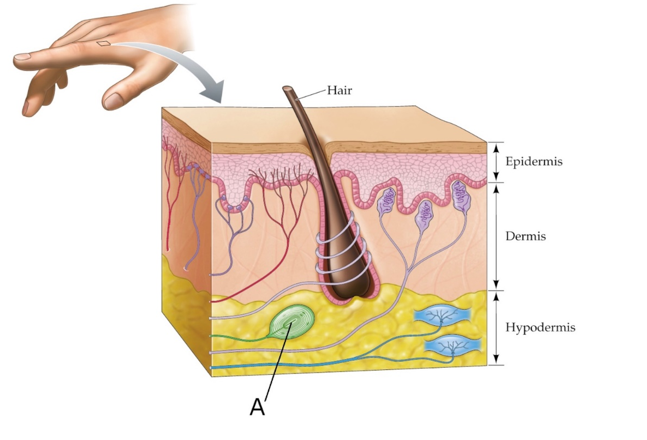 What is the receptor labeled A on this figure, and what type of senses are detected by this receptor?
Free
(Multiple Choice)
4.8/5 (77)
(77) Correct Answer:Verified
VerifiedC
Electrical stimulation of the _______ produces analgesia in both rats and humans.
(Multiple Choice)
4.7/5 (73)
(73) The brain can differentiate between each sensory modality because
(Multiple Choice)
4.8/5 (76)
(76) Individual cortical neurons that respond to inputs from more than one type of sense are called _______ neurons.
(Short Answer)
4.8/5 (79)
(79) Which substance is not important in mediating pain perception?
(Multiple Choice)
4.8/5 (71)
(71) Each sensory receptor organ is affected by particular environmental events for which that organ is particularly adapted. These events are called
(Multiple Choice)
4.8/5 (72)
(72) How does a sensory system code a wide range of stimulus intensities?
(Short Answer)
4.9/5 (91)
(91) Discuss the plasticity of cortical sensory representations in the cortex as a result of de-afferentation from the hand (such as occurs in amputation).
(Essay)
4.7/5 (76)
(76) Mice lacking the gene for TRPV1 respond to _______ but not to _______.
(Multiple Choice)
4.7/5 (80)
(80) As you sit and answer this question, you are receiving less and less information about the feeling of the seat on which you are sitting. This is due to the process underlying your sensory receptors response to the stimuli called
(Multiple Choice)
4.9/5 (70)
(70) The progressive loss of sensitivity of a sensory receptor as a consequence of sustained stimulation is known as
(Multiple Choice)
4.9/5 (81)
(81) The two systems that provide us with the itch sensation use
(Multiple Choice)
5.0/5 (77)
(77) The evolutionary advantage of sensory adaptation is that it
(Multiple Choice)
4.7/5 (91)
(91) Summarize the manner in which sensory energy is encoded in patterns of neural impulses, and explain how information about the strength, adaptation, and location of stimuli is extracted by the nervous system while filtering out extraneous information.
(Essay)
4.9/5 (84)
(84) 
Filters
- Essay(0)
- Multiple Choice(0)
- Short Answer(0)
- True False(0)
- Matching(0)