



 Chat with AI
Exam 15: Emotions, Aggression, and Stress

Exam 1: Behavioral Neuroscience Scope and Outlook99 Questions
Exam 2: Functional Neuroanatomy: The Cells and Structures of the Nervous System143 Questions
Exam 3: Neurophysiology: The Generation, Transmission, and Integration of Neural Signals136 Questions
Exam 4: The Chemistry of Behavior: Neurotransmitters and Neuropharmacology130 Questions
Exam 5: Hormones and the Brain130 Questions
Exam 6: Evolution of the Brain and Behavior125 Questions
Exam 7: Life-Span Development of the Brain and Behavior127 Questions
Exam 8: General Principles of Sensory Processing, Touch, and Pain127 Questions
Exam 9: Hearing, Balance, Taste, and Smell125 Questions
Exam 10: Vision: From Eye to Brain124 Questions
Exam 11: Motor Control and Plasticity132 Questions
Exam 12: Sex: Evolutionary, Hormonal, and Neural Bases139 Questions
Exam 13: Homeostasis: Active Regulation of the Internal Environment126 Questions
Exam 14: Biological Rhythms, Sleep, and Dreaming138 Questions
Exam 15: Emotions, Aggression, and Stress136 Questions
Exam 16: Psychopathology: Biological Basis of Behavioral Disorders127 Questions
Exam 17: Learning and Memory129 Questions
Exam 18: Attention and Higher Cognition127 Questions
Exam 19: Language and Lateralization127 Questions
Select questions type


Define stress and outline the neuroendocrine changes that acute and chronic stress may produce in humans and other animals.
(Essay)
4.8/5  (81)
(81) According to Lacey and Lacey, emotional responses and various physiological reactions show persistent patterns that are unique to the individual. This characteristic is called
(Multiple Choice)
4.8/5 (68)
(68) Summarize the evidence related to the view that stress causes disease in humans.
(Essay)
4.8/5 (72)
(72) Which gesture is not one of the three types of facial expression that have been identified in nonhuman primates?
(Multiple Choice)
4.8/5 (85)
(85) The brain monitors the immune system closely. The achy and lethargic feelings of illness may be adaptive responses that force those who are ill to remain at rest. These symptoms could be related to increases in _______, which are also decreased by the administration of antidepressants.
(Multiple Choice)
4.8/5 (74)
(74) Write a coherent and informative paragraph incorporating each of the following terms or concepts: Darwin; facial muscles; grimace; tense mouth; play face
(Essay)
4.8/5 (81)
(81) With increased levels of adrenal steroid hormones, the response of the immune system to pathogens such as viruses is
(Multiple Choice)
4.7/5 (92)
(92) Which brain sites are included in the Papez circuit of emotion?
(Multiple Choice)
4.9/5 (73)
(73) Refer to the figure.
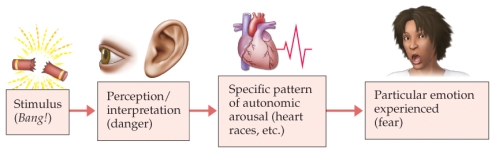 The sequence of events shown in this diagram illustrate the ______ theory.
 (Short Answer)
4.7/5 (77)
(77) Describe current theories about how brain structures, especially the nuclei of the amygdala, function in fear conditioning.
(Essay)
4.8/5 (81)
(81) Which of the following CNS regions play a role in maternal aggression?
(Multiple Choice)
4.8/5 (81)
(81) The polygraph, which is claimed to serve as a lie detector, measures
(Multiple Choice)
4.9/5 (88)
(88) Paul Ekman and colleagues have proposed the existence of facial expressions for eight emotions that are recognized across all societies. Which emotion is not one of those eight?
(Multiple Choice)
4.9/5 (82)
(82) Refer to the figure.
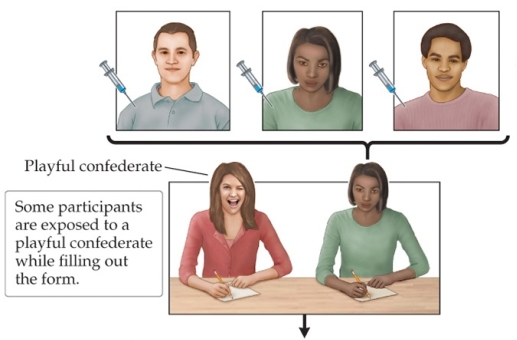 Based on the findings of Schachter's cognitive attribution model, the people shown receiving the injection of epinephrine are likely to report feeling _______ after filling out the form.
 (Short Answer)
5.0/5 (77)
(77) Discuss some of the differences from both functional and structural imaging studies between the brains of those with psychopathic tendencies and controls.
(Essay)
4.8/5 (76)
(76) 
Filters
- Essay(0)
- Multiple Choice(0)
- Short Answer(0)
- True False(0)
- Matching(0)