



 Chat with AI
Exam 15: Emotions, Aggression, and Stress

Exam 1: Behavioral Neuroscience Scope and Outlook99 Questions
Exam 2: Functional Neuroanatomy: The Cells and Structures of the Nervous System143 Questions
Exam 3: Neurophysiology: The Generation, Transmission, and Integration of Neural Signals136 Questions
Exam 4: The Chemistry of Behavior: Neurotransmitters and Neuropharmacology130 Questions
Exam 5: Hormones and the Brain130 Questions
Exam 6: Evolution of the Brain and Behavior125 Questions
Exam 7: Life-Span Development of the Brain and Behavior127 Questions
Exam 8: General Principles of Sensory Processing, Touch, and Pain127 Questions
Exam 9: Hearing, Balance, Taste, and Smell125 Questions
Exam 10: Vision: From Eye to Brain124 Questions
Exam 11: Motor Control and Plasticity132 Questions
Exam 12: Sex: Evolutionary, Hormonal, and Neural Bases139 Questions
Exam 13: Homeostasis: Active Regulation of the Internal Environment126 Questions
Exam 14: Biological Rhythms, Sleep, and Dreaming138 Questions
Exam 15: Emotions, Aggression, and Stress136 Questions
Exam 16: Psychopathology: Biological Basis of Behavioral Disorders127 Questions
Exam 17: Learning and Memory129 Questions
Exam 18: Attention and Higher Cognition127 Questions
Exam 19: Language and Lateralization127 Questions
Select questions type


Which neurotransmitter has been linked to the rewarding effects of electrical stimulation of various brain regions?
(Multiple Choice)
4.9/5  (76)
(76) According to Lacey and Lacey, individual differences in emotional responses to stimuli that can be detected in childhood
(Multiple Choice)
4.8/5 (90)
(90) Summarize research concerning the neural mechanisms of emotion, including functional and imaging studies of brain substrates for reward, aggression, and other emotional behavior.
(Essay)
4.8/5 (78)
(78) The brain affects the immune system through autonomic nerve fibers that innervate immune system organs such as the spleen and the thymus gland. These fibers are usually _______ sympathetic postganglionic axons.
(Multiple Choice)
4.8/5 (87)
(87) In a classic study by Ursin et al., hormonal responses to stress was studied in a group of Norwegian military during parachute training. What did the results show during training?
(Multiple Choice)
4.9/5 (80)
(80) Refer to the figure.
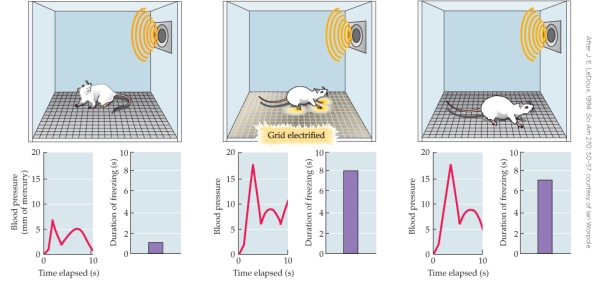 This sequence of images and graphs illustrates the phenomenon of
 (Multiple Choice)
4.9/5 (81)
(81) Fear conditioning, or "conditioned freezing," is a learned response to a previously neutral stimulus that has been associated with a stressful stimulus, such as shock. The _______ is a key structure involved in this conditioning.
(Multiple Choice)
4.9/5 (83)
(83) Evidence that two different emotions can elicit approximately the same autonomic profile supports
(Multiple Choice)
4.9/5 (82)
(82) Write a coherent and informative paragraph incorporating each of the following terms or concepts: stress; autonomic; testosterone; cortisol
(Essay)
4.9/5 (79)
(79) Discuss the theoretical and empirical underpinnings of health psychology as it pertains to the effects of stress on disease; explain the relationship between the nervous system and immune functioning.
(Essay)
4.8/5 (88)
(88) Epigenetic changes in the expression of the adrenal steroid receptor have been observed in people
(Multiple Choice)
4.9/5 (82)
(82) Which individual is likely to feel happiest after receiving a poor mark on an exam?
(Multiple Choice)
4.8/5 (69)
(69) According to some research, the universal properties of facial expressions may be limited by differences in
(Multiple Choice)
4.8/5 (72)
(72) Describe the effects of fear conditioning on dendritic spines as demonstrated by two-photon excitation microscopy. How do these changes relate to possible changes in synaptic strength?
(Essay)
4.8/5 (83)
(83) Which of the following is not used for visualizing dendritic changes in the cortical neurons in mice undergoing fear conditioning?
(Multiple Choice)
4.8/5 (67)
(67) 
Filters
- Essay(0)
- Multiple Choice(0)
- Short Answer(0)
- True False(0)
- Matching(0)