



 Chat with AI
Exam 15: Emotions, Aggression, and Stress

Exam 1: Behavioral Neuroscience Scope and Outlook99 Questions
Exam 2: Functional Neuroanatomy: The Cells and Structures of the Nervous System143 Questions
Exam 3: Neurophysiology: The Generation, Transmission, and Integration of Neural Signals136 Questions
Exam 4: The Chemistry of Behavior: Neurotransmitters and Neuropharmacology130 Questions
Exam 5: Hormones and the Brain130 Questions
Exam 6: Evolution of the Brain and Behavior125 Questions
Exam 7: Life-Span Development of the Brain and Behavior127 Questions
Exam 8: General Principles of Sensory Processing, Touch, and Pain127 Questions
Exam 9: Hearing, Balance, Taste, and Smell125 Questions
Exam 10: Vision: From Eye to Brain124 Questions
Exam 11: Motor Control and Plasticity132 Questions
Exam 12: Sex: Evolutionary, Hormonal, and Neural Bases139 Questions
Exam 13: Homeostasis: Active Regulation of the Internal Environment126 Questions
Exam 14: Biological Rhythms, Sleep, and Dreaming138 Questions
Exam 15: Emotions, Aggression, and Stress136 Questions
Exam 16: Psychopathology: Biological Basis of Behavioral Disorders127 Questions
Exam 17: Learning and Memory129 Questions
Exam 18: Attention and Higher Cognition127 Questions
Exam 19: Language and Lateralization127 Questions
Select questions type


The James-Lange theory of emotion argues that each emotion is produced by
(Multiple Choice)
4.9/5  (67)
(67) Rat pups deprived from maternal care for long periods show which of the following?
(Multiple Choice)
4.9/5 (73)
(73) The structures of the Papez circuit of emotion are primarily parts of the _______ system.
(Short Answer)
4.8/5 (68)
(68) Explain the latest hypotheses regarding why baby rats that received daily handling by humans in the laboratory when young show less of a stress response as adults?
(Essay)
5.0/5 (88)
(88) 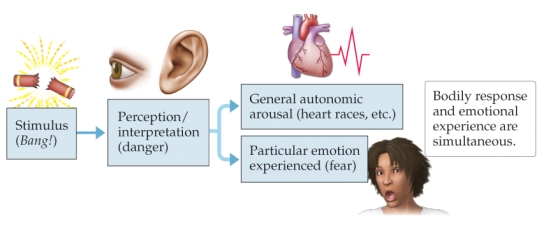 This sequence of events illustrates
Psychopathy _______ a psychiatric disorder with formal diagnostic criterion in the DSM V.
(Short Answer)
4.8/5 (85)
(85) Refer to the figure.
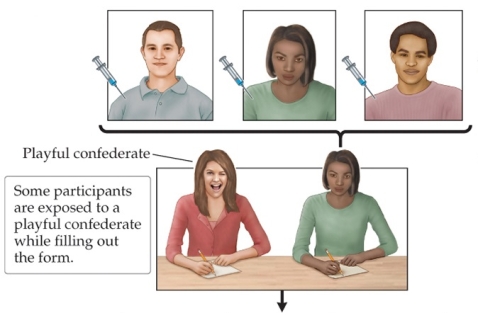 Based on the findings of Schachter's cognitive attribution model, the people shown receiving the injection of epinephrine are likely to report feeling _______ after filling out the form.
 (Multiple Choice)
4.9/5 (86)
(86) The balance between which two neurotransmitters appears to be important in aggressive responses to stimuli?
(Multiple Choice)
4.8/5 (87)
(87) In rats, lesions of the _______ nucleus of the amygdala inhibit blood pressure increases and constrain freezing behavior in response to conditioned fearful stimuli.
(Short Answer)
4.9/5 (78)
(78) Female mice are most likely display aggression when confronted with
(Multiple Choice)
4.9/5 (85)
(85) Write a coherent and informative paragraph incorporating each of the following terms or concepts: heart disease; type A; type B; hostility; purpose
(Essay)
4.9/5 (68)
(68) A subject whose medial forebrain bundle has been cut would most likely
(Multiple Choice)
4.9/5 (80)
(80) In fear conditioning, the central nucleus of the amygdala transmits information through the _______ to evoke hormonal responses.
(Multiple Choice)
4.9/5 (92)
(92) The autonomic response patterns of newborns to stressful stimuli
(Multiple Choice)
4.9/5 (74)
(74) Studies of facial expression among nonhuman primates have led researchers to propose that "tense mouth" is analogous to the expression of _______ in humans.
(Short Answer)
4.9/5 (96)
(96) Which transmitter has been especially implicated in the control of aggression?
(Multiple Choice)
4.9/5 (92)
(92) Which is a behavioral manifestation of emotion that does not have the same meaning among different groups of primates?
(Multiple Choice)
4.8/5 (77)
(77) If you wanted to set up an experiment to reduce maternal aggression, you might try which of the following techniques?
(Multiple Choice)
4.8/5 (86)
(86) 
Filters
- Essay(0)
- Multiple Choice(0)
- Short Answer(0)
- True False(0)
- Matching(0)