



 Chat with AI
Exam 3: Process Cost Systems

Exam 1: Introduction to Managerial Accounting191 Questions
Exam 2: Job Order Costing178 Questions
Exam 3: Process Cost Systems182 Questions
Exam 4: Activity Based Costing110 Questions
Exam 5: Cost Volume Profit Analysis210 Questions
Exam 6: Variable Costing for Management Analysis153 Questions
Exam 7: Budgeting182 Questions
Exam 8: Evaluating Variances From Standard Costs166 Questions
Exam 9: Evaluating Decentralized Operations204 Questions
Exam 10: Differential Analysis and Product Pricing165 Questions
Exam 11: Capital Investment Analysis177 Questions
Exam 12: Lean Manufacturing and Activity Analysis123 Questions
Exam 13: Statement of Cash Flows171 Questions
Exam 14: Financial Statement Analysis183 Questions
Select questions type


If the costs for direct materials, direct labor, and factory overhead were $522,200, $82,700, and $45,300, respectively, for 16,000 equivalent units of production, the conversion cost per equivalent unit was $8.00.
(True/False)
5.0/5  (74)
(74) Custom-made goods would be accounted for using a process costing system.
(True/False)
5.0/5 (74)
(74) Both process and job order cost systems maintain perpetual inventory accounts with subsidiary ledgers.
(True/False)
4.7/5 (74)
(74) Alexandra Company's Molding Department opened on July 1. During July, 70.000 units were completed and transferred out to the next department. On July 31, the 10,000 units which remained in inventory were 40% complete with respect to conversion costs and 100% complete with respect to materials.
How many equivalent units of work did the Molding Department complete during July for materials and conversion costs?
(Short Answer)
4.8/5 (95)
(95) If a company uses a process costing system to account for the costs in its five production departments, how many work in process accounts will it use?
(Multiple Choice)
4.8/5 (78)
(78) Match each phrase that follows with the term (a-h) it describes.
Correct Answer: Verified
Premises:
Responses:
(Matching)
4.8/5 (81)
(81) Costs of ending work in process inventory are included in the cost per equivalent unit computation.
(True/False)
4.9/5 (71)
(71) Which of the following is not a characteristic of a process cost system?
(Multiple Choice)
4.8/5 (65)
(65) Department E had 4,000 units in Work in Process that were 40% completed at the beginning of the period at a cost of $12,500. During the period, 14,000 units of direct materials were added at a cost of $28,700, and 15,000 units were completed. At the end of the period, 3,000 units were 75% completed. All materials are added at the beginning of the process. Direct labor was $32,450 and factory overhead was $18,710. The number of equivalent units of production for the period for conversion if the first-in, first-out method is used to cost inventories was
(Multiple Choice)
4.8/5 (89)
(89) On August 1, Jones Corporation's Packaging Department had work in process inventory of 8,000 units that were 75% complete with respect to materials and 30% complete with respect to conversion costs. The cost of these units was $99,525 ($62,000 transferred-in from previous departments, $28,775 in materials, and $8,750 in labor and overhead). During August, 125,000 units were transferred into the department. These units had accumulated costs in previous departments of $1,418,560. The packaging department incurred costs of $799,225 for materials and $498,010 for conversion costs in August and transferred 131,000 units out of the department. The 2,000 units remaining in ending inventory are 50% complete with respect to materials and 20% complete with respect to conversion costs. Jones uses the average cost method to cost its inventories.
(a) Calculate the cost per equivalent unit for transferred-in costs, materials, and conversion costs.
(b) Calculate the cost of the units transferred out of the department.
(c) Calculate the cost of the ending inventory.
(Short Answer)
4.8/5 (68)
(68) Department G had 3,600 units 25% completed at the beginning of the period, 11,000 units were completed during the period; 3,000 units were 20% completed at the end of the period, and the following manufacturing costs debited to the departmental work in process account during the period:  All direct materials are placed in process at the beginning of production and the first-in, first-out method of inventory costing is used. What is the total cost of the units started and completed during the period (round unit cost calculations to four decimal places)?
 (Multiple Choice)
5.0/5 (76)
(76) Equivalent units of production are the number of units that could have been manufactured from start to finish during an accounting period.
(True/False)
4.9/5 (73)
(73) In a just-in-time system, processing functions are combined into work centers, sometimes called departments.
(True/False)
4.8/5 (90)
(90) Conversion and direct materials are generally both added at the end of the production process.
(True/False)
4.8/5 (85)
(85) Match each business that follows to the type of costing system (a or b) it would typically use.
Correct Answer:Verified
VerifiedPremises:
Responses:
(Matching)
4.9/5 (79)
(79) Information for the Nichols Manufacturing Company for the month of May is as follows: 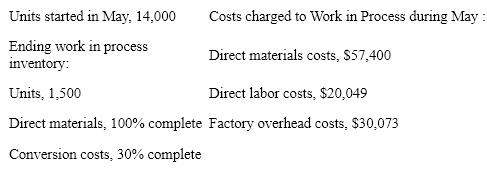 Prepare a cost of production report for the month of May , using the FIFO method.
 (Short Answer)
4.8/5 (80)
(80) The cost of production report reports the cost charged to production and the costs allocated to finished goods and work in process.
(True/False)
4.9/5 (60)
(60) Discuss how equivalent units are computed under the average cost method.
(Short Answer)
4.8/5 (86)
(86) The following production data were taken from the records of the Finishing Department for June:  What is the number of material equivalent units of production in the June 30 Finishing Department inventory, assuming that the first-in, first-out method is used to cost inventories and materials were added at the beginning of the process?
 (Multiple Choice)
4.8/5 (95)
(95) When a firm adopts a l ean manufacturing operating environment,
(Multiple Choice)
4.9/5 (79)
(79) 
Filters
- Essay(0)
- Multiple Choice(0)
- Short Answer(0)
- True False(0)
- Matching(0)