



 Chat with AI
Exam 3: Process Cost Systems

Exam 1: Introduction to Managerial Accounting191 Questions
Exam 2: Job Order Costing178 Questions
Exam 3: Process Cost Systems182 Questions
Exam 4: Activity Based Costing110 Questions
Exam 5: Cost Volume Profit Analysis210 Questions
Exam 6: Variable Costing for Management Analysis153 Questions
Exam 7: Budgeting182 Questions
Exam 8: Evaluating Variances From Standard Costs166 Questions
Exam 9: Evaluating Decentralized Operations204 Questions
Exam 10: Differential Analysis and Product Pricing165 Questions
Exam 11: Capital Investment Analysis177 Questions
Exam 12: Lean Manufacturing and Activity Analysis123 Questions
Exam 13: Statement of Cash Flows171 Questions
Exam 14: Financial Statement Analysis183 Questions
Select questions type


The cost per equivalent units of direct materials and conversion in the Bottling Department of Mountain Springs Water Company is $0.45 and $0.12, respectively. The equivalent units to be assigned costs are as follows. 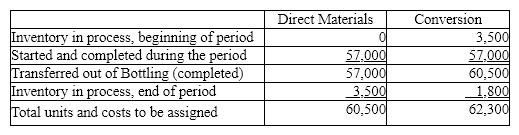 The beginning work in process inventory had a cost of $2,200. Determine the cost of completed and transferred out production, and the ending work in process inventory.
 (Short Answer)
4.9/5  (83)
(83) The cost of production report summarizes (1) the units for which the department is accountable and the units to be assigned costs and (2) the costs charged to the department and the allocation of those costs.
(True/False)
4.8/5 (77)
(77) The Mountain Springs Water Company has two departments, Purifying and Bottling. The Bottling Department received 58,000 liters from the Purifying Department. During the period, the Bottling Department completed 56,000 liters, including 4,000 liters of work in process at the beginning of the period. The ending work in process was 6,000 liters. How many liters were started and completed during the period?
(Short Answer)
4.7/5 (87)
(87) Which of the following costs incurred by a tool manufacturer would not be included in conversion costs?
(Multiple Choice)
4.7/5 (80)
(80) One of the primary uses of a cost of production report is to assist management in controlling production costs.
(True/False)
4.8/5 (90)
(90) The direct materials costs and direct labor costs incurred by a production department are referred to as conversion costs.
(True/False)
4.9/5 (75)
(75) The Brass Works is in the process of determining manufacturing overhead. Journalize events (a) - (d) to Factory Overhead, Administrative Expenses, Selling expenses, or allocated between the three as appropriate. All items were paid in cash at the time of acquisition. Next calculate the overhead application rate and apply overhead to Work in Process.
(a) Brass Works purchases an insurance policy for $4,000. It is computed that 80% of the value of the policy protects production, the balance protects the administrative offices. brass Works charges insurance initially to expense.
(b) The electric bill is received showing an amount due of $1,200. This meter is utilized only by production as the office spaces have their own meter.
(c) Payroll reports that the sales manager's salary for the period is $3,500 and that production supervisors wages for the period are $5,500.
(d) The stockroom reports that $2,575 in materials were purchased for the production Maintenance Department.
(e) If the driver for the application of overhead is drop-forge strokes and there are expected to be 1,000 strokes in this period, what is the rate per stroke? Do not round your answer.
(f) Assuming that there are 1,150 drop-forge strokes in this period, apply factory overhead to Work in Process. Round your answers to nearest dollar.
Round overhead rate to four decimal places and total cost to nearest dollar.
(Short Answer)
4.8/5 (72)
(72) The cost system best suited to industries that manufacture a large number of identical units of commodities on a continuous basis is
(Multiple Choice)
4.8/5 (77)
(77) Mocha Company manufactures a single product by a continuous process, involving three production departments. The records indicate that direct materials, direct labor, and applied factory overhead for Department 1 were $100,000, $125,000, and $150,000, respectively. The records further indicate that direct materials, direct labor, and applied factory overhead for Department 2 were $55,000, $65,000, and $80,000, respectively. In addition, work in process at the beginning of the period for Department 1 totaled $75,000, and work in process at the end of the period totaled $60,000.
The journal entry to record the flow of costs into Department 1 during the period for applied overhead is
(Multiple Choice)
4.8/5 (77)
(77) Zang Co. manufacturers its products in a continuous process involving two departments, Machining and Assembly. Prepare journal entries to record the following transactions related to production during June:
(a) Materials purchased on account, $180,000
(b) Materials requisitioned by: Machining, $73,000 direct and $9,000 indirect materials; Assembly, $4,900 indirect materials
(c) Direct labor used by Machining, $23,000; Assembly, $47,000
(d) Depreciation expenses: Machining, $4,500; Assembly, $7,800
(e) Factory overhead applied: Machining, $9,700; Assembly, $11,300
(f) Machining Department transferred $98,300 to Assembly Department; Assembly Department transferred $83,400 to finished goods
(g) Sold goods on account, $100,000; cost of goods sold, $68,000
(Short Answer)
4.8/5 (93)
(93) Which of the following measures would not help managers to control and improve operations?
(Multiple Choice)
4.8/5 (79)
(79) In a process costing system, a separate work in process inventory account is maintained for each customer's job.
(True/False)
4.9/5 (74)
(74) Mocha Company manufactures a single product by a continuous process, involving three production departments. The records indicate that direct materials, direct labor, and applied factory overhead for Department 1 were $100,000, $125,000, and $150,000, respectively. The records further indicate that direct materials, direct labor, and applied factory overhead for Department 2 were $55,000, $65,000, and $80,000, respectively. In addition, work in process at the beginning of the period for Department 1 totaled $75,000, and work in process at the end of the period totaled $60,000.
The journal entry to record the flow of costs into Department 1 for direct labor is
(Multiple Choice)
4.9/5 (91)
(91) In applying the first-in, first-out method of costing inventories, if 8,000 units which are 30% completed are in process at June 1, 28,000 units are completed during June, and 4,000 units were 75% completed at June 30, the number of equivalent units of production for June was 33,400.
(True/False)
4.8/5 (65)
(65) Penny, Inc. employs a process costing system. Direct materials are added at the beginning of the process. Here is information about July's activities: 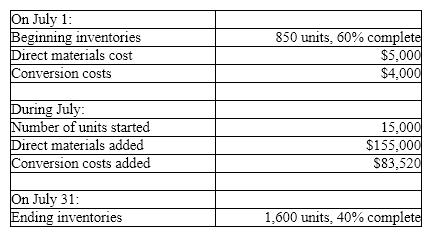 Using the FIFO method and rounding cost per unit to four decimal places, the cost of goods completed and transferred out during July was:
 (Multiple Choice)
4.9/5 (76)
(76) If a company uses average costing instead of FIFO, it will still get the same unit costs.
(True/False)
4.9/5 (86)
(86) Equivalent units are the sum of direct materials used and direct labor incurred.
(True/False)
4.7/5 (80)
(80) Companies that use the average costing method for process costing have unit costs that include costs from more than one accounting period.
(True/False)
4.9/5 (88)
(88) Process manufacturers typically use large machines to process a continuous flow of raw materials into a finished state.
(True/False)
4.9/5 (86)
(86) 
Filters
- Essay(0)
- Multiple Choice(0)
- Short Answer(0)
- True False(0)
- Matching(0)