



 Chat with AI
Exam 3: Process Cost Systems

Exam 1: Introduction to Managerial Accounting191 Questions
Exam 2: Job Order Costing178 Questions
Exam 3: Process Cost Systems182 Questions
Exam 4: Activity Based Costing110 Questions
Exam 5: Cost Volume Profit Analysis210 Questions
Exam 6: Variable Costing for Management Analysis153 Questions
Exam 7: Budgeting182 Questions
Exam 8: Evaluating Variances From Standard Costs166 Questions
Exam 9: Evaluating Decentralized Operations204 Questions
Exam 10: Differential Analysis and Product Pricing165 Questions
Exam 11: Capital Investment Analysis177 Questions
Exam 12: Lean Manufacturing and Activity Analysis123 Questions
Exam 13: Statement of Cash Flows171 Questions
Exam 14: Financial Statement Analysis183 Questions
Select questions type


In process cost accounting, the costs of direct materials and direct labor are charged directly to
(Multiple Choice)
4.9/5  (92)
(92) Kramer Company started its production operations on August 1. During August, the Printing Department completed 17,600 units. There were 4,400 units in ending inventory which were 80% complete with respect to materials and 10% complete with respect to conversion costs. During August, the department accumulated materials costs of $45,408 and conversion costs of $76,670.
Required:
(a) Calculate the cost of the goods transferred out.
(b) What is the value of the ending inventory?
(Short Answer)
4.8/5 (84)
(84) Mocha Company manufactures a single product by a continuous process, involving three production departments. The records indicate that direct materials, direct labor, and applied factory overhead for Department 1 were $100,000, $125,000, and $150,000, respectively. The records further indicate that direct materials, direct labor, and applied factory overhead for Department 2 were $50,000, $60,000, and $70,000, respectively. Department 2 has transferred-in costs of $390,000 for the current period. In addition, work in process at the beginning of the period for Department 2 totaled $75,000, and work in process at the end of the period totaled $90,000. The journal entry to record the flow of costs into Department 3 during the period is
(Multiple Choice)
4.7/5 (85)
(85) Job order manufacturing and process manufacturing are two major costing systems used in manufacturing. Briefly contrast the characteristics of these two systems.
(Short Answer)
4.7/5 (76)
(76) The following unit data were assembled for the assembly process of the Super Co. for the month of April. Direct materials are added at the beginning of the process. Conversion costs are added uniformly over the production process. The company uses the FIFO method. 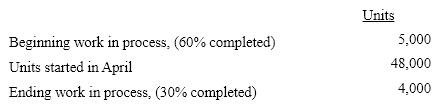 The number of equivalent units produced with respect to direct materials costs is
 (Multiple Choice)
4.8/5 (96)
(96) In a process costing system, the cost per equivalent unit is computed before computing equivalent units.
(True/False)
5.0/5 (80)
(80) Mocha Company manufactures a single product by a continuous process, involving three production departments. The records indicate that direct materials, direct labor, and applied factory overhead for Department 1 were $100,000, $125,000, and $150,000, respectively. The records further indicate that direct materials, direct labor, and applied factory overhead for Department 2 were $55,000, $65,000, and $80,000, respectively. In addition, work in process at the beginning of the period for Department 1 totaled $75,000, and work in process at the end of the period totaled $60,000.
The journal entry to record the flow of costs into Department 2 for direct labor is
(Multiple Choice)
4.9/5 (83)
(83) Department R had 5,000 units in work in process that were 75% completed as to labor and overhead at the beginning of the period; 30,000 units of direct materials were added during the period; 32,000 units were completed during the period; and 3,000 units were 40% completed as to labor and overhead at the end of the period. All materials are added at the beginning of the process. The first-in, first-out method is used to cost inventories. The number of equivalent units of production for conversion costs for the period was
(Multiple Choice)
4.8/5 (70)
(70) Department A had 5,000 units in work in process that were 60% completed as to labor and overhead at the beginning of the period; 34,000 units of direct materials were added during the period; 31,000 units were completed during the period; and 2,000 units were 80% completed as to labor and overhead at the end of the period. All materials are added at the beginning of the process. The first-in, first-out method is used to cost inventories.
The number of equivalent units of production for material costs for the period was
(Multiple Choice)
4.8/5 (73)
(73) The debits to Work in Process-Assembly Department for April, together with data concerning production, are as follows: 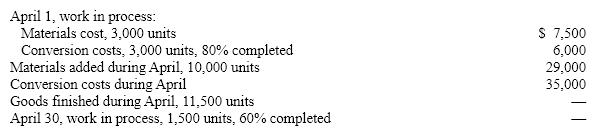 All direct materials are placed in process at the beginning of the process and the average cost method is used to cost inventories.
The conversion cost per equivalent unit (to the nearest cent) for April is:
All direct materials are placed in process at the beginning of the process and the average cost method is used to cost inventories.
The conversion cost per equivalent unit (to the nearest cent) for April is: (Multiple Choice)
4.8/5 (80)
(80) A form prepared periodically for each processing department summarizing the units for which the department is accountable and the units to be assigned costs and the costs charged to the department and the allocation of these costs is termed a
(Multiple Choice)
4.9/5 (87)
(87) Department E had 4,000 units in Work in Process that were 40% completed at the beginning of the period at a cost of $12,500. 14,000 units of direct materials were added during the period at a cost of $28,700. 15,000 units were completed during the period, and 3,000 units were 75% completed at the end of the period. All materials are added at the beginning of the process. Direct labor was $32,450 and factory overhead was $18,710.
The number of equivalent units of production for the period for materials if the average cost method is used to cost inventories was
(Multiple Choice)
4.7/5 (96)
(96) Department W had 2,400 units, one-third completed at the beginning of the period; 16,000 units were transferred to Department X from Department W during the period; and 1,800 units were one-half completed at the end of the period. Assume the completion ratios apply to direct materials and conversion costs.
What is the total number of units to be assigned cost on the cost of production report for Department W?
(Multiple Choice)
4.9/5 (77)
(77) In a process costing system, costs flow into finished goods inventory only from the work in process inventory of the last manufacturing process.
(True/False)
4.8/5 (66)
(66) Once equivalent units are calculated for materials, this number will also be used for direct labor and factory overhead.
(True/False)
4.8/5 (73)
(73) If the products of a manufacturing process are produced to customer specifications, a process cost system is more appropriate than a job order cost system.
(True/False)
4.8/5 (72)
(72) Process and job order cost systems are similar in all of the following ways except
(Multiple Choice)
4.8/5 (83)
(83) Department A had 5,000 units in work in process that were 60% completed as to labor and overhead at the beginning of the period; 34,000 units of direct materials were added during the period; 31,000 units were completed during the period; and 2,000 units were 80% completed as to labor and overhead at the end of the period. All materials are added at the beginning of the process. The first-in, first-out method is used to cost inventories.
The number of equivalent units of production for conversion costs for the period was
(Multiple Choice)
4.9/5 (86)
(86) If the costs for direct materials, direct labor, and factory overhead were $277,300, $52,600, and $61,000, respectively, for 14,000 equivalent units of production, the total conversion cost was $390,900.
(True/False)
4.8/5 (86)
(86) 
Filters
- Essay(0)
- Multiple Choice(0)
- Short Answer(0)
- True False(0)
- Matching(0)