



 Chat with AI
Exam 18: Gaining From International Trade

Exam 1: The Economic Approach185 Questions
Exam 2: Some Tools of the Economist204 Questions
Exam 3: Demand, Supply, and the Market Process339 Questions
Exam 4: Supply and Demand: Applications and Extensions268 Questions
Exam 5: Difficult Cases for the Market, and the Role of Government134 Questions
Exam 6: The Economics of Political Action161 Questions
Exam 7: Taking the Nations Economic Pulse222 Questions
Exam 8: Economic Fluctuations, Unemployment, and Inflation182 Questions
Exam 9: An Introduction to Basic Macroeconomic Markets219 Questions
Exam 10: Dynamic Change, Economic Fluctuations, and the Ad--As Model193 Questions
Exam 11: Fiscal Policy: The Keynesian View and the Historical Development of Macroeconomics112 Questions
Exam 12: Fiscal Policy: Incentives, and Secondary Effects154 Questions
Exam 13: Money and the Banking System198 Questions
Exam 14: Modern Macroeconomics and Monetary Policy204 Questions
Exam 15: Stabilization Policy, Output, and Employment170 Questions
Exam 16: Creating an Environment for Growth and Prosperity125 Questions
Exam 17: Institutions, Policies, and Cross-Country Differences in Income and Growth115 Questions
Exam 18: Gaining From International Trade182 Questions
Exam 19: International Finance and the Foreign Exchange Market148 Questions
Exam 20: Special Topics274 Questions
Select questions type


According to international trade theory, a country can gain if it
(Multiple Choice)
5.0/5  (68)
(68) Compared to the no-trade situation, when a country imports a good,
(Multiple Choice)
4.7/5 (63)
(63) International trade is advantageous because trade makes it possible for people in each country to
(Multiple Choice)
4.8/5 (60)
(60) In recent years, the largest trading partners of the United States have been
(Multiple Choice)
4.8/5 (90)
(90) Figure 17-5 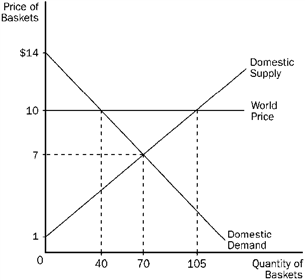 Refer to Figure 17-5. If this country chooses to trade, the price of baskets in this country will be
 (Multiple Choice)
4.8/5 (81)
(81) The main problem with using the infant industries argument to justify protecting an industry from foreign competition is that
(Multiple Choice)
4.9/5 (72)
(72) Figure 17-13 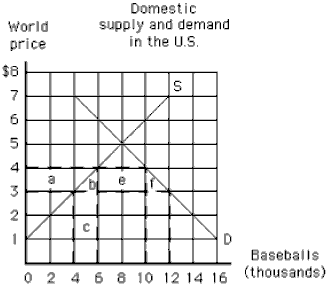 In Figure 17-13, if the world price of a baseball is $3 and a tariff of $1 per baseball is imposed in the United States, which area represents the amount of tariff revenue the United States government collects?
 (Multiple Choice)
4.8/5 (90)
(90) Each trading nation can gain by specializing in producing those things for which it is a low-opportunity cost producer. This statement best describes the implications of the
(Multiple Choice)
4.9/5 (87)
(87) Figure 17-5 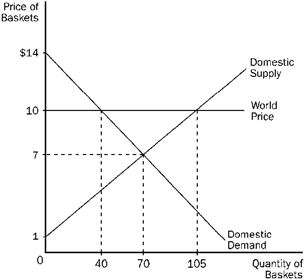 Refer to Figure 17-5. With free trade, this country will
 (Multiple Choice)
4.8/5 (77)
(77) During the last several decades, the size of the trade sector (exports plus imports) of the United States has been
(Multiple Choice)
4.9/5 (80)
(80) Relative to a no-trade situation, if the United States imported jeans, the U.S. domestic price of jeans would
(Multiple Choice)
4.7/5 (85)
(85) In 1993 the negotiations over the North American Free Trade Agreement and the General Agreement on Tariffs and Trade were frequently characterized by comments such as, "Free trade with low-wage countries will cause the wages of U.S. workers to fall." Identify the errors in statements such as this.
(Essay)
4.9/5 (87)
(87) Figure 17-6 The domestic country is China.
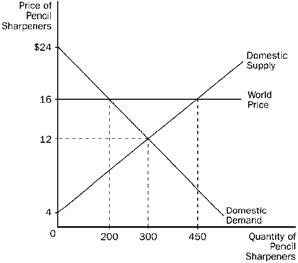 Refer to Figure 17-6. With trade, China will
 (Multiple Choice)
4.7/5 (65)
(65) Trade restrictions that limit the sale of low-price foreign goods in the U.S. market
(Multiple Choice)
4.8/5 (90)
(90) A decrease in the tariff on foreign-produced automobiles would be most likely to harm
(Multiple Choice)
4.9/5 (81)
(81) Figure 17-13 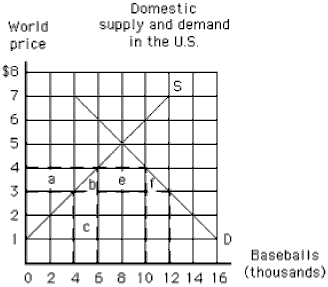 In Figure 17-13, the world price of a baseball is $3. With free trade, how many baseballs will the United States import?
 (Multiple Choice)
4.9/5 (91)
(91) When the nation of Venezia allows trade and as a result becomes an exporter of shoes,
(Multiple Choice)
4.7/5 (72)
(72) Figure 17-10 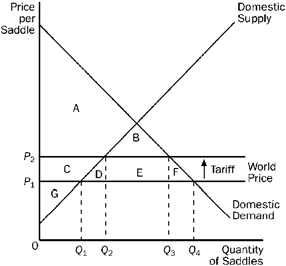 Refer to Figure 17-10. As a result of the tariff, there is a deadweight loss that amounts to
 (Multiple Choice)
4.9/5 (98)
(98) According to public choice theory, tariffs, quotas, and other trade restrictions are primarily the result of the
(Multiple Choice)
4.8/5 (80)
(80) 
Filters
- Essay(0)
- Multiple Choice(0)
- Short Answer(0)
- True False(0)
- Matching(0)