



 Chat with AI
Exam 18: Gaining From International Trade

Exam 1: The Economic Approach185 Questions
Exam 2: Some Tools of the Economist204 Questions
Exam 3: Demand, Supply, and the Market Process339 Questions
Exam 4: Supply and Demand: Applications and Extensions268 Questions
Exam 5: Difficult Cases for the Market, and the Role of Government134 Questions
Exam 6: The Economics of Political Action161 Questions
Exam 7: Taking the Nations Economic Pulse222 Questions
Exam 8: Economic Fluctuations, Unemployment, and Inflation182 Questions
Exam 9: An Introduction to Basic Macroeconomic Markets219 Questions
Exam 10: Dynamic Change, Economic Fluctuations, and the Ad--As Model193 Questions
Exam 11: Fiscal Policy: The Keynesian View and the Historical Development of Macroeconomics112 Questions
Exam 12: Fiscal Policy: Incentives, and Secondary Effects154 Questions
Exam 13: Money and the Banking System198 Questions
Exam 14: Modern Macroeconomics and Monetary Policy204 Questions
Exam 15: Stabilization Policy, Output, and Employment170 Questions
Exam 16: Creating an Environment for Growth and Prosperity125 Questions
Exam 17: Institutions, Policies, and Cross-Country Differences in Income and Growth115 Questions
Exam 18: Gaining From International Trade182 Questions
Exam 19: International Finance and the Foreign Exchange Market148 Questions
Exam 20: Special Topics274 Questions
Select questions type


Figure 17-10 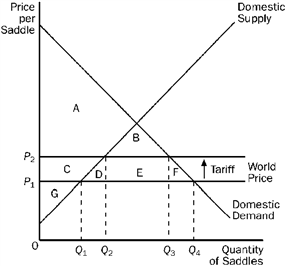 Refer to Figure 17-10. Producer surplus with trade and without a tariff is
 (Multiple Choice)
4.7/5  (88)
(88) Assume, for the U.S., that the domestic price of beef without international trade is lower than the world price of beef. This suggests that with trade,
(Multiple Choice)
4.8/5 (88)
(88) If a country allows trade and, for a certain good, the domestic price without trade is lower than the world price,
(Multiple Choice)
5.0/5 (68)
(68) Figure 17-6 The domestic country is China.
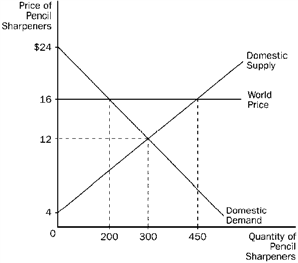 Refer to Figure 17-6. If China were to abandon a no-trade policy in favor of a free-trade policy,
 (Multiple Choice)
5.0/5 (83)
(83) Data on trade barriers, income levels, and the growth of per capita GDP indicate that
(Multiple Choice)
4.9/5 (82)
(82) Figure 17-10 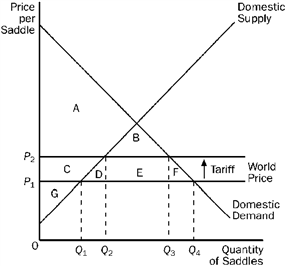 Refer to Figure 17-10. The amount of government revenue created by the tariff is
 (Multiple Choice)
4.9/5 (80)
(80) Figure 17-12 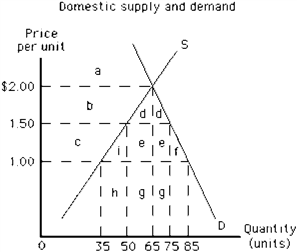 If the country illustrated in Figure 17-12 is initially trading without restrictions at a world price of $1.00, the gain in producer surplus as a result of a tariff of $0.50 per unit is represented by area
 (Multiple Choice)
4.8/5 (99)
(99) If the U.S. put an import quota on clothes dryers, it would
(Multiple Choice)
4.8/5 (78)
(78) Which of the following would be expected if the tariff on foreign-produced shoes were decreased?
(Multiple Choice)
4.9/5 (96)
(96) Figure 17-13 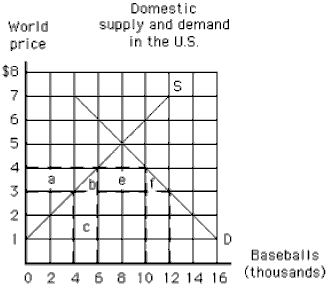 Figure 17-13 shows domestic supply and demand for baseballs in the United States. The world price of a baseball is $3. With free trade, how many baseballs will be purchased in the United States?
 (Multiple Choice)
4.9/5 (84)
(84) At one time, it was believed that the way for a nation to prosper was to export as much as possible while importing as little as possible. More money would flow into a country than out of a country. Is this really a sound economic strategy? What is the relationship between exports and imports?
(Essay)
5.0/5 (82)
(82) Which of the following has resulted from the North American Free Trade Agreement (NAFTA)?
(Multiple Choice)
4.8/5 (87)
(87) If Country A has an absolute advantage over Country B in the production of every commodity,
(Multiple Choice)
4.8/5 (87)
(87) "Economists have demonstrated that imports benefit consumers while causing losses to producers, and exports benefit producers while causing losses to consumers. In the balance then, international trade neither benefits nor hurts a nation as a whole." Evaluate this statement.
(Essay)
4.8/5 (77)
(77) Which of the following has occurred since the North American Free Trade Agreement (NAFTA) took affect in 1994?
(Multiple Choice)
4.9/5 (93)
(93) An increase in the tariff on foreign-produced automobiles would most likely help
(Multiple Choice)
4.8/5 (81)
(81) Globalization is becoming more of a worldwide phenomenon because
(Multiple Choice)
4.8/5 (99)
(99) Compared to the no-trade situation, when a country exports a good,
(Multiple Choice)
4.9/5 (75)
(75) 
Filters
- Essay(0)
- Multiple Choice(0)
- Short Answer(0)
- True False(0)
- Matching(0)