



 Chat with AI
Exam 18: Gaining From International Trade

Exam 1: The Economic Approach185 Questions
Exam 2: Some Tools of the Economist204 Questions
Exam 3: Demand, Supply, and the Market Process339 Questions
Exam 4: Supply and Demand: Applications and Extensions268 Questions
Exam 5: Difficult Cases for the Market, and the Role of Government134 Questions
Exam 6: The Economics of Political Action161 Questions
Exam 7: Taking the Nations Economic Pulse222 Questions
Exam 8: Economic Fluctuations, Unemployment, and Inflation182 Questions
Exam 9: An Introduction to Basic Macroeconomic Markets219 Questions
Exam 10: Dynamic Change, Economic Fluctuations, and the Ad--As Model193 Questions
Exam 11: Fiscal Policy: The Keynesian View and the Historical Development of Macroeconomics112 Questions
Exam 12: Fiscal Policy: Incentives, and Secondary Effects154 Questions
Exam 13: Money and the Banking System198 Questions
Exam 14: Modern Macroeconomics and Monetary Policy204 Questions
Exam 15: Stabilization Policy, Output, and Employment170 Questions
Exam 16: Creating an Environment for Growth and Prosperity125 Questions
Exam 17: Institutions, Policies, and Cross-Country Differences in Income and Growth115 Questions
Exam 18: Gaining From International Trade182 Questions
Exam 19: International Finance and the Foreign Exchange Market148 Questions
Exam 20: Special Topics274 Questions
Select questions type


When a country fixes the price of foreign exchange (in terms of the domestic currency) below equilibrium, which of the following will result?
(Multiple Choice)
4.9/5  (81)
(81) Which of the following is a partially valid economic argument for restricting free trade?
(Multiple Choice)
4.9/5 (72)
(72) Figure 17-13 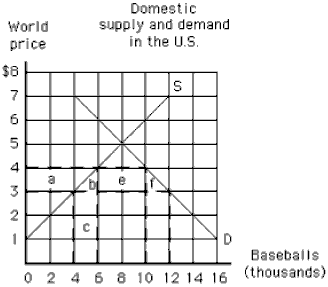 In Figure 17-13, if the world price of a baseball is $3 and a tariff of $1 per baseball is imposed in the United States, how much tariff revenue will the United States government collect?
 (Multiple Choice)
4.8/5 (65)
(65) When a country allows trade and becomes an importer of steel,
(Multiple Choice)
4.8/5 (74)
(74) As the result of specialization and trade, according to the law of comparative advantage, total output will
(Multiple Choice)
4.8/5 (89)
(89) Nevada is the low opportunity cost producer of computer software, and California is low opportunity cost producer of wine. Which of the following is true?
(Multiple Choice)
4.9/5 (73)
(73) Suppose the lowest-wage state in the United States is West Virginia and the highest-wage state is New York. Which of the following would be true?
(Multiple Choice)
4.8/5 (70)
(70) The figure below illustrates a tariff. On the graph, Q represents quantity and P represents price. Figure 17-11
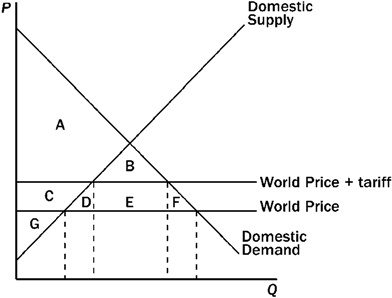 Refer to Figure 17-11. The deadweight loss created by the tariff is represented by the area
 (Multiple Choice)
4.7/5 (73)
(73) The theory of comparative advantage suggests that nations should produce a good if they
(Multiple Choice)
4.9/5 (78)
(78) Figure 17-2 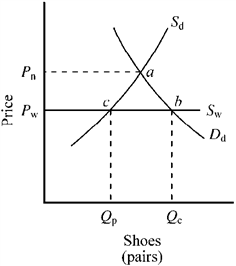
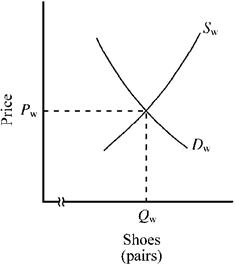 In Figure 17-2, in the absence of trade, the domestic price of shoes is Pn. Since many foreign countries have a comparative advantage in the production of shoes, when the United States begins to trade, the domestic price will fall to the world price. When this happens, what does the quantity Qc through Qp represent?
 (Multiple Choice)
4.9/5 (83)
(83) Figure 17-8 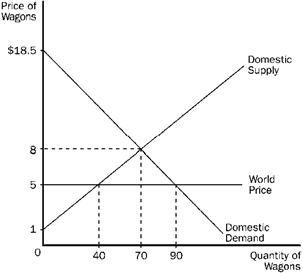 Refer to Figure 17-8. If this country allows free trade in wagons,
 (Multiple Choice)
4.9/5 (82)
(82) Public choice theory indicates that tariffs, quotas, and other trade restrictions are primarily the result of the
(Multiple Choice)
5.0/5 (90)
(90) The figure below illustrates a tariff. On the graph, Q represents quantity and P represents price. Figure 17-11
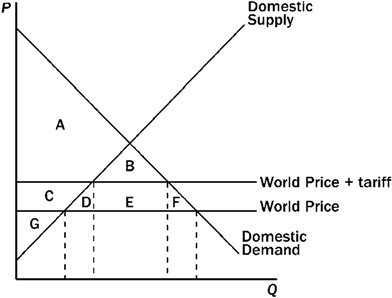 Refer to Figure 17-11. The tariff
 (Multiple Choice)
4.8/5 (68)
(68) A major difference between a tariff and a quota is that a tariff
(Multiple Choice)
4.9/5 (91)
(91) Compared to the no-trade situation, if the United States imports video games,
(Multiple Choice)
5.0/5 (97)
(97) The United States is the world's leading grain-producing nation. Exporting U.S. grain causes the
(Multiple Choice)
4.8/5 (74)
(74) For each watch Denmark produces, it gives up the opportunity to make 50 pounds of cheese. Germany can produce one watch for every 100 pounds of cheese it produces. Which of the following is true with regard to opportunity costs in the two countries?
(Multiple Choice)
4.7/5 (64)
(64) Opening trade between a nation that has "cheap labor" and one that has "expensive labor" will
(Multiple Choice)
4.8/5 (78)
(78) Which of the following would be expected if the tariff on foreign-produced automobiles were increased?
(Multiple Choice)
4.9/5 (71)
(71) 
Filters
- Essay(0)
- Multiple Choice(0)
- Short Answer(0)
- True False(0)
- Matching(0)