



 Chat with AI
Exam 18: Gaining From International Trade

Exam 1: The Economic Approach185 Questions
Exam 2: Some Tools of the Economist204 Questions
Exam 3: Demand, Supply, and the Market Process339 Questions
Exam 4: Supply and Demand: Applications and Extensions268 Questions
Exam 5: Difficult Cases for the Market, and the Role of Government134 Questions
Exam 6: The Economics of Political Action161 Questions
Exam 7: Taking the Nations Economic Pulse222 Questions
Exam 8: Economic Fluctuations, Unemployment, and Inflation182 Questions
Exam 9: An Introduction to Basic Macroeconomic Markets219 Questions
Exam 10: Dynamic Change, Economic Fluctuations, and the Ad--As Model193 Questions
Exam 11: Fiscal Policy: The Keynesian View and the Historical Development of Macroeconomics112 Questions
Exam 12: Fiscal Policy: Incentives, and Secondary Effects154 Questions
Exam 13: Money and the Banking System198 Questions
Exam 14: Modern Macroeconomics and Monetary Policy204 Questions
Exam 15: Stabilization Policy, Output, and Employment170 Questions
Exam 16: Creating an Environment for Growth and Prosperity125 Questions
Exam 17: Institutions, Policies, and Cross-Country Differences in Income and Growth115 Questions
Exam 18: Gaining From International Trade182 Questions
Exam 19: International Finance and the Foreign Exchange Market148 Questions
Exam 20: Special Topics274 Questions
Select questions type


People living in different countries can benefit from international trade because
(Multiple Choice)
4.8/5  (76)
(76) "Trade restrictions will stop foreign imports, which will increase American employment and protect American jobs." Most economists realize this argument is wrong. Can you explain why?
(Essay)
5.0/5 (75)
(75) Figure 17-8 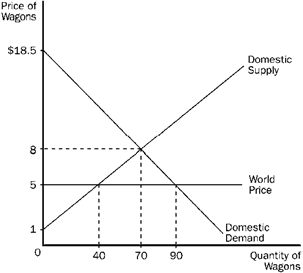 Refer to Figure 17-8. If this country allows free trade in wagons,
 (Multiple Choice)
4.7/5 (83)
(83) Figure 17-3 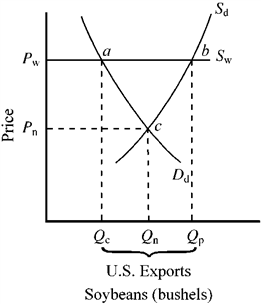
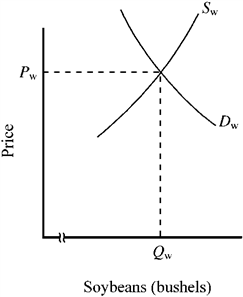 In Figure 17-3, in the absence of trade, the domestic price of soybeans is Pn. If the world price of soybeans is Pw, which of the following will occur when the United States begins to trade internationally?
 (Multiple Choice)
4.9/5 (81)
(81) Relative to a no-trade situation, if the United States exported chairs, the domestic price of chairs
(Multiple Choice)
4.8/5 (78)
(78) Figure 17-9 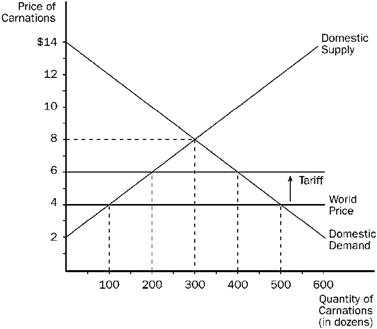 Refer to Figure 17-9. Without trade, the equilibrium price of carnations is
 (Multiple Choice)
5.0/5 (86)
(86) When a country allows trade and becomes an exporter of a good,
(Multiple Choice)
4.7/5 (72)
(72) If domestic producers have a comparative advantage in producing a good,
(Multiple Choice)
5.0/5 (84)
(84) If a country allows trade and, for a certain good, the domestic price without trade is higher than the world price,
(Multiple Choice)
4.8/5 (73)
(73) In 2002, President Bush enacted a 30 percent tariff on imported steel. The primary beneficiaries of this tariff were
(Multiple Choice)
4.8/5 (71)
(71) 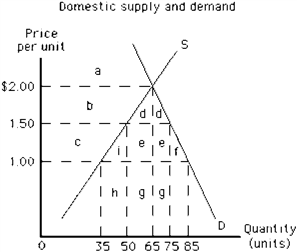 At a world price of $1.00 in Figure 17-12,
Use the table below to answer the following question. The table outlines the production possibilities of Slavia and Italia for food and clothing.  The law of comparative advantage suggests that
 (Multiple Choice)
5.0/5 (76)
(76) Figure 17-12 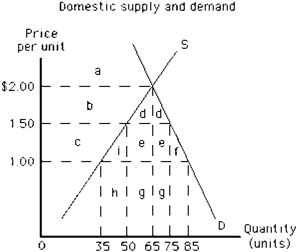 If the country illustrated in Figure 17-12 is initially trading without restrictions at a world price of $1.00, the loss of consumer surplus as a result of a tariff of $0.50 per unit is represented by area
 (Multiple Choice)
4.9/5 (88)
(88) The agreement of the United States, Canada, and Mexico to eliminate tariffs on the shipment of most products among the three countries is called the
(Multiple Choice)
4.9/5 (88)
(88) Suppose the United States levies a tariff, t, on automobiles. Which of the following correctly describes the effect on the tariff?
(Multiple Choice)
4.7/5 (72)
(72) What are the effects of a tariff, and who benefits and who loses when tariffs are imposed? What are the effects of a quota, and who benefits and who loses when quotas are imposed?
(Essay)
4.8/5 (60)
(60) 
Filters
- Essay(0)
- Multiple Choice(0)
- Short Answer(0)
- True False(0)
- Matching(0)