



 Chat with AI
Exam 14: Modern Macroeconomics and Monetary Policy

Exam 1: The Economic Approach185 Questions
Exam 2: Some Tools of the Economist204 Questions
Exam 3: Demand, Supply, and the Market Process339 Questions
Exam 4: Supply and Demand: Applications and Extensions268 Questions
Exam 5: Difficult Cases for the Market, and the Role of Government134 Questions
Exam 6: The Economics of Political Action161 Questions
Exam 7: Taking the Nations Economic Pulse222 Questions
Exam 8: Economic Fluctuations, Unemployment, and Inflation182 Questions
Exam 9: An Introduction to Basic Macroeconomic Markets219 Questions
Exam 10: Dynamic Change, Economic Fluctuations, and the Ad--As Model193 Questions
Exam 11: Fiscal Policy: The Keynesian View and the Historical Development of Macroeconomics112 Questions
Exam 12: Fiscal Policy: Incentives, and Secondary Effects154 Questions
Exam 13: Money and the Banking System198 Questions
Exam 14: Modern Macroeconomics and Monetary Policy204 Questions
Exam 15: Stabilization Policy, Output, and Employment170 Questions
Exam 16: Creating an Environment for Growth and Prosperity125 Questions
Exam 17: Institutions, Policies, and Cross-Country Differences in Income and Growth115 Questions
Exam 18: Gaining From International Trade182 Questions
Exam 19: International Finance and the Foreign Exchange Market148 Questions
Exam 20: Special Topics274 Questions
Select questions type


Why will it difficult for the Fed to use monetary policy to direct the economy back to full employment and price stability from the recession of 2008-2009?
(Multiple Choice)
5.0/5  (72)
(72) Which of the following developments will most likely lead to an increase in the velocity of money?
(Multiple Choice)
4.9/5 (69)
(69) 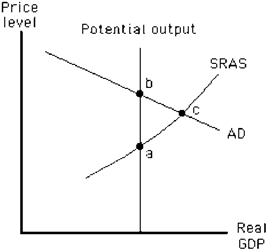 In Figure 14-7, short-run equilibrium occurs
Which of the following contributed to the dramatic rise in housing prices between 2002 and mid-year 2006?
(Multiple Choice)
4.8/5 (87)
(87) Comparisons of the link between the growth of the money supply and inflation indicate that
(Multiple Choice)
4.9/5 (89)
(89) The short run sequence of events following an unanticipated shift to a more expansionary monetary policy would be lower interest rates followed by dollar
(Multiple Choice)
4.9/5 (92)
(92) Suppose the velocity of money is 8, the amount of money in circulation is $200 billion, the index of prices is 150, and real GDP is $10 billion. According to the strict quantity theory of money, if the money supply doubled to $400 billion,
(Multiple Choice)
4.8/5 (70)
(70) An expansionary monetary policy is most likely to increase real output
(Multiple Choice)
4.9/5 (69)
(69) A study of countries with high inflation rates indicates that the inflation is generally
(Multiple Choice)
4.9/5 (67)
(67) Empirical studies indicate that the velocity of money tends to increase when interest rates rise. Which of the following best explains why this is true?
(Multiple Choice)
4.8/5 (81)
(81) When the Fed increases the money supply by buying Treasury securities, it will
(Multiple Choice)
4.8/5 (83)
(83) Starting from an initial long-run equilibrium, an unanticipated shift to a more expansionary monetary policy would tend to increase
(Multiple Choice)
4.9/5 (79)
(79) Other things being equal, an increase in the rate of interest causes
(Multiple Choice)
4.7/5 (84)
(84) Which of the following contributed to the financial crisis of 2008?
(Multiple Choice)
4.9/5 (91)
(91) If changes in monetary policy are going to help stabilize the economy, they must
(Multiple Choice)
4.8/5 (61)
(61) Which of the following reduced the demand stimulus effects of the Fed's low interest rate policy pursued during, and after, the financial crisis of 2008-2009?
(Multiple Choice)
4.8/5 (74)
(74) What happens to the aggregate demand curve when the Fed reduces the money supply?
(Multiple Choice)
4.9/5 (80)
(80) 
Filters
- Essay(0)
- Multiple Choice(0)
- Short Answer(0)
- True False(0)
- Matching(0)