



 Chat with AI
Exam 14: Modern Macroeconomics and Monetary Policy

Exam 1: The Economic Approach185 Questions
Exam 2: Some Tools of the Economist204 Questions
Exam 3: Demand, Supply, and the Market Process339 Questions
Exam 4: Supply and Demand: Applications and Extensions268 Questions
Exam 5: Difficult Cases for the Market, and the Role of Government134 Questions
Exam 6: The Economics of Political Action161 Questions
Exam 7: Taking the Nations Economic Pulse222 Questions
Exam 8: Economic Fluctuations, Unemployment, and Inflation182 Questions
Exam 9: An Introduction to Basic Macroeconomic Markets219 Questions
Exam 10: Dynamic Change, Economic Fluctuations, and the Ad--As Model193 Questions
Exam 11: Fiscal Policy: The Keynesian View and the Historical Development of Macroeconomics112 Questions
Exam 12: Fiscal Policy: Incentives, and Secondary Effects154 Questions
Exam 13: Money and the Banking System198 Questions
Exam 14: Modern Macroeconomics and Monetary Policy204 Questions
Exam 15: Stabilization Policy, Output, and Employment170 Questions
Exam 16: Creating an Environment for Growth and Prosperity125 Questions
Exam 17: Institutions, Policies, and Cross-Country Differences in Income and Growth115 Questions
Exam 18: Gaining From International Trade182 Questions
Exam 19: International Finance and the Foreign Exchange Market148 Questions
Exam 20: Special Topics274 Questions
Select questions type


The short run sequence of events following an unanticipated shift to a more expansionary monetary policy would be
(Multiple Choice)
4.9/5  (89)
(89) Which of the following reduced the effectiveness of the Fed's low interest rate policy during the aftermath of the 2008-2009 recession?
(Multiple Choice)
4.8/5 (74)
(74) In the aggregate demand-aggregate supply model, the short-run effects of an unanticipated increase in the money supply will be
(Multiple Choice)
4.9/5 (87)
(87) According to the monetarists, what is the primary cause of a recession? Explain the steps by which reductions in the money supply lead to reductions in real output.
(Essay)
4.9/5 (67)
(67) Suppose the velocity of money is 6, the amount of money in circulation is $600 billion, the index of prices is 180, and real GDP is $20 billion. According to the strict quantity theory of money, if the money supply decreased to $300 billion,
(Multiple Choice)
4.7/5 (76)
(76) Which of the following correctly indicates a potential path for the transmission of expansionary monetary policy to the goods and services market?
(Multiple Choice)
4.9/5 (89)
(89) When the Fed unexpectedly increases the money supply, it will cause an increase in aggregate demand because
(Multiple Choice)
4.8/5 (70)
(70) According to monetarists, which of the following would be most important for the control of inflation?
(Multiple Choice)
4.9/5 (82)
(82) In response to a severe recession, the Fed more than doubled the monetary base and pushed short-term interest rates to near zero during 2009-2010. What happened in 2011?
(Multiple Choice)
4.7/5 (65)
(65) If the amount of money in circulation is $50 billion and the nominal GDP is $200 billion, the velocity of money is
(Multiple Choice)
4.7/5 (88)
(88) If the Fed unexpectedly decreases the money supply, real GDP
(Multiple Choice)
4.7/5 (76)
(76) If the amount of money in circulation is $400 billion and the nominal GDP is $800 billion, the velocity of money is
(Multiple Choice)
4.7/5 (68)
(68) Figure 14-6 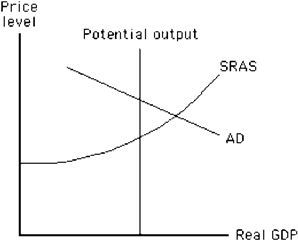 In the situation shown in Figure 14-6, how could the Fed return the economy to potential output?
 (Multiple Choice)
4.9/5 (82)
(82) Figure 14-8 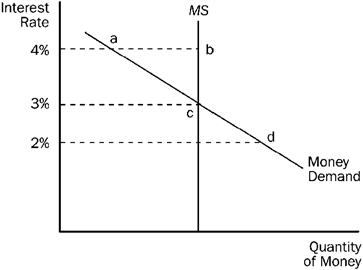 Refer to Figure 14-8. At an interest rate of 4 percent there is excess
 (Multiple Choice)
4.7/5 (70)
(70) Which of the following is true of home mortgage loans since the late 1990s?
(Multiple Choice)
4.9/5 (86)
(86) Countries that persistently expand the supply of money at a rapid rate can expect to experience
(Multiple Choice)
5.0/5 (79)
(79) If the Fed wanted to shift to a more restrictive monetary policy, it would
(Multiple Choice)
4.8/5 (70)
(70) 
Filters
- Essay(0)
- Multiple Choice(0)
- Short Answer(0)
- True False(0)
- Matching(0)