



 Chat with AI
Exam 14: Modern Macroeconomics and Monetary Policy

Exam 1: The Economic Approach185 Questions
Exam 2: Some Tools of the Economist204 Questions
Exam 3: Demand, Supply, and the Market Process339 Questions
Exam 4: Supply and Demand: Applications and Extensions268 Questions
Exam 5: Difficult Cases for the Market, and the Role of Government134 Questions
Exam 6: The Economics of Political Action161 Questions
Exam 7: Taking the Nations Economic Pulse222 Questions
Exam 8: Economic Fluctuations, Unemployment, and Inflation182 Questions
Exam 9: An Introduction to Basic Macroeconomic Markets219 Questions
Exam 10: Dynamic Change, Economic Fluctuations, and the Ad--As Model193 Questions
Exam 11: Fiscal Policy: The Keynesian View and the Historical Development of Macroeconomics112 Questions
Exam 12: Fiscal Policy: Incentives, and Secondary Effects154 Questions
Exam 13: Money and the Banking System198 Questions
Exam 14: Modern Macroeconomics and Monetary Policy204 Questions
Exam 15: Stabilization Policy, Output, and Employment170 Questions
Exam 16: Creating an Environment for Growth and Prosperity125 Questions
Exam 17: Institutions, Policies, and Cross-Country Differences in Income and Growth115 Questions
Exam 18: Gaining From International Trade182 Questions
Exam 19: International Finance and the Foreign Exchange Market148 Questions
Exam 20: Special Topics274 Questions
Select questions type


Which of the following makes it more difficult for monetary policy makers to time policy changes correctly?
(Multiple Choice)
4.9/5  (66)
(66) Continuous rapid growth of the money supply relative to the growth of real output will most likely lead to
(Multiple Choice)
4.8/5 (73)
(73) Use the figure below to answer the following question(s). Figure 14-5
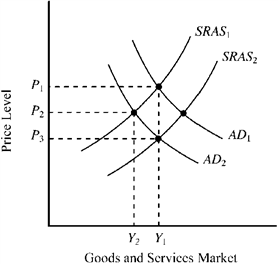 In Figure 14-5, AD1 and SRAS1 indicate an economy initially operating at full-employment output level, Y1. The long-run impact of the Fed unexpectedly shifting to a more restrictive monetary policy will be
 (Multiple Choice)
4.8/5 (82)
(82) During 2001-2004, the Fed injected additional reserves into the banking system, which reduced the federal funds rate and other short-term interest rates. Other things constant, what is the most likely short-run impact of this policy?
(Multiple Choice)
4.8/5 (77)
(77) If the Fed shifts to a more restrictive monetary policy in order to help control inflation, the policy shift will generally
(Multiple Choice)
4.8/5 (76)
(76) During 2008-2013, the Fed initiated several rounds of "quantitative easing." Under this policy, the Fed
(Multiple Choice)
4.7/5 (84)
(84) Which of the following would be most indicative of a shift to a more expansionary monetary policy?
(Multiple Choice)
4.7/5 (83)
(83) In 2008, nominal GDP was equal to $14,265 billion while the M1 money supply was $1,423 billion. What was the velocity of the M1 money stock?
(Multiple Choice)
4.8/5 (69)
(69) The short run sequence of events following an unanticipated shift to restrictive monetary policy would be higher interest rates followed by dollar
(Multiple Choice)
4.9/5 (83)
(83) Persistently expansionary monetary policy that stimulates aggregate demand and leads to inflation will
(Multiple Choice)
4.8/5 (82)
(82) Which of the following interest rates will be least affected by a shift in monetary policy that alters the money supply?
(Multiple Choice)
5.0/5 (75)
(75) Answer the following questions:
a.What is the equation of exchange? Explain each component.
b.What assumptions are placed on the equation of exchange to generate the quantity theory of money?
c.Explain the quantity theory of money and what it implies about the impact of changes in the money supply on real output and prices.
(Essay)
4.8/5 (66)
(66) Discuss the following views concerning the impact of monetary policy:
a.classicals
b.Keynesians
c.monetarists
d."modern view"
(Essay)
4.9/5 (72)
(72) Which of the following was true of the actions of the Federal Reserve in response to the recession of 2008?
(Multiple Choice)
4.8/5 (78)
(78) If expansionary monetary policy reduces real interest rates in the United States, which of the following is most likely to occur?
(Multiple Choice)
5.0/5 (90)
(90) According to modern analysis, what is the link between the long-run growth rate of the money supply and inflation?
(Multiple Choice)
4.9/5 (92)
(92) 
Filters
- Essay(0)
- Multiple Choice(0)
- Short Answer(0)
- True False(0)
- Matching(0)