



 Chat with AI
Exam 14: Modern Macroeconomics and Monetary Policy

Exam 1: The Economic Approach185 Questions
Exam 2: Some Tools of the Economist204 Questions
Exam 3: Demand, Supply, and the Market Process339 Questions
Exam 4: Supply and Demand: Applications and Extensions268 Questions
Exam 5: Difficult Cases for the Market, and the Role of Government134 Questions
Exam 6: The Economics of Political Action161 Questions
Exam 7: Taking the Nations Economic Pulse222 Questions
Exam 8: Economic Fluctuations, Unemployment, and Inflation182 Questions
Exam 9: An Introduction to Basic Macroeconomic Markets219 Questions
Exam 10: Dynamic Change, Economic Fluctuations, and the Ad--As Model193 Questions
Exam 11: Fiscal Policy: The Keynesian View and the Historical Development of Macroeconomics112 Questions
Exam 12: Fiscal Policy: Incentives, and Secondary Effects154 Questions
Exam 13: Money and the Banking System198 Questions
Exam 14: Modern Macroeconomics and Monetary Policy204 Questions
Exam 15: Stabilization Policy, Output, and Employment170 Questions
Exam 16: Creating an Environment for Growth and Prosperity125 Questions
Exam 17: Institutions, Policies, and Cross-Country Differences in Income and Growth115 Questions
Exam 18: Gaining From International Trade182 Questions
Exam 19: International Finance and the Foreign Exchange Market148 Questions
Exam 20: Special Topics274 Questions
Select questions type


The coefficient that represents the average number of times a dollar is used to buy goods and services is called
(Multiple Choice)
4.9/5  (72)
(72) Which of the following reduced the demand stimulus effects of the Fed's low interest rate policy pursued during, and after, the financial crisis of 2008-2009?
(Multiple Choice)
4.9/5 (74)
(74) Alan Greenspan and Ben Bernanke, former chairmen of the Fed's Board of Governors, believe that the low interest rates of 2003-2014 were primarily the result of
(Multiple Choice)
4.7/5 (78)
(78) In the long run, changes in the money supply affect only the price level because
(Multiple Choice)
4.8/5 (71)
(71) Since the mid-1980s, the primary indicator of monetary policy has been
(Multiple Choice)
4.9/5 (63)
(63) Which of the following is inconsistent with the view that Fed monetary policy was excessively expansionary during 2010-2013?
(Multiple Choice)
4.9/5 (79)
(79) When the Fed sells bonds and drains reserves from the banking system, thereby reducing the supply of money, this policy will
(Multiple Choice)
4.8/5 (83)
(83) In an economy in which real output grows at an average rate of 3 percent per year, a 7 percent average rate of growth in the money supply would result in
(Multiple Choice)
4.8/5 (68)
(68) Demographic changes that increase the number of people in the lending phase (for example, age 50 to 75) and reduce the number in the borrowing phase (under age 50), will
(Multiple Choice)
4.9/5 (79)
(79) If the Federal Reserve unexpectedly decides to sell bonds, which of the following will most likely happen in the short run?
(Multiple Choice)
4.9/5 (71)
(71) When continued for several years, rapid growth in the money supply relative to the growth of real output will likely lead to an extended period of
(Multiple Choice)
5.0/5 (73)
(73) Figure 14-3 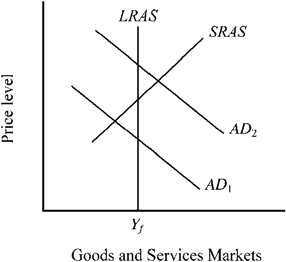 Suppose the economy was currently operating at SRAS and AD2 in Figure 14-3. To combat inflation, the Fed institutes restrictive monetary policy. Suppose that by the time the policy impacts the economy, AD has already moved to AD1. Which of the following would be true?
 (Multiple Choice)
4.8/5 (62)
(62) In the short run, which of the following is the most likely effect of an unanticipated move to a more expansionary monetary policy?
(Multiple Choice)
4.9/5 (91)
(91) In an economy in which velocity is constant and real output grows at an average rate of 3 percent per year, a 5 percent average rate of growth in the money supply would result in a
(Multiple Choice)
4.8/5 (81)
(81) During the second half of 2008 the monetary base was growing far more rapidly than the money supply because
(Multiple Choice)
4.8/5 (88)
(88) 
Filters
- Essay(0)
- Multiple Choice(0)
- Short Answer(0)
- True False(0)
- Matching(0)