



 Chat with AI
Exam 8: Air Masses, Fronts, and Middle Latitude Cyclones

Exam 1: The Earths Atmosphere65 Questions
Exam 2: Warming the Earth and the Atmosphere65 Questions
Exam 3: Air Temperature65 Questions
Exam 4: Humidity, Condensation and Clouds65 Questions
Exam 5: Cloud Development and Precipitation65 Questions
Exam 6: Air Pressure and Winds65 Questions
Exam 7: Atmospheric Circulations65 Questions
Exam 8: Air Masses, Fronts, and Middle Latitude Cyclones65 Questions
Exam 9: Weather Forecasting65 Questions
Exam 10: Thunderstorms and Tornadoes65 Questions
Exam 11: Hurricanes65 Questions
Exam 12: Climate Change65 Questions
Exam 13: Global Climate65 Questions
Exam 14: Air Pollution65 Questions
Exam 15: Light, Color, and Atmospheric Optics65 Questions
Select questions type


Cold fronts that move into the U.S. from the east, or northeast, are called ____.
(Multiple Choice)
4.9/5  (84)
(84) Record breaking low temperatures are associated with which air mass?
(Multiple Choice)
4.9/5 (88)
(88) Because it is located at middle latitudes, the United States is only rarely affected by polar and tropical air masses.
(True/False)
4.7/5 (91)
(91) Generally, the greatest lake-effect snowfall in the Great Lakes region occurs on the ____ shores.
(Multiple Choice)
4.7/5 (80)
(80) Is it possible for a stationary front to produce precipitation? If so, explain the conditions in which precipitation is favorable.
(Essay)
4.9/5 (72)
(72) An air mass is characterized by similar properties of ____ and ____ in any horizontal direction at a given altitude.
(Multiple Choice)
4.9/5 (87)
(87) A stationary front does not move because winds on both sides of the front ____.
(Multiple Choice)
4.9/5 (79)
(79) The air pressure normally ____ before a cold front passes and ____ after the front passes.
(Multiple Choice)
4.8/5 (74)
(74) Air masses are large bodies of air whose properties of ____________________ and ____________________ are fairly similar in any horizontal direction at any given altitude.
(Short Answer)
4.9/5 (72)
(72) 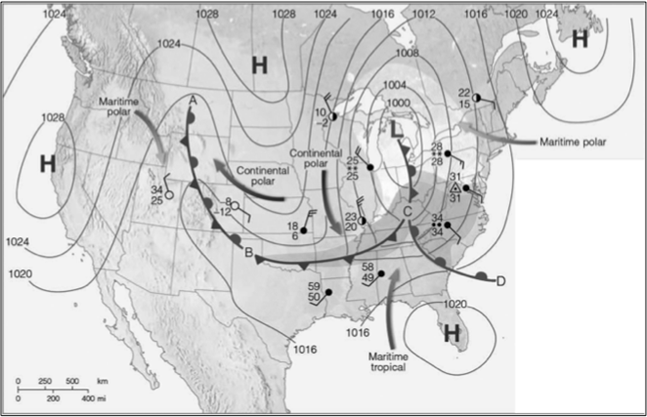 Using the weather map in the accompanying figure, provide the following information: (1) Identify the type of front between points A and B. Describe the weather surrounding the front. (2) Identify the type of front between points B and C. Describe the weather surrounding the front. (3) Show on the weather map where a "warm sector" would be located.
 (Essay)
4.9/5 (86)
(86) Cyclogenesis occurs frequently on the eastern slopes of the Rockies as a result of ____.
(Multiple Choice)
4.8/5 (79)
(79) If lows and highs aloft are directly above lows and high at the surface, ____.
(Multiple Choice)
4.9/5 (80)
(80) Describe or illustrate the various phases in the life cycle of a mid-latitude cyclonic storm in the Northern Hemisphere according to the polar front theory.
(Essay)
4.9/5 (77)
(77) Some mid-latitude cyclones may have calm winds at their center, similar to a hurricane's "eye".
(True/False)
4.9/5 (94)
(94) Instructions: Choose one answer from each pair of selections. Would you expect a city to the EAST or WEST of the Appalachian Mountains to experience colder temperatures after a continental polar air mass has passed?
(Short Answer)
4.8/5 (79)
(79) Lake-effect snows are best developed around the Great Lakes during ____.
(Multiple Choice)
4.8/5 (88)
(88) 
Filters
- Essay(0)
- Multiple Choice(0)
- Short Answer(0)
- True False(0)
- Matching(0)