



 Chat with AI
Exam 8: Assessment of Pulmonary Function

Exam 1: Basic Physics for the Respiratory Therapist107 Questions
Exam 2: Principles of Infection Control95 Questions
Exam 3: Manufacture, Storage, and Transport of Medical Gases101 Questions
Exam 4: Administering Medical Gases: Regulators, Flowmeters, and97 Questions
Exam 5: Airway Management Devices and Advanced Cardiac Life Support70 Questions
Exam 6: Humidity and Aerosol Therapy88 Questions
Exam 7: Lung Expansion Therapy Devices57 Questions
Exam 8: Assessment of Pulmonary Function120 Questions
Exam 9: Assessment of Cardiovascular Function77 Questions
Exam 10: Blood Gas Monitoring96 Questions
Exam 11: Sleep Diagnostics37 Questions
Exam 12: Introduction to Ventilators107 Questions
Exam 13: Mechanical Ventilators: General-Use Devices45 Questions
Exam 14: Infant and Pediatric Devices96 Questions
Exam 15: Transport, Home Care, and Noninvasive Ventilatory Devices52 Questions
Select questions type


Capnography is widely used to determine:

Free
(Multiple Choice)
4.8/5  (71)
(71) Correct Answer: Verified
C
What is the pressure reading on the anemometer of a ventilator during an inspiratory hold maneuver?
Free
(Multiple Choice)
4.8/5 (82)
(82) Correct Answer:Verified
VerifiedA
What is the volume displacement when the pen of a 13.5-L water-sealed spirometer moves 28 mm?
Free
(Multiple Choice)
4.9/5 (85)
(85) Correct Answer:Verified
VerifiedD
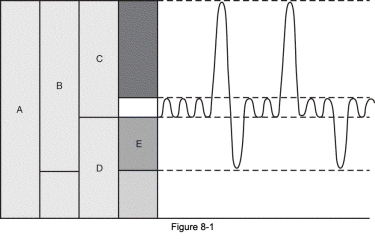
One type of ventilatory pattern necessary for calculating functional residual capacity through the use of a body plethysmograph is:
(Multiple Choice)
4.9/5 (67)
(67) 
Which of the measurements shown in the figure is obtained by using body plethysmography?
(Multiple Choice)
4.8/5 (77)
(77) When a patient inhales while connected to a water-sealed spirometer,the bell moves _____ and the pen moves _____.
(Multiple Choice)
4.8/5 (83)
(83) The rotating motor-driven drum used to document the bell movement of a water-sealed spirometer is known as which of the following?
(Multiple Choice)
4.8/5 (78)
(78) Patients with restrictive pulmonary disease demonstrate a decrease in which of the following measurements?
1)Vital capacity
2)Total lung capacity
3)Forced expiratory flow from 25% to 75% of the vital capacity (FEF₂₅₋₇₅)
4)Ratio of forced expiratory volume in 1 second to vital capacity (FEV₁/VC)
(Multiple Choice)
4.9/5 (77)
(77) The principle that the respiratory system moves with 2 degrees of freedom describes the basis for which of the following?
(Multiple Choice)
4.8/5 (77)
(77) Vital capacity is the sum of which of the following?
1)Residual volume
2)Inspiratory capacity
3)Expiratory reserve volume
4)Inspiratory reserve volume
5)Functional residual capacity
(Multiple Choice)
4.8/5 (72)
(72) "Opposition to the flow of an alternating current" is the definition of:
(Multiple Choice)
4.9/5 (84)
(84) A normal capnogram contains the most CO₂ during which of the following phases?
(Multiple Choice)
4.7/5 (76)
(76) Body plethysmography is based on which of the following gas laws?
(Multiple Choice)
4.8/5 (70)
(70) The amount of pressure required by a ventilator to maintain tidal volume when there is no gas flow is known as:
(Multiple Choice)
4.8/5 (66)
(66) What is the tidal volume measurement when the pen of a 9-L water-sealed spirometer moves 25 mm?
(Multiple Choice)
4.9/5 (89)
(89) Which of the following devices can a patient with asthma use in the home to monitor daily variations in Raw?
(Multiple Choice)
4.8/5 (77)
(77) 
Filters
- Essay(0)
- Multiple Choice(0)
- Short Answer(0)
- True False(0)
- Matching(0)