



 Chat with AI
Exam 6: The Economics of Political Action

Exam 1: The Economic Approach210 Questions
Exam 2: Some Tools of the Economist257 Questions
Exam 3: Demand, Supply, and the Market Process585 Questions
Exam 4: Supply and Demand: Applications and Extensions331 Questions
Exam 5: Difficult Cases for the Market, and the Role of Government168 Questions
Exam 6: The Economics of Political Action360 Questions
Exam 7: Consumer Choice and Elasticity223 Questions
Exam 8: Costs and the Supply of Goods231 Questions
Exam 9: Price Takers and the Competitive Process497 Questions
Exam 10: Price-Searcher Markets With Low Entry Barriers216 Questions
Exam 11: Price-Searcher Markets With High Entry Barriers254 Questions
Exam 12: The Supply of and Demand for Productive Resources200 Questions
Exam 13: Earnings, Productivity, and the Job Market109 Questions
Exam 14: Investment, the Capital Market, and the Wealth of Nations129 Questions
Exam 15: Income Inequality and Poverty136 Questions
Exam 16: Applying the Basics: Special Topics in Economics709 Questions
Select questions type


Market allocation and the political process differ in that
(Multiple Choice)
4.8/5  (91)
(91) People who spend more time and effort investigating the advantages and disadvantages of different automobile models when they go to purchase one than they do investigating the strengths and weaknesses of presidential candidates are saying, in effect, that
(Multiple Choice)
4.8/5 (71)
(71) Use the figure below to answer the following question(s).
Figure 6-1
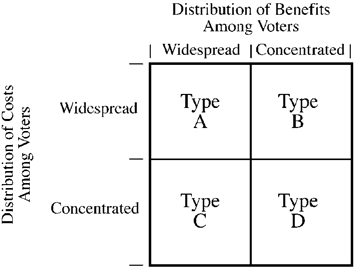 Figure 6-1 illustrates the four possibilities of the distribution of costs and benefits among voters for a government project. For which type would the government most likely fail to undertake many projects that would be considered efficient or productive (in other words, do too few of them relative to economic efficiency)?
 (Multiple Choice)
4.8/5 (82)
(82) Which of the following is true of government activities under a system of representative democracy?
(Multiple Choice)
5.0/5 (88)
(88) Public choice theory suggests that politicians will be most likely to favor redistribution of income from
(Multiple Choice)
4.9/5 (87)
(87) Use the figure below to answer the following question(s).
Figure 6-1
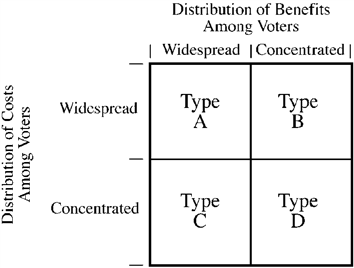 Figure 6-1 illustrates the four possibilities of the distribution of costs and benefits among voters for a government project. A tariff on imported steel to protect jobs in the domestic steel industry that raises the cost of many products for consumers would be considered which type of project?
 (Multiple Choice)
4.9/5 (100)
(100) Scenario 6-1 The quotation below relates to the following question(s).
"The ideal policy, from the viewpoint of the state, is one with identifiable beneficiaries, each of whom is helped appreciably, at the cost of many unidentifiable persons, none of whom is hurt very much." (George Stigler, A Dialogue on the Proper Economic Role of the State )
Refer to Scenario 6-1. This statement is probably
(Multiple Choice)
4.8/5 (82)
(82) As both the budget and regulatory powers of government grow, public choice analysis indicates that individuals and groups will find it in their interest to
(Multiple Choice)
4.7/5 (86)
(86) Legislation that offers immediate and easily recognized benefits, at the expense of uncertain costs that are in the distant future (such as financing by government debt), is often enacted even when economic inefficiency results. This can be expected because of
(Multiple Choice)
4.8/5 (79)
(79) The branch of economics that applies the principles and methodology of economics to the operation of the political process is known as
(Multiple Choice)
4.9/5 (88)
(88) According to the economic way of thinking, personal benefits and costs influence the actions of
(Multiple Choice)
4.8/5 (74)
(74) Public choice theory assumes each voter will tend to support the political candidate who offers
(Multiple Choice)
4.9/5 (80)
(80) Public choice analysis suggests that voters considering whether to vote for a candidate will ask,
(Multiple Choice)
4.9/5 (82)
(82) Which of the following provides the most reasonable explanation for why agricultural interests lobby for higher farm subsidies and price supports?
(Multiple Choice)
4.9/5 (78)
(78) When the government both provides a service and covers its costs through taxation,
(Multiple Choice)
4.8/5 (67)
(67) Which of the following factors weakens the case for private-sector provision of goods and services relative to public-sector provision?
(Multiple Choice)
4.9/5 (71)
(71) 
Filters
- Essay(0)
- Multiple Choice(0)
- Short Answer(0)
- True False(0)
- Matching(0)