



 Chat with AI
Exam 6: The Economics of Political Action

Exam 1: The Economic Approach210 Questions
Exam 2: Some Tools of the Economist257 Questions
Exam 3: Demand, Supply, and the Market Process585 Questions
Exam 4: Supply and Demand: Applications and Extensions331 Questions
Exam 5: Difficult Cases for the Market, and the Role of Government168 Questions
Exam 6: The Economics of Political Action360 Questions
Exam 7: Consumer Choice and Elasticity223 Questions
Exam 8: Costs and the Supply of Goods231 Questions
Exam 9: Price Takers and the Competitive Process497 Questions
Exam 10: Price-Searcher Markets With Low Entry Barriers216 Questions
Exam 11: Price-Searcher Markets With High Entry Barriers254 Questions
Exam 12: The Supply of and Demand for Productive Resources200 Questions
Exam 13: Earnings, Productivity, and the Job Market109 Questions
Exam 14: Investment, the Capital Market, and the Wealth of Nations129 Questions
Exam 15: Income Inequality and Poverty136 Questions
Exam 16: Applying the Basics: Special Topics in Economics709 Questions
Select questions type


Producers tend to be better represented in lobbying efforts and other elements of the political process than consumers because
(Multiple Choice)
4.7/5  (87)
(87) Which one of the following economists has played a central role in the development of the "economics of collective decision making," better known as public choice analysis?
(Multiple Choice)
4.8/5 (75)
(75) When voters pay in proportion to the benefits received from an economic action of the government, if the government activity is productive,
(Multiple Choice)
4.8/5 (77)
(77) In the case of a private good, which of the following forms of economic organization will result in the strongest incentive for consumers and producers to economize?
(Multiple Choice)
5.0/5 (78)
(78) Which of the following represents why private production tends to be more efficient then government production?
(Multiple Choice)
4.8/5 (91)
(91) How does a voting structure that relies on unanimity for an action guarantee that no one will be adversely affected? Why isn't this type of decision making used more frequently?
(Essay)
4.8/5 (95)
(95) In economics, actions by individuals and interest groups designed to influence public policy in a manner that will either directly or indirectly redistribute more income to themselves are known as
(Multiple Choice)
4.8/5 (83)
(83) In 2010, the combined expenditures of federal, state, and local governments in the United States were approximately 40 percent of gross domestic product (GDP). Approximately what percentage of GDP were government expenditures in 1930?
(Multiple Choice)
4.9/5 (90)
(90) Which of the following provides the best summary of the basic idea of public choice analysis?
(Multiple Choice)
5.0/5 (82)
(82) Public choice theory indicates that the behavior of people in government
(Multiple Choice)
4.7/5 (85)
(85) Use the figure below to answer the following question(s).
Figure 6-1
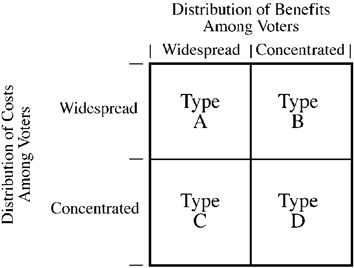 Figure 6-1 illustrates the four possibilities of the distribution of costs and benefits among voters for a government project. For which types of projects would government action most likely work well, undertaking only efficient projects and rejecting inefficient ones?
 (Multiple Choice)
4.8/5 (85)
(85) When goods are produced privately, but the cost of their purchase is paid for by the taxpayer or some other third party,
(Multiple Choice)
4.9/5 (95)
(95) When politicians support policies that benefit small interest groups, such as farmers, at the expense of unorganized, widely dispersed groups, for example, taxpayers or consumers, this is a reflection of the
(Multiple Choice)
4.9/5 (88)
(88) Legislation that offers immediate and easily recognized benefits, at the expense of costs that are observable only in the distant future, is often enacted, even when economic inefficiency results. In economics this is referred to as the
(Multiple Choice)
4.8/5 (92)
(92) According to the Bureau of Economic Analysis, government income transfer payments amounted to approximately what percent of national income?
(Multiple Choice)
5.0/5 (62)
(62) Which of the following is an example of a transfer payment?
(Multiple Choice)
4.9/5 (72)
(72) Scenario 6-1 The quotation below relates to the following question(s).
"The ideal policy, from the viewpoint of the state, is one with identifiable beneficiaries, each of whom is helped appreciably, at the cost of many unidentifiable persons, none of whom is hurt very much." (George Stigler, A Dialogue on the Proper Economic Role of the State )
Which of the following groups does the quotation in Scenario 6-1 suggest would have the most influence on public sector action?
(Multiple Choice)
4.9/5 (79)
(79) 
Filters
- Essay(0)
- Multiple Choice(0)
- Short Answer(0)
- True False(0)
- Matching(0)