



 Chat with AI
Exam 6: The Economics of Political Action

Exam 1: The Economic Approach210 Questions
Exam 2: Some Tools of the Economist257 Questions
Exam 3: Demand, Supply, and the Market Process585 Questions
Exam 4: Supply and Demand: Applications and Extensions331 Questions
Exam 5: Difficult Cases for the Market, and the Role of Government168 Questions
Exam 6: The Economics of Political Action360 Questions
Exam 7: Consumer Choice and Elasticity223 Questions
Exam 8: Costs and the Supply of Goods231 Questions
Exam 9: Price Takers and the Competitive Process497 Questions
Exam 10: Price-Searcher Markets With Low Entry Barriers216 Questions
Exam 11: Price-Searcher Markets With High Entry Barriers254 Questions
Exam 12: The Supply of and Demand for Productive Resources200 Questions
Exam 13: Earnings, Productivity, and the Job Market109 Questions
Exam 14: Investment, the Capital Market, and the Wealth of Nations129 Questions
Exam 15: Income Inequality and Poverty136 Questions
Exam 16: Applying the Basics: Special Topics in Economics709 Questions
Select questions type


Legislators often gain by bundling a number of projects benefiting local districts at the expense of general taxpayers together on a single bill. Such legislation is called
(Multiple Choice)
4.8/5  (68)
(68) Use the figure below to answer the following question(s).
Figure 6-1
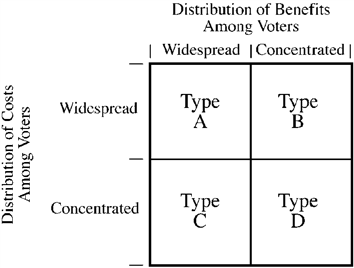 Figure 6-1 illustrates the four possibilities of the distribution of costs and benefits among voters for a government project. For which type would the government most likely undertake many projects that would be considered inefficient or counterproductive (in other words, do too many of them relative to economic efficiency)?
 (Multiple Choice)
4.9/5 (85)
(85) Which of the following is an example of a good that is produced by the public sector but consumers purchase it in proportion to the benefit received?
(Multiple Choice)
4.8/5 (72)
(72) An analysis of market failure and government failure indicates
(Multiple Choice)
4.7/5 (85)
(85) Which of the following is a distinguishing characteristic of a user charge?
(Multiple Choice)
4.9/5 (79)
(79) Use the figure below to answer the following question(s).
Figure 6-1
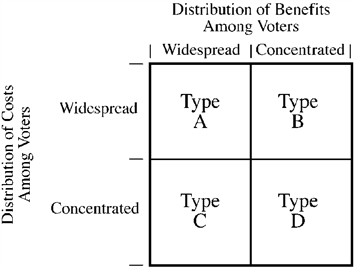 Figure 6-1 illustrates the four possibilities of the distribution of costs and benefits among voters for a government project. A tariff on imported steel to protect jobs in the domestic steel industry that raises the cost of many products for consumers would be considered which type of project?
 (Multiple Choice)
4.9/5 (103)
(103) Which of the following is accurate regarding government expenditures in the United States?
(Multiple Choice)
4.8/5 (78)
(78) In which case is the political process most likely to result in the acceptance of productive programs and rejection of unproductive political activities?
(Multiple Choice)
4.9/5 (67)
(67) Which of the following is most likely to result in an increase in crony capitalism?
(Multiple Choice)
4.8/5 (90)
(90) Payments that users (consumers) are required to make if they want to receive certain services provided by the government are called
(Multiple Choice)
4.7/5 (70)
(70) A survey of income by county revealed that four of the five wealthiest counties were located in the suburbs surrounding Washington, D.C. Why?
(Essay)
4.8/5 (102)
(102) In the case of a private good, which of the following forms of economic organization will result in the strongest incentive for consumers and producers to economize?
(Multiple Choice)
4.7/5 (83)
(83) Government decisions tend to be biased toward actions that have
(Multiple Choice)
4.8/5 (91)
(91) Use the figure below to answer the following question(s).
Figure 6-1
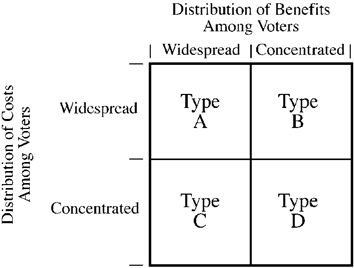 Figure 6-1 illustrates the four possibilities of the distribution of costs and benefits among voters for a government project. For which type would the government most likely undertake many projects that would be considered inefficient or counterproductive (in other words, do too many of them relative to economic efficiency)?
 (Multiple Choice)
4.8/5 (71)
(71) When analyzing public sector decision making, economic theory assumes that voters, politicians, and government officials will
(Multiple Choice)
4.9/5 (67)
(67) The branch of economics that attempts to understand the outcomes observed in the public sector by examining the incentives faced by the individual actors involved (such as voters, politicians, and bureaucrats) is known as
(Multiple Choice)
4.9/5 (76)
(76) Which of the following is an example of a transfer payment?
(Multiple Choice)
4.7/5 (80)
(80) Economic analysis suggests that bureaucrats and public-sector managers have a strong incentive to
(Multiple Choice)
4.8/5 (71)
(71) 
Filters
- Essay(0)
- Multiple Choice(0)
- Short Answer(0)
- True False(0)
- Matching(0)