



 Chat with AI
Exam 2: Some Tools of the Economist

Exam 1: The Economic Approach210 Questions
Exam 2: Some Tools of the Economist257 Questions
Exam 3: Demand, Supply, and the Market Process585 Questions
Exam 4: Supply and Demand: Applications and Extensions331 Questions
Exam 5: Difficult Cases for the Market, and the Role of Government168 Questions
Exam 6: The Economics of Political Action360 Questions
Exam 7: Consumer Choice and Elasticity223 Questions
Exam 8: Costs and the Supply of Goods231 Questions
Exam 9: Price Takers and the Competitive Process497 Questions
Exam 10: Price-Searcher Markets With Low Entry Barriers216 Questions
Exam 11: Price-Searcher Markets With High Entry Barriers254 Questions
Exam 12: The Supply of and Demand for Productive Resources200 Questions
Exam 13: Earnings, Productivity, and the Job Market109 Questions
Exam 14: Investment, the Capital Market, and the Wealth of Nations129 Questions
Exam 15: Income Inequality and Poverty136 Questions
Exam 16: Applying the Basics: Special Topics in Economics709 Questions
Select questions type


If the resources of an economy are being used inefficiently, it would be
(Multiple Choice)
4.8/5  (83)
(83) Which of the following is true of the production possibilities curve?
(Multiple Choice)
4.7/5 (87)
(87) When private ownership rights are well-defined and enforced, owners of physical assets and resources
(Multiple Choice)
4.8/5 (81)
(81) Sean can build sandboxes twice as fast as Matt. Sean can assemble swing sets three times as fast as Matt. The law of comparative advantage suggests that
(Multiple Choice)
5.0/5 (73)
(73) The primary benefit that results when a nation employs its resources in accordance with the principle of comparative advantage is
(Multiple Choice)
5.0/5 (68)
(68) A nation with cheap, efficient communications is likely to be
(Multiple Choice)
4.9/5 (76)
(76) In Zimbabwe and Botswana, elephants can be owned by local tribes and trade in ivory is legal, while in countries such as Kenya, it is illegal to trade in ivory and elephants cannot be privately owned but are protected by the government. Which of the following is true regarding the change in the elephant populations since 1979 in these countries?
(Multiple Choice)
4.8/5 (79)
(79) Explain the idea of capital investment by using the story of Robinson Crusoe. What is sacrificed, and what is gained?
(Essay)
4.9/5 (86)
(86) "If I didn't have a date tonight, I would save $10 and spend the evening playing tennis." The opportunity cost of the date is
(Multiple Choice)
4.9/5 (78)
(78) Use the production possibilities data below for Avokia and Baldonia to answer the following question(s).
Table 2-2
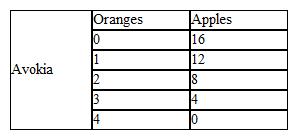
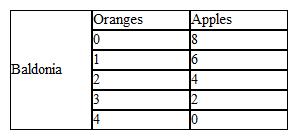 Refer to Table 2-2. According to the law of comparative advantage, both Avokia and Baldonia could gain if
 (Multiple Choice)
4.7/5 (78)
(78) According to the law of comparative advantage, both individuals and nations will be able to produce a larger joint output if each productive activity is undertaken by
(Multiple Choice)
5.0/5 (76)
(76) Figure 2-10 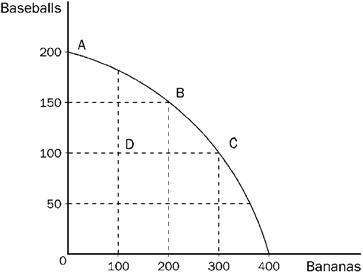 Refer to Figure 2-10. What is the opportunity cost of the movement from point A to point C?
 (Multiple Choice)
4.9/5 (80)
(80) If Shawn can produce donuts at a lower opportunity cost than Sue, then
(Multiple Choice)
4.9/5 (74)
(74) Which of the following will most likely occur under a system of clearly defined and enforced private property rights?
(Multiple Choice)
4.8/5 (94)
(94) The price of an airline ticket from Denver to Washington, D.C. costs $600. A bus ticket costs $150. Traveling by plane takes 6 hours compared with 51 hours by bus. Other things constant, an individual would gain by choosing air travel if, and only if, his time were valued at more than
(Multiple Choice)
4.7/5 (77)
(77) 
Filters
- Essay(0)
- Multiple Choice(0)
- Short Answer(0)
- True False(0)
- Matching(0)