



 Chat with AI
Exam 2: Some Tools of the Economist

Exam 1: The Economic Approach210 Questions
Exam 2: Some Tools of the Economist257 Questions
Exam 3: Demand, Supply, and the Market Process585 Questions
Exam 4: Supply and Demand: Applications and Extensions331 Questions
Exam 5: Difficult Cases for the Market, and the Role of Government168 Questions
Exam 6: The Economics of Political Action360 Questions
Exam 7: Consumer Choice and Elasticity223 Questions
Exam 8: Costs and the Supply of Goods231 Questions
Exam 9: Price Takers and the Competitive Process497 Questions
Exam 10: Price-Searcher Markets With Low Entry Barriers216 Questions
Exam 11: Price-Searcher Markets With High Entry Barriers254 Questions
Exam 12: The Supply of and Demand for Productive Resources200 Questions
Exam 13: Earnings, Productivity, and the Job Market109 Questions
Exam 14: Investment, the Capital Market, and the Wealth of Nations129 Questions
Exam 15: Income Inequality and Poverty136 Questions
Exam 16: Applying the Basics: Special Topics in Economics709 Questions
Select questions type


Senator Smart, who understands economic principles, is trying to convince workers in her district that trade with other countries is beneficial. Senator Smart should argue that trade can be beneficial
(Multiple Choice)
5.0/5  (78)
(78) The law of comparative advantage implies that a nation, individual, or region should produce those economic goods for which it
(Multiple Choice)
5.0/5 (88)
(88) In a market economy, what is produced is ultimately determined by
(Multiple Choice)
4.9/5 (79)
(79) Even countries that depend primarily on market forces to resolve the basic economic questions will usually rely on the collective decision-making process to
(Multiple Choice)
4.9/5 (78)
(78) If Kim can wash 10 cars or wax 2 cars during a day, and Susan can wash 8 cars or wax 2 cars during a day, then according to the law of comparative advantage,
(Multiple Choice)
5.0/5 (83)
(83) Use the production possibilities data below to answer the following question(s).
Table 2-3
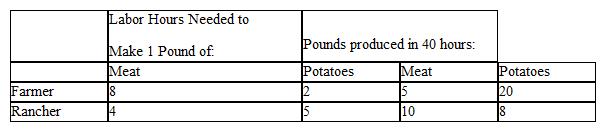 Refer to Table 2-3. The opportunity cost of 1 pound of potatoes for the rancher is
 (Multiple Choice)
4.9/5 (86)
(86) Which of the following is true of a production possibilities curve?
(Multiple Choice)
4.8/5 (83)
(83) Given freedom of movement for both goods and resources, if Florida producers specialize in oranges and Georgia producers specialize in peaches, then it would be reasonable to conclude that
(Multiple Choice)
4.8/5 (64)
(64) Suppose a country attempts to be self-sufficient and doesn't trade with any other countries. From an economic perspective, citizens of this nation can be expected to
(Multiple Choice)
4.9/5 (78)
(78) A form of economic organization that relies primarily on private ownership of productive assets, freedom of exchange, and market prices to allocate goods and resources is often called
(Multiple Choice)
4.9/5 (78)
(78) When property rights are clearly defined and enforced, private owners will
(Multiple Choice)
4.8/5 (75)
(75) If Kim can either wash 10 cars or wax 2 cars during a day, and Vince can either wash 17 cars or wax 2 cars during a day, then according to the law of comparative advantage,
(Multiple Choice)
4.8/5 (71)
(71) Economic debates that focus on the distribution of a nation's income are generally associated with which basic economic question?
(Multiple Choice)
4.7/5 (79)
(79) Richer economies often have more middlemen. Economic thinking indicates that such economies
(Multiple Choice)
4.7/5 (94)
(94) Production possibilities curve are usually bowed outward. This is because
(Multiple Choice)
5.0/5 (75)
(75) John takes 10 minutes to iron a shirt and 20 minutes to type a paper. Harry takes 10 minutes to iron a shirt and 30 minutes to type a paper. Which of the following statements is correct?
(Multiple Choice)
4.9/5 (67)
(67) 
Filters
- Essay(0)
- Multiple Choice(0)
- Short Answer(0)
- True False(0)
- Matching(0)