



 Chat with AI
Exam 2: Some Tools of the Economist

Exam 1: The Economic Approach210 Questions
Exam 2: Some Tools of the Economist257 Questions
Exam 3: Demand, Supply, and the Market Process585 Questions
Exam 4: Supply and Demand: Applications and Extensions331 Questions
Exam 5: Difficult Cases for the Market, and the Role of Government168 Questions
Exam 6: The Economics of Political Action360 Questions
Exam 7: Consumer Choice and Elasticity223 Questions
Exam 8: Costs and the Supply of Goods231 Questions
Exam 9: Price Takers and the Competitive Process497 Questions
Exam 10: Price-Searcher Markets With Low Entry Barriers216 Questions
Exam 11: Price-Searcher Markets With High Entry Barriers254 Questions
Exam 12: The Supply of and Demand for Productive Resources200 Questions
Exam 13: Earnings, Productivity, and the Job Market109 Questions
Exam 14: Investment, the Capital Market, and the Wealth of Nations129 Questions
Exam 15: Income Inequality and Poverty136 Questions
Exam 16: Applying the Basics: Special Topics in Economics709 Questions
Select questions type


Which of the following would be most likely to increase your opportunity cost of attending college?
(Multiple Choice)
4.9/5  (83)
(83) Figure 2-3 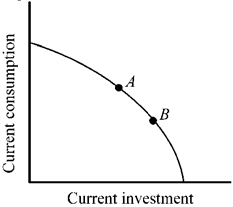 Points A and B in Figure 2-3 indicate consumption and investment for two economies. Other things constant, which of the economies is likely to grow more rapidly in the future?
 (Multiple Choice)
4.7/5 (86)
(86) Which of the following activities describes the opportunity cost of attending an economics class?
(Multiple Choice)
4.9/5 (69)
(69) Mr. Peters can drive or fly from Tallahassee, Florida to Savannah, Georgia, for a one-day business trip. If he drives, he will be able to work three hours once he arrives in Savannah, whereas traveling by plane will enable him to work eight hours. His expected income from each hour of work in Savannah is $30. If Mr. Peters is a rational decision maker, he will fly if and only if the price differential (air cost minus driving cost) is less than
(Multiple Choice)
4.7/5 (88)
(88) If Matt trades two candy bars to Andy in exchange for one baseball card,
(Multiple Choice)
4.7/5 (89)
(89) The economic principle that states that individuals or nations can gain by specializing in the production of goods that they produce cheaply and exchanging for other desired goods that they could only produce at a higher cost is
(Multiple Choice)
4.7/5 (75)
(75) Which of the following most accurately indicates the implications of an economy's production possibilities curve?
(Multiple Choice)
4.9/5 (82)
(82) Kim has two tickets to a concert tonight. She, however, has a headache and decides not to go. Which of the following would best fit Kim's needs?
(Multiple Choice)
4.7/5 (71)
(71) Rebecca decides to buy a dress that Hillary has for sale; they agree on a price of $20. Which of the following best describes who gains and who loses from the transaction?
(Multiple Choice)
4.9/5 (72)
(72) Steve values his Honda Accord at $10,000, and Jennifer values it at $14,000. If Jennifer buys it from Steve for $11,000, which of the following is true?
(Multiple Choice)
4.8/5 (78)
(78) Which of the following is an implication of the law of comparative advantage?
(Multiple Choice)
4.8/5 (87)
(87) Figure 2-7 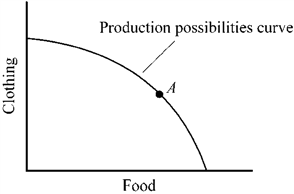 If an economy operates at point A on the production possibilities curve shown in Figure 2-7,
 (Multiple Choice)
4.9/5 (82)
(82) If an economy uses its resources inefficiently, this situation would be illustrated on a production possibilities diagram as
(Multiple Choice)
4.8/5 (88)
(88) Hutch Technology makes computer monitors, which sell for $500 each. What is the opportunity cost of producing ten monitors?
(Multiple Choice)
4.9/5 (64)
(64) Other things constant, which of the following would you expect to increase the output growth rate of a country?
(Multiple Choice)
4.9/5 (84)
(84) It can be said that, ultimately, consumers are the driving force in answering the three basic economic questions. Explain the consumer's role in providing these answers.
(Essay)
4.9/5 (67)
(67) Two individuals engage in the same two productive activities. In which of the following circumstances would neither individual have a comparative advantage in either activity?
(Multiple Choice)
4.7/5 (80)
(80) Market economies are often criticized for how they answer the basic question, "For whom are goods produced?" This criticism usually comes from people who believe that the distribution of income is not "fair." Is there some way to separate production from distribution so that we can leave production just as it is but make the distribution of income "fairer"?
(Essay)
4.9/5 (80)
(80) 
Filters
- Essay(0)
- Multiple Choice(0)
- Short Answer(0)
- True False(0)
- Matching(0)