



 Chat with AI
Exam 35: The International Monetary System: Order or Disorder

Exam 1: What Is Economics261 Questions
Exam 2: The Economy: Myth and Reality185 Questions
Exam 3: The Fundamental Economic Problem: Scarcity and Choice290 Questions
Exam 4: Supply and Demand: an Initial Look337 Questions
Exam 21: An Introduction to Macroeconomics216 Questions
Exam 22: The Goals of Macroeconomic Policy212 Questions
Exam 23: Economic Growth: Theory and Policy228 Questions
Exam 24: Aggregate Demand and the Powerful Consumer219 Questions
Exam 25: Demand-Side Equilibrium: Unemployment or Inflation216 Questions
Exam 26: Bringing in the Supply Side: Unemployment and Inflation228 Questions
Exam 27: Managing Aggregate Demand: Fiscal Policy210 Questions
Exam 28: Money and the Banking System224 Questions
Exam 29: Monetary Policy: Conventional and Unconventional210 Questions
Exam 30: The Financial Crisis and the Great Recession66 Questions
Exam 31: The Debate Over Monetary and Fiscal Policy219 Questions
Exam 32: Budget Deficits in the Short and Long Run215 Questions
Exam 33: The Trade-Off Between Inflation and Unemployment219 Questions
Exam 34: International Trade and Comparative Advantage226 Questions
Exam 35: The International Monetary System: Order or Disorder218 Questions
Exam 36: Exchange Rates and the Macroeconomy219 Questions
Exam 37: Contemporary Issues in the Us Economy23 Questions
Select questions type


The main component of the monetary union created by the Treaty of Maastricht is a(n)
(Multiple Choice)
4.9/5  (88)
(88) On May 12, 2011, the U.S. dollar was worth 28 Russian rubles. How many U.S. dollars did it take to buy 1 Russian ruble?
(Multiple Choice)
4.9/5 (80)
(80) A federal deficit that raises interest rates will, everything else being equal,
(Multiple Choice)
4.7/5 (70)
(70) The International Monetary Fund was established to manage the Bretton Woods System.
(True/False)
4.8/5 (79)
(79) Figure 19-3
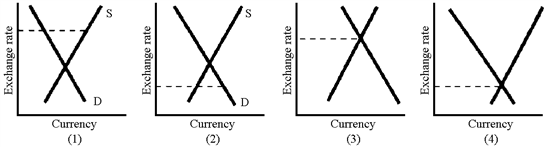 Of the graphs in Figure 19-3, where the dotted line shows the actual exchange rate, which one shows a country with an undervalued currency and a balance of trade surplus?
 (Multiple Choice)
4.8/5 (85)
(85) If the dollar depreciates relative to other currencies, which of the following is true?
(Multiple Choice)
4.9/5 (87)
(87) An area in which the United States has had a sizable surplus in its balance of payments is sales of ____ to foreigners.
(Multiple Choice)
4.8/5 (70)
(70) The Bretton Woods system worked fairly well for a number of years, but it finally broke down over
(Multiple Choice)
4.8/5 (85)
(85) The rate at which one currency is traded for another is called a(n)
(Multiple Choice)
4.8/5 (84)
(84) The advantage of a system of fixed exchange rates over one where exchange rates are flexible is that
(Multiple Choice)
5.0/5 (83)
(83) Under floating exchange rates, investors who speculate on international currency values provide a valuable service by assuming the risks of those who do not wish to speculate.
(True/False)
4.8/5 (71)
(71) Foreign direct investment leads to demand for a country's currency.
(True/False)
5.0/5 (76)
(76) If Japanese tourists visit Yellowstone Park, what is the effect in the foreign-exchange market?
(Multiple Choice)
5.0/5 (83)
(83) The exchange rate between yen and dollars at one point in 2010 was 83 yen per dollar. If a Big Mac, fries, and a Coke cost $3.91 in San Francisco, how much should the same order cost in yen in Osaka?
(Multiple Choice)
4.8/5 (83)
(83) The current role of the International Monetary Fund is one of
(Multiple Choice)
4.9/5 (70)
(70) Assume that an economic boom occurs in the United States, so that the United States has a much higher growth rate than other nations. What will happen to the exchange rate of the U.S. dollar?
(Essay)
4.7/5 (82)
(82) The purchasing power parity theory of exchange rate determination maintains that
(Multiple Choice)
4.9/5 (79)
(79) What happened to the peso when the Argentine government succumbed to the market forces in 2002?
(Multiple Choice)
4.8/5 (82)
(82) 
Filters
- Essay(0)
- Multiple Choice(0)
- Short Answer(0)
- True False(0)
- Matching(0)