



 Chat with AI
Exam 35: The International Monetary System: Order or Disorder

Exam 1: What Is Economics261 Questions
Exam 2: The Economy: Myth and Reality185 Questions
Exam 3: The Fundamental Economic Problem: Scarcity and Choice290 Questions
Exam 4: Supply and Demand: an Initial Look337 Questions
Exam 21: An Introduction to Macroeconomics216 Questions
Exam 22: The Goals of Macroeconomic Policy212 Questions
Exam 23: Economic Growth: Theory and Policy228 Questions
Exam 24: Aggregate Demand and the Powerful Consumer219 Questions
Exam 25: Demand-Side Equilibrium: Unemployment or Inflation216 Questions
Exam 26: Bringing in the Supply Side: Unemployment and Inflation228 Questions
Exam 27: Managing Aggregate Demand: Fiscal Policy210 Questions
Exam 28: Money and the Banking System224 Questions
Exam 29: Monetary Policy: Conventional and Unconventional210 Questions
Exam 30: The Financial Crisis and the Great Recession66 Questions
Exam 31: The Debate Over Monetary and Fiscal Policy219 Questions
Exam 32: Budget Deficits in the Short and Long Run215 Questions
Exam 33: The Trade-Off Between Inflation and Unemployment219 Questions
Exam 34: International Trade and Comparative Advantage226 Questions
Exam 35: The International Monetary System: Order or Disorder218 Questions
Exam 36: Exchange Rates and the Macroeconomy219 Questions
Exam 37: Contemporary Issues in the Us Economy23 Questions
Select questions type


The prospect of a recession in the United States would probably cause the dollar to
(Multiple Choice)
4.8/5  (70)
(70) The Big Mac index uses prices of a common item to predict long-run changes in exchange rates.
(True/False)
4.7/5 (79)
(79) If the price of the dollar changes from 135 Japanese yen to 127 Japanese yen, the dollar has
(Multiple Choice)
4.9/5 (73)
(73) The gold standard prevented a nation from controlling its domestic economy through monetary policy.
(True/False)
4.9/5 (90)
(90) Which of the following had prompted the Chinese authorities to stand ready to buy or sell dollars steadily and in large volume?
(Multiple Choice)
4.9/5 (70)
(70) If the quantity supplied of euro were greater than the quantity demanded, then the price of the
(Multiple Choice)
4.8/5 (75)
(75) In order to "defend" its overvalued currency, Argentina in 2002 had to reduce its
(Multiple Choice)
4.9/5 (86)
(86) If a Mexican pension fund decides to purchase U.S. government bonds, what is the effect in the foreign-exchange market?
(Multiple Choice)
4.9/5 (75)
(75) The supply of a country's currency arises from its imports and from foreign investment by its own citizens.
(True/False)
4.9/5 (78)
(78) A rise in interest rates is expected to lead to an appreciation of the currency, and a drop in interest rates is expected to lead to a depreciation.
(True/False)
4.9/5 (85)
(85) In 2008-2009, Iceland and several Baltic states increased their interest rates. One would expect which of the following?
(Multiple Choice)
4.8/5 (87)
(87) The current account balance includes international purchases and sales of goods and services, cross-border interest and dividend payments, and cross-border gifts to and from both private individuals and governments. It is approximately the same as net exports.
(True/False)
4.9/5 (81)
(81) If the quantity of euro demanded were greater than the quantity supplied, then the price of the
(Multiple Choice)
4.8/5 (74)
(74) Which of the following companies would gain from foreign currency depreciation?
(Multiple Choice)
4.9/5 (73)
(73) One method for a deficit country to correct the situation under a fixed exchange rate system is to
(Multiple Choice)
4.8/5 (76)
(76) Figure 19-1
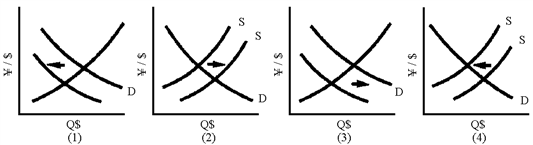 Of the graphs in Figure 19-1, which one shows that an expansion of the Japanese economy leads to a depreciation of the yen?
 (Multiple Choice)
4.7/5 (84)
(84) If a country is in a major recessionary phase of the business cycle, one can expect that its currency will
(Multiple Choice)
4.8/5 (77)
(77) In the long run, the chief determinant of exchange rate changes is a change in
(Multiple Choice)
4.9/5 (67)
(67) 
Filters
- Essay(0)
- Multiple Choice(0)
- Short Answer(0)
- True False(0)
- Matching(0)