



 Chat with AI
Exam 35: The International Monetary System: Order or Disorder

Exam 1: What Is Economics261 Questions
Exam 2: The Economy: Myth and Reality185 Questions
Exam 3: The Fundamental Economic Problem: Scarcity and Choice290 Questions
Exam 4: Supply and Demand: an Initial Look337 Questions
Exam 21: An Introduction to Macroeconomics216 Questions
Exam 22: The Goals of Macroeconomic Policy212 Questions
Exam 23: Economic Growth: Theory and Policy228 Questions
Exam 24: Aggregate Demand and the Powerful Consumer219 Questions
Exam 25: Demand-Side Equilibrium: Unemployment or Inflation216 Questions
Exam 26: Bringing in the Supply Side: Unemployment and Inflation228 Questions
Exam 27: Managing Aggregate Demand: Fiscal Policy210 Questions
Exam 28: Money and the Banking System224 Questions
Exam 29: Monetary Policy: Conventional and Unconventional210 Questions
Exam 30: The Financial Crisis and the Great Recession66 Questions
Exam 31: The Debate Over Monetary and Fiscal Policy219 Questions
Exam 32: Budget Deficits in the Short and Long Run215 Questions
Exam 33: The Trade-Off Between Inflation and Unemployment219 Questions
Exam 34: International Trade and Comparative Advantage226 Questions
Exam 35: The International Monetary System: Order or Disorder218 Questions
Exam 36: Exchange Rates and the Macroeconomy219 Questions
Exam 37: Contemporary Issues in the Us Economy23 Questions
Select questions type


Which of the following would cause an increase in the demand for U.S. dollars?
(Multiple Choice)
4.8/5  (85)
(85) The ¬_______ is a way to fix exchange rates by defining each participating currency in terms of gold and allowing holders of each participating currency to convert that currency into gold.
(Multiple Choice)
4.8/5 (86)
(86) The demand for U.S. dollars is derived from foreign demand for U.S. exports.
(True/False)
4.8/5 (79)
(79) The principal goal of the Treaty of Maastricht was the creation of a
(Multiple Choice)
4.9/5 (78)
(78) Under the Bretton Woods system, a country with a balance of payments deficit
(Multiple Choice)
4.8/5 (84)
(84) Other things equal, countries that offer investors higher rates of return attract more capital than countries that offer lower rates.
(True/False)
5.0/5 (70)
(70) Speculation in exchange markets is often thought of as conducive to wild fluctuations in exchange rates. In practice it appears that speculators
(Multiple Choice)
4.9/5 (91)
(91) The purchasing power parity theory of exchange rate determination states that
(Multiple Choice)
4.9/5 (86)
(86) Under a gold standard, a balance of payments surplus automatically
(Multiple Choice)
4.8/5 (84)
(84) Define the following terms and explain their importance to the study of macroeconomics.
a. Exchange rate
b. Depreciation
c. Devaluation
d. Fixed exchange rates
(Essay)
4.8/5 (82)
(82) One major reason why the purchasing power parity theory does not always predict exchange rates accurately is that the theory focuses on trade in
(Multiple Choice)
4.8/5 (79)
(79) Suppose that a nation has adopted a fixed exchange rate with another country, and has a persistent trade deficit. What is most likely to happen?
(Multiple Choice)
4.9/5 (86)
(86) Table 19-1 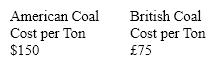 From Table 19-1, what is the exchange rate between the dollar and the pound?
 (Multiple Choice)
4.8/5 (95)
(95) Table 19-1 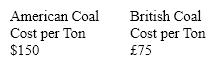 Assume that the information in Table 19-1 applies to the cost per ton of coal in 1998. Assume that also over a 10-year period prices rise 100 percent in Great Britain and 200 percent in the United States. According to the purchasing power parity theory, the exchange rate between the dollar and the pound in the year 2008 will be
 (Multiple Choice)
4.9/5 (94)
(94) 
Filters
- Essay(0)
- Multiple Choice(0)
- Short Answer(0)
- True False(0)
- Matching(0)