



 Chat with AI
Exam 35: The International Monetary System: Order or Disorder

Exam 1: What Is Economics261 Questions
Exam 2: The Economy: Myth and Reality185 Questions
Exam 3: The Fundamental Economic Problem: Scarcity and Choice290 Questions
Exam 4: Supply and Demand: an Initial Look337 Questions
Exam 21: An Introduction to Macroeconomics216 Questions
Exam 22: The Goals of Macroeconomic Policy212 Questions
Exam 23: Economic Growth: Theory and Policy228 Questions
Exam 24: Aggregate Demand and the Powerful Consumer219 Questions
Exam 25: Demand-Side Equilibrium: Unemployment or Inflation216 Questions
Exam 26: Bringing in the Supply Side: Unemployment and Inflation228 Questions
Exam 27: Managing Aggregate Demand: Fiscal Policy210 Questions
Exam 28: Money and the Banking System224 Questions
Exam 29: Monetary Policy: Conventional and Unconventional210 Questions
Exam 30: The Financial Crisis and the Great Recession66 Questions
Exam 31: The Debate Over Monetary and Fiscal Policy219 Questions
Exam 32: Budget Deficits in the Short and Long Run215 Questions
Exam 33: The Trade-Off Between Inflation and Unemployment219 Questions
Exam 34: International Trade and Comparative Advantage226 Questions
Exam 35: The International Monetary System: Order or Disorder218 Questions
Exam 36: Exchange Rates and the Macroeconomy219 Questions
Exam 37: Contemporary Issues in the Us Economy23 Questions
Select questions type


Figure 19-3
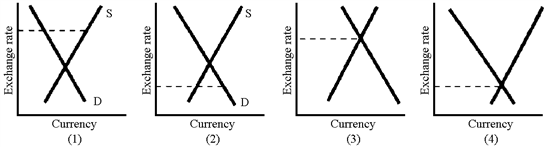 Of the graphs in Figure 19-3, where the dotted line shows the actual exchange rate, which one shows a country with an overvalued currency and a balance of trade deficit?
 (Multiple Choice)
4.9/5  (83)
(83) A fixed exchange rate system encourages speculators to attack weaker currencies.
(True/False)
4.8/5 (74)
(74) A country's imports will rise quickly when its economy booms and rise only slowly when its economy stagnates .
(True/False)
4.9/5 (83)
(83) A fixed exchange rate can be maintained by a government as long as it has sufficient
(Multiple Choice)
4.8/5 (69)
(69) A balance of payments deficit is defined as the amount by which
(Multiple Choice)
4.9/5 (80)
(80) The appropriate "medicine" for correcting payments imbalances under a fixed exchange rate system is
(Multiple Choice)
4.8/5 (89)
(89) For developing countries, one of the dangers inherent in the inflows of capital that finance investment is
(Multiple Choice)
4.9/5 (92)
(92) When a country decreases the official value of its currency, for example, Russia changes the value of the ruble from $.16 to $.04, it is said to have ____ its currency.
(Multiple Choice)
4.9/5 (79)
(79) If gold and the dollar are substitutes, a cut in the Japanese discount rate can be expected to
(Multiple Choice)
5.0/5 (71)
(71) Lately, the Chinese authorities seem to be backing away from ____ and the Yuan has ____ relative to the dollar.
(Multiple Choice)
4.8/5 (88)
(88) A recession in the United States will tend to cause recessions in other countries because as U.S. GDP falls, U.S.
(Multiple Choice)
4.8/5 (79)
(79) Everything else being equal, one can expect the euro to appreciate relative to the dollar if
(Multiple Choice)
4.9/5 (91)
(91) If U.S. securities pay 6 percent interest, and if Great Britain's securities pay 8 percent interest, then
(Multiple Choice)
4.9/5 (91)
(91) According to the purchasing power parity theory, which of the following is most likely to affect exchange rates?
(Multiple Choice)
4.8/5 (92)
(92) Balance of payments deficits arise whenever the exchange rate is pegged at an artificially high level.
(True/False)
4.9/5 (74)
(74) The principal result of the rising value of the U.S. dollar in the mid-1990s was a(n)
(Multiple Choice)
4.7/5 (79)
(79) If the price of the dollar changes from 100 Japanese yen to 120 Japanese yen, the dollar has appreciated
(True/False)
4.8/5 (57)
(57) 
Filters
- Essay(0)
- Multiple Choice(0)
- Short Answer(0)
- True False(0)
- Matching(0)