



 Chat with AI
Exam 17: Population Ecology

Exam 1: Invitation to Biology76 Questions
Exam 2: Molecules of Life79 Questions
Exam 3: Cell Structure74 Questions
Exam 4: Energy and Metabolism80 Questions
Exam 5: Photosynthesis79 Questions
Exam 6: Releasing Chemical Energy69 Questions
Exam 7: Dna Structure and Function76 Questions
Exam 8: Gene Expression and Control86 Questions
Exam 9: How Cells Reproduce72 Questions
Exam 10: Patterns of Inheritance69 Questions
Exam 11: Biotechnology75 Questions
Exam 12: Evidence of Evolution72 Questions
Exam 13: Processes of Evolution74 Questions
Exam 14: Prokaryotes, Protists, and Viruses72 Questions
Exam 15: Plants and Fungi74 Questions
Exam 16: Animal Evolution84 Questions
Exam 17: Population Ecology72 Questions
Exam 18: Communities and Ecosystems77 Questions
Exam 19: The Biosphere and Human Effects73 Questions
Exam 20: Animal Tissues and Organs74 Questions
Exam 21: How Animals Move74 Questions
Exam 22: Circulation and Respiration74 Questions
Exam 23: Immunity75 Questions
Exam 24: Digestion and Excretion74 Questions
Exam 25: Neural Control and the Senses74 Questions
Exam 26: Endocrine Control73 Questions
Exam 27: Animal Reproduction and Development89 Questions
Exam 28: Plant Form and Function74 Questions
Exam 29: Life Cycles of Flowering Plants76 Questions
Select questions type


Killifish preferentially prey upon small, young guppies. This leads to selective pressure for the guppy population to ____.
(Multiple Choice)
5.0/5  (87)
(87) The maximum number of individuals of a species that a given environment can sustain indefinitely defines ____.
(Multiple Choice)
4.8/5 (82)
(82) Which type of growth curve is pictured for the accompanying photo of a desert shrub? 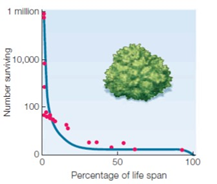
(Multiple Choice)
4.8/5 (84)
(84) Many species of terns nest on the ground in seabird colonies. However, if nests are too close together, aggression will break out. This tends to produce a(n) ____.
(Multiple Choice)
4.7/5 (77)
(77) A population ecologist wants to estimate the size of a robin population. In an apple orchard, she captures 10 robins, marks them, and then releases them. She returns several weeks later and captures another 10 robins, of which 2 are robins she previously marked. The estimated population size of robins is ____.
(Multiple Choice)
4.9/5 (75)
(75) Resource consumption tends to ____ with economic and industrial development.
(Multiple Choice)
4.7/5 (77)
(77) In which type of population distribution would plot sampling be most accurate?
(Multiple Choice)
4.8/5 (78)
(78) Which important discovery in the early 1900s enhanced food production, thus increasing human population growth?
(Multiple Choice)
4.9/5 (82)
(82) What invention about 11,000 years ago led to a boom in the human population?
(Multiple Choice)
4.8/5 (69)
(69) Sea lions can live into their thirties and produce no more than one pup per year. A sea lion is a(n) ____ species.
(Multiple Choice)
4.8/5 (86)
(86) Density-independent controls over population growth include ____.
(Multiple Choice)
4.7/5 (84)
(84) E. coli is an intestinal bacterium that reproduces every 20 minutes. E. coli is representative of a(n) ____ species.
(Multiple Choice)
4.8/5 (82)
(82) Refer to the following figure for questions 53, 54, and 55. 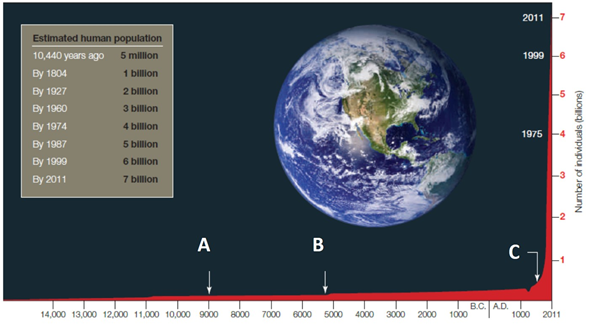
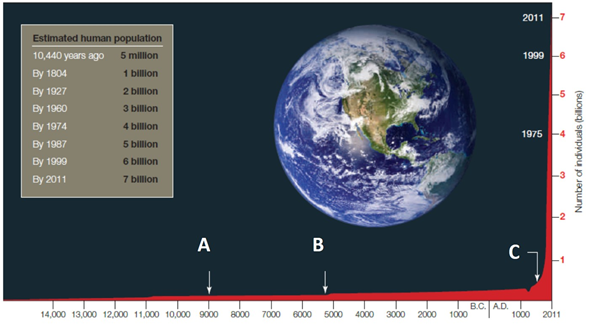 Letter "A" designates the ____, which provided for a more reliable food supply approximately 11,000 years ago.
 (Multiple Choice)
4.8/5 (86)
(86) The rapid increase in the population of Canada geese in the United States can be primarily attributed to ____.
(Multiple Choice)
4.7/5 (79)
(79) In which demographic model is population growth the fastest?
(Multiple Choice)
4.8/5 (84)
(84) A J-shaped growth curve is converted to an S-shaped one ____.
(Multiple Choice)
4.8/5 (74)
(74) 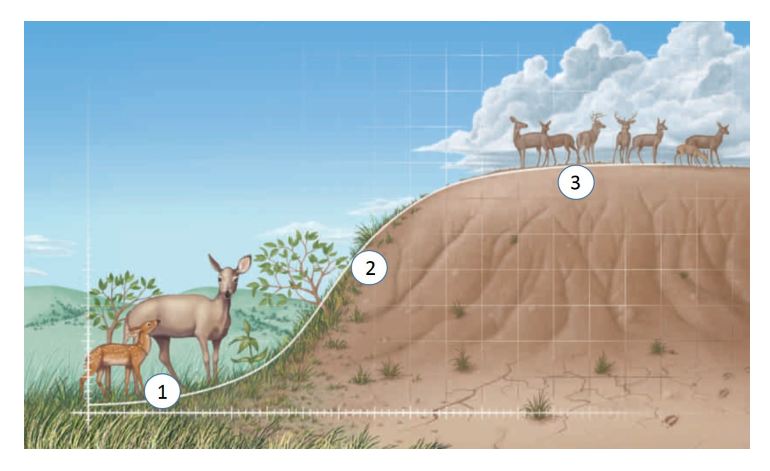 During phase "3" in the given figure, the population growth slows and then levels off because ____.
 (Multiple Choice)
4.7/5 (67)
(67) 
Filters
- Essay(0)
- Multiple Choice(0)
- Short Answer(0)
- True False(0)
- Matching(0)