



 Chat with AI
Exam 8: Stock

Exam 1: An Introduction to Investments19 Questions
Exam 2: Securities Markets77 Questions
Exam 3: The Time Value of Money41 Questions
Exam 4: Financial Planning, Taxation and the Efficiency of Financial Markets57 Questions
Exam 5: Risk and Portfolio Management56 Questions
Exam 6: Investment Companies: Mutual Funds65 Questions
Exam 7: Closed-End Investment Companies, Real Estate Investment Trusts Reits, and Exchange-Traded Funds Etfs50 Questions
Exam 8: Stock104 Questions
Exam 9: The Valuation of Common Stock35 Questions
Exam 10: Investment Returns and Aggregate Measures of Stock Markets42 Questions
Exam 11: The Macroeconomic Environment for Investment Decisions36 Questions
Exam 12: Behavioral Finance and Technical Analysis34 Questions
Exam 13: The Bond Market64 Questions
Exam 14: The Valuation of Fixed-Income Securities64 Questions
Exam 15: Government Securities50 Questions
Exam 16: Convertible Bonds and Convertible Preferred Stock47 Questions
Exam 17: An Introduction to Options85 Questions
Exam 18: Option Valuation and Strategies40 Questions
Exam 19: Commodity and Financial Futures47 Questions
Exam 20: Financial Planning and Investing in an Efficient Market Context22 Questions
Select questions type


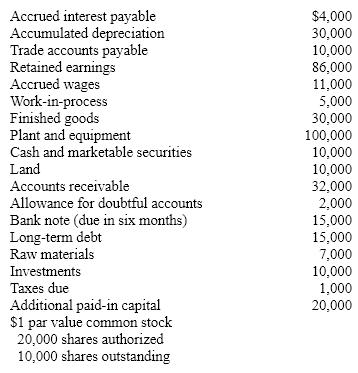
Which of the following does not appear on the statement of cash flows?
(Multiple Choice)
4.9/5  (92)
(92) 
A one-for-two reverse split increases a stock's price but not its total value.
(True/False)
4.9/5 (64)
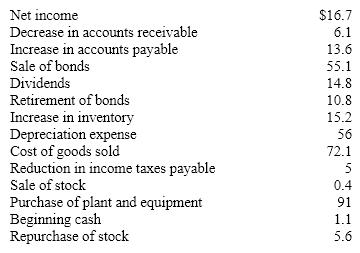
(64) Given the following information, construct the statement of cash flows. What happened to the firm's liquidity position during the year?
(Essay)
4.7/5 (76)
(76) If accounts receivable are collected, the quick ratio is unaffected.
(True/False)
4.8/5 (69)
(69) If a firm operates at a loss, its retained earnings are decreased.
(True/False)
5.0/5 (87)
(87) A two-for-one stock split doubles the number of shares and their price.
(True/False)
4.7/5 (87)
(87) A major advantage associated with dividend reinvestment plans is forced saving.
(True/False)
4.9/5 (82)
(82) The return on assets employs operating income instead of net income.
(True/False)
4.8/5 (83)
(83) Lower cash flow may be the result of higher depreciation expense.
(True/False)
4.8/5 (84)
(84) 
Filters
- Essay(0)
- Multiple Choice(0)
- Short Answer(0)
- True False(0)
- Matching(0)