



 Chat with AI
Exam 14: The Valuation of Fixed-Income Securities


Junk Corp.'s high-yield bond has the following features:
Principal $1,000
Coupon 10%
Maturity 5 years
Special features: Company may extend the life of the bond to 10 years
a. If interest rates are currently 12 percent on comparable high-yield securities and are not expected to change, what is the price of this bond?
b. If interest rates are currently 9 percent on comparable high-yield securities and are not expected to change, what is the price of this bond?
c. If interest rates are currently 9 percent on comparable high-yield securities but the investor has no forecast as to future rates, what is the possible range of prices for this bond?

 (79)
 Verified
This problem raises the question of how long will the bond be outstanding.a. If interest rates remain at 12 percent, the company will extend the life of the bond, so the term of the bond is 10 years. The value of the bond is
$110(5.650)+ $1,000(0.322)= $943.50.
(N = 10; I = 12; PMT = 110; FV = 1000;
PV = ? = -943.50.)
b. If interest rates remain at 9 percent, the firm will refinance and retire the bond after five years. The value of the bond is
$110(3.890)+ $1,000(.650)= $1,077.90.
(N = 5; I = 9; PMT = 110; FV = 1000;
PV = ? = -1077.79.)
c. Since there is no forecast of interest rates after five years, the term of the bond could be five or ten years. Value (5 years to maturity):
$110(3.890)+ $1,000(.650)= $1,077.90 Value (10 years to maturity):
$110(6.418)+ $1,000(.422)= $1,127.98The price could range from $1,072 to $1,127.98 if yields are 9 percent (interest payments made annually)but the term of the bond is uncertain.
If investors expect interest rates to rise, they should sell preferred stock and buy bonds.
(86) VerifiedFalse
If a preferred stock pays an annual $4.50 dividend, what should be the price of the stock if comparable yields are 10 percent? What would be the loss if yields rose to 12 percent?
(80) VerifiedThe price: $4.50/.1 = $45If yields rise to 12 percent, the price declines to $4.50/.12 = $37.50. The capital loss is $37.50 - $45 = ($7.50).
An investor buys a $1,000, 20 year 7 percent (interest paid semiannually)bond at par. After five years have passed, interest rates are 10 percent. How much did the investor lose on the purchase of the bond?
(88) An individual may purchase preferred stock
1. in anticipation of lower interest rates
2. in anticipation of higher interest rates
3. to receive a flow of tax-free income
4. to receive a flow of income
(70) Compute the durations of the following bonds and rank them on the basis of their price volatility. Assume that the current rate of interest is 8 percent.
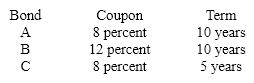 Confirm your ranking by calculating the percentage change in the price of each bond when interest rates rise from 8 to 12 percent.
 (84) If a bond sells for a discount, the yield to maturity exceeds the current yield.
(98) A call feature will have no impact on the value of a bond if interest rates rise.
(75) A bond is more likely to be called after interest rates have fallen.
(72) The market price of preferred stock moves directly with changes in interest rates.
(75) If a bond sells for a premium, the current yield exceeds the yield to maturity.
(76) If bond prices were to decline, the current yield would increase.
(69) As interest rates increase, the prices of existing bonds increase.
(92) The value of a bond depends on the amount of principal, when it matures, and the interest it pays.
(75) You purchase a high-yield, junk bond for $1,000 that pays $140 annually. After buying the bond, yields decline and you are able to reinvest the interest at only 9 percent. You reinvest all the interest payments. How much will you have when the bond is retired after twelve years? What was the annual return you earned on this investment?
(89) If a $100 par value preferred stock pays an annual dividend of $5 and comparable yields are 10 percent, the price of this preferred stock will be
(62) If interest rates in general were to fall,
1. the prices of existing bonds would rise
2. the prices of existing bonds would fall
3. yields to maturity would rise
4. yields to maturity would fall
(85) 
Filters
- Essay(0)
- Multiple Choice(0)
- Short Answer(0)
- True False(0)
- Matching(0)