



 Chat with AI
Exam 9: The Valuation of Common Stock

Exam 1: An Introduction to Investments19 Questions
Exam 2: Securities Markets77 Questions
Exam 3: The Time Value of Money41 Questions
Exam 4: Financial Planning, Taxation and the Efficiency of Financial Markets57 Questions
Exam 5: Risk and Portfolio Management56 Questions
Exam 6: Investment Companies: Mutual Funds65 Questions
Exam 7: Closed-End Investment Companies, Real Estate Investment Trusts Reits, and Exchange-Traded Funds Etfs50 Questions
Exam 8: Stock104 Questions
Exam 9: The Valuation of Common Stock35 Questions
Exam 10: Investment Returns and Aggregate Measures of Stock Markets42 Questions
Exam 11: The Macroeconomic Environment for Investment Decisions36 Questions
Exam 12: Behavioral Finance and Technical Analysis34 Questions
Exam 13: The Bond Market64 Questions
Exam 14: The Valuation of Fixed-Income Securities64 Questions
Exam 15: Government Securities50 Questions
Exam 16: Convertible Bonds and Convertible Preferred Stock47 Questions
Exam 17: An Introduction to Options85 Questions
Exam 18: Option Valuation and Strategies40 Questions
Exam 19: Commodity and Financial Futures47 Questions
Exam 20: Financial Planning and Investing in an Efficient Market Context22 Questions
Select questions type


The dividend-growth valuation model employs current dividends, future dividend growth, and the required return.

Free
(True/False)
5.0/5  (91)
(91) Correct Answer: Verified
True
The price to sales ratio may be a preferred analytical tool if
Free
(Multiple Choice)
4.9/5 (78)
(78) Correct Answer:Verified
VerifiedB
According to the efficient market hypothesis, purchasing companies with high cash flow should produce superior investment results.
Free
(True/False)
4.9/5 (85)
(85) Correct Answer:Verified
VerifiedFalse
The required return includes the risk-free rate and a risk premium.
(True/False)
4.8/5 (84)
(84) You know the following concerning a common stock:
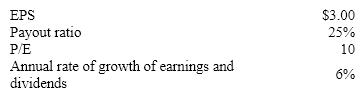 If you want to earn 10 percent, should you buy this stock? What is the maximum price you should be willing to pay for the stock?
 (Essay)
4.9/5 (81)
(81) The risk-free rate of return is 8 percent; the expected rate of return on the market is 12 percent. Stock X has a beta coefficient of 1.3, an earnings and dividend-growth rate of 7 percent, and a current dividend of $2.40. If the stock is selling for $35, what should you do?
(Essay)
4.8/5 (91)
(91) Presently, Stock A pays a dividend of $2.00 a share, and you expect the dividend to grow rapidly for the next four years at 20 percent. Thus the dividend payments will be
Year Dividend
1 $1.20
2 1.44
3 1.73
4 2.07
After this initial period of super growth, the rate of increase in the dividend should decline to 8 percent. If you want to earn 12 percent on investments in common stock, what is the maximum you should pay for this stock?
(Essay)
4.7/5 (75)
(75) An increase in the risk-free rate will tend to decrease stock prices.
(True/False)
4.8/5 (81)
(81) The use of price to book ratios to select stocks suggests that
(Multiple Choice)
4.7/5 (78)
(78) The dividend-growth model includes both the current and past years' dividends.
(True/False)
4.9/5 (90)
(90) According to the efficient market hypothesis, purchasing high P/E stock should not produce superior investment results.
(True/False)
4.7/5 (71)
(71) If the required rate of return is 10 percent and the stock pays a fixed $5 dividend, its value is
(Multiple Choice)
4.9/5 (82)
(82) As an investor you have a required rate of return of 14 percent for investments in risky stocks. You have analyzed three risky firms and must decide which (if any)to purchase. Your information is
 a. What is your valuation of each stock using the dividend-growth model? Which (if any)should you buy?
b. If you bought Stock A, what is your implied rate of return?
c. If your required rate of return were 10 percent, what should be the price necessary to induce you to buy Stock A?
a. What is your valuation of each stock using the dividend-growth model? Which (if any)should you buy?
b. If you bought Stock A, what is your implied rate of return?
c. If your required rate of return were 10 percent, what should be the price necessary to induce you to buy Stock A? (Essay)
4.9/5 (81)
(81) The dividend-growth model requires that dividends grow annually at the same rate.
(True/False)
4.8/5 (83)
(83) The PEG ratio multiplies a stock's earnings, price, and growth rate.
(True/False)
4.7/5 (91)
(91) The efficient market hypothesis suggests that the current prices of stocks reflect what the investment community believes the stocks are worth.
(True/False)
4.8/5 (93)
(93) If the anticipated return exceeds the required rate of return, the investor should buy the stock.
(True/False)
4.9/5 (92)
(92) 
Filters
- Essay(0)
- Multiple Choice(0)
- Short Answer(0)
- True False(0)
- Matching(0)